



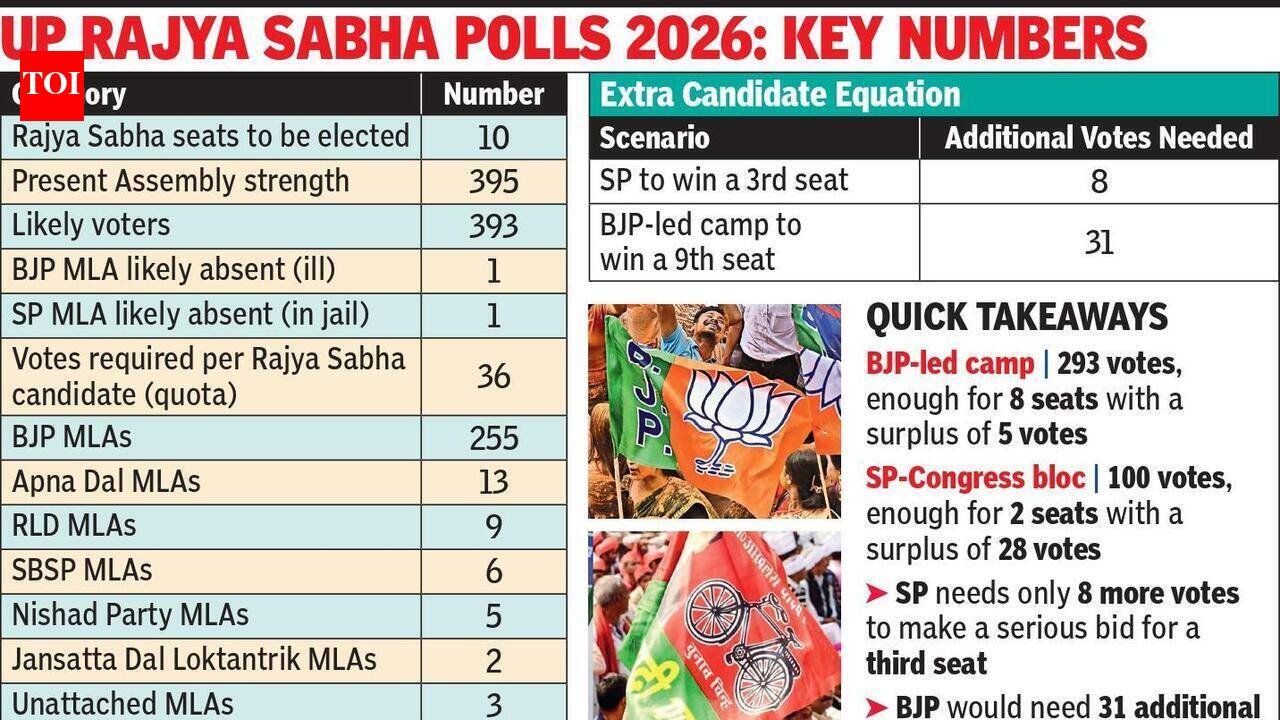
Lucknow: The biennial Rajya Sabha elections for 10 seats in the state are emerging as a pitched battle to test confidence, loyalty and perception in the two rival camps — NDA led by BJP and India Bloc helmed by Samajwadi Party. While BJP and SP have enough numbers to get eight and two candidates elected, both parties have reportedly purchased additional nomination sets for the October 16 Rajya Sabha elections, indicating they are keeping the option open to field extra candidates. If neither side takes that gamble, all 10 candidates could be elected unopposed after the October 9 withdrawal deadline.The arithmetic of the election explains the caution. Under the proportional representation system, the quota required for victory is calculated on the basis of valid votes cast. With the Assembly’s effective voting strength likely to be 393, against the present strength of 395, the winning quota is expected to be 36 first-preference votes per candidate. BJP MLA Neel Ratan Singh is reportedly unwell, while SP MLA Ramakant Yadav is in jail and unlikely to participate in voting.BJP remains the dominant force in the Assembly with 255 MLAs. Its allies Apna Dal (13), Rashtriya Lok Dal (9), Suheldev Bharatiya Samaj Party (6) and Nishad Party (5) together contribute another 33 votes. The ruling camp is also expected to receive support from the two MLAs of Raja Bhaiyya-led Jansatta Dal Loktantrik as well as three unattached legislators — Manoj Pandey, Rakesh Pratap Singh and Abhay Singh — taking its effective strength to around 293.Samajwadi Party officially has 101 MLAs, while ally Congress has two. However, two SP legislators, Puja Pal and Vinod Chaturvedi, have already crossed over politically to the BJP camp and are expected to vote accordingly. With Ramakant Yadav unlikely to cast his vote, the SP’s effective strength comes down to 98. Adding the Congress’ two members gives the opposition camp a total of 100 votes.If one includes the votes of Puja Pal and Chaturvedi in NDA’s tally, its strength reaches 295. However, there are apprehensions of some NDA legislators — like SBPS’s Abbas Ansari — switching sides, too thus making the final scenario much more complicated than it appears.However, if one goes by the parties’ strength on the paper, SP can comfortably get two candidates — Prof Ram Gopal Yadav and businessman Dhanraj Parimal Nathwani — elected. Two successful candidates would require 72 first-preference votes, leaving SP with approximately 28 surplus votes.The NDA camp is comfortably placed to ensure the victory of eight candidates. However, despite holding an apparent surplus of around 5-7 votes after securing eight seats, it still falls considerably short of the numbers required to guarantee a ninth seat on its own. Conversely, the SP would need only eight additional votes beyond its surplus to make a serious attempt at winning a third seat.This numerical reality has fuelled speculation in political circles that SP president Akhilesh Yadav could field a third candidate. Such a move would not necessarily be aimed at winning outright but at testing BJP cohesion and exposing possible fault lines within the ruling alliance.Political observers believe this is where perception politics becomes as important as electoral arithmetic. If SP fields an extra candidate, it would need to attract only a handful of cross-votes from the BJP camp. Even limited success could allow the opposition to claim growing discontent within the ruling ranks ahead of the Assembly elections.For the BJP, however, attempting a similar strategy appears far more difficult. To secure a ninth seat, the ruling alliance would require a significantly larger number of opposition votes, making the exercise politically risky and harder to execute. Any visible shortfall could create an impression of weakness at a crucial time.As a result, both parties face a delicate balancing act. Contesting only the seats they can comfortably win would ensure a smooth election and avoid unnecessary embarrassment. Fielding extra candidates, on the other hand, could provide an opportunity to project momentum and expose rival vulnerabilities.With Assembly elections only months away, the Rajya Sabha contest has evolved into more than a battle for Upper House seats. While both camps have left the door open for an aggressive move, the numbers suggest that if anyone is better placed to take a calculated risk, it is the Samajwadi Party. Whether it chooses to do so could determine the political narrative emerging from the Rajya Sabha polls.UP Rajya Sabha Polls 2026: Key NumbersCategory NumberRajya Sabha seats to be elected 10Present Assembly strength 395Likely voters 393BJP MLA likely absent (ill) 1SP MLA likely absent (in jail) 1Votes required per Rajya Sabha candidate (quota) 36BJP MLAs 255Apna Dal MLAs 13RLD MLAs 9SBSP MLAs 6Nishad Party MLAs 5Jansatta Dal Loktantrik MLAs 2Unattached MLAs 3Total BJP-led camp strength 293Official SP strength 101SP effective strength (after defections & absence) 98Congress MLAs2SP + Congress strength 100Winning PotentialBloc Votes Available Seats Assured Votes Required Surplus VotesBJP-led camp 293 8 288 5SP + Congress 100 2 72 28Extra Candidate EquationScenario Additional Votes NeededSP to win a 3rd seat 8BJP-led camp to win a 9th seat 31Quick TakeawaysBJP-led camp: 293 votes, enough for 8 seats with a surplus of 5 votes.SP-Congress bloc: 100 votes, enough for 2 seats with a surplus of 28 votes.SP needs only 8 more votes to make a serious bid for a third seat.BJP would need 31 additional votes to secure a ninth seat.Numerically, the SP is in a better position to risk fielding an extra candidate and test the possibility of cross-voting ahead of the 2027 Assembly elections.
