



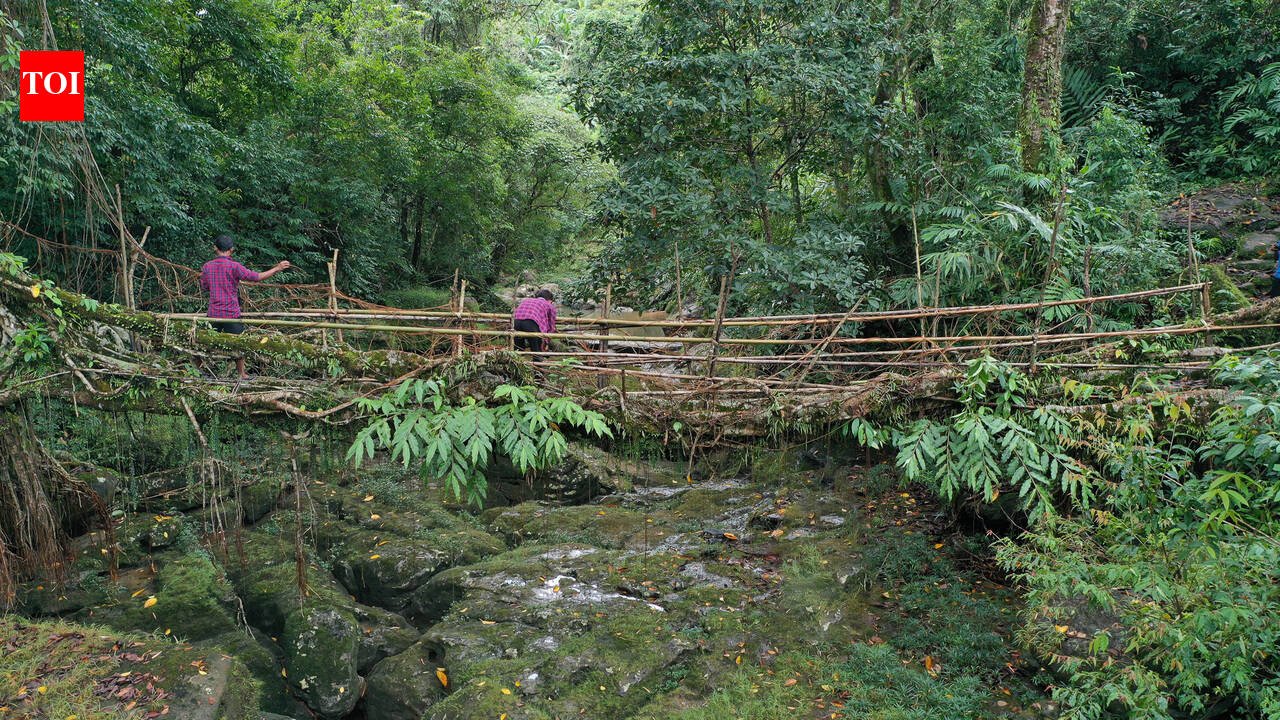
Prime Minister Narendra Modi’s recent Mann Ki Baat address has cast a national spotlight on Meghalaya’s iconic Living Root Bridges, elevating a localized indigenous tradition into a premier national model for community-led climate resilience.Far from being mere tourist attractions, the Jingkieng Jri (Living Root Bridges) of the southern Khasi and Jaiñtia Hills are now being recognized as a masterclass in how state governments and indigenous communities can co-manage fragile ecosystems.
The Power of intergenerational stewardship
For centuries, the Khasi and Jaiñtia communities have operated under a profound cultural worldview: humans are not owners of the land, but its transient caretakers. This philosophy takes physical form in the Jingkieng Jri. Created by meticulously guiding the aerial roots of Ficus elastica (rubber fig) trees across roaring rivers and streams, these living structures take decades to mature. Unlike concrete infrastructure, they grow stronger and more resilient over centuries.“A living root bridge is not built by one person,” explains Letbot Sohkia, a local community member. “It is the work of many hands across many generations. Our ancestors began this work, our parents cared for it, and now it is our responsibility to nurture it for our children. Protecting the forests and the bridges means protecting our way of life.”Today, this ancient practice has been institutionalized. A massive community-led collective—the Syrwet U Barim Mariang Jingkieng Jri Cooperative Federation Ltd.—unites 46 primary cooperative societies spanning more than 74 villages.
De-Centering the State: The Meghalaya Model
What makes Meghalaya’s approach a blueprint for the rest of India is how the state government has engaged with these indigenous systems. Rather than overtaking local efforts, the Meghalaya Basin Development Authority (MBDA) has deliberately chosen to act as an equal partner, strengthening local leadership and traditional governance rather than replacing them.
A Vision for Global Recognition
The success of this collaborative model has laid the groundwork for the official UNESCO World Heritage nomination of the Jingkieng Jri / Lyu Chrai Cultural Landscape.Wankit K. Swer, General Manager of the MBDA/MBMA, emphasized that the state’s role is strictly supportive. “The landscape stands today because communities have cared for it over countless generations,” Swer said. “Our commitment is to work alongside them as equal partners, ensuring that conservation continues to be led by the people who know and care for this landscape best.”As the world grapples with the escalating climate crisis, Meghalaya’s roaring streams and living green canopies offer a quiet, powerful truth: the most sophisticated solutions to modern environmental challenges are often woven from ancestral roots.As Federation member Pren Khongbri beautifully notes: “The Ficus tree teaches us that strength comes through embrace, not possession. As its roots reach out to support one another, so too do our communities come together as caretakers of Mother Earth.”
Conservation by the Numbers
The synergy between the community federation and the MBDA has yielded massive ecological and cultural dividends across the Jingkieng Jri / Lyu Chrai Cultural Landscape:Initiative/ Impact & ScaleLiving Root Bridges Protected/ Over 120 interconnected structures safeguardedCommunity Infrastructure/ 26 Ïing Mariang (Nature Homes) & Shlem Jingtip (Learning Centres) establishedBiodiversity Support/ 25 nurseries set up to propagate native plant speciesScope of Conservation/ Extends to khlaw (forests), ki wah (rivers), and ki Lawkyntang (sacred groves)By actively involving women and youth, the partnership has successfully revived traditional footpaths (ki lynti ki syngkien), documented invaluable ecological knowledge, and created sustainable livelihoods through responsible heritage tourism.


