



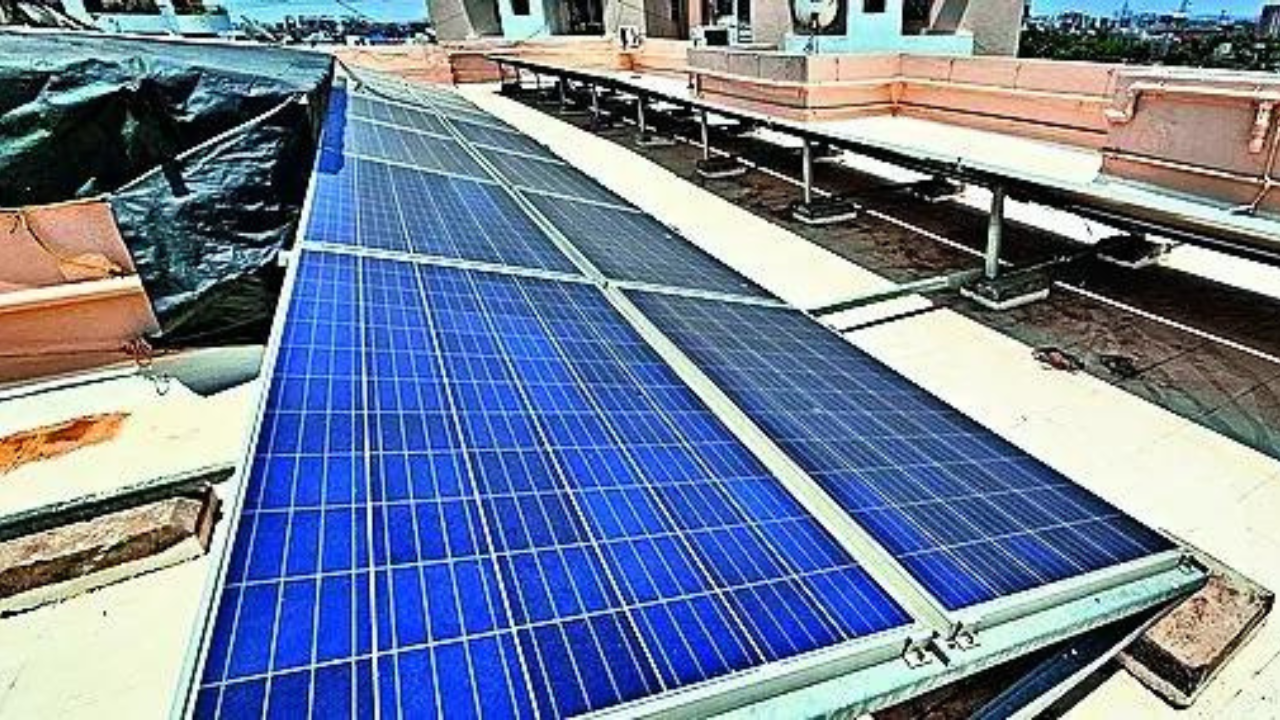
NEW DELHI: What do Lucknow, Nagpur, Surat, Varanasi and Ernakulam districts have in common? These smaller urban centres are contributing to the country’s energy transition, with a growing number of households opting for rooftop solar systems to meet their daytime electricity needs and reduce monthly power bills. Surplus power generated during solar hours is fed into the grid and drawn back at night, bringing electricity bills down to zero in many cases.These districts, along with several other tier-II and tier-III centres such as Jalgaon, Amravati and Chhatrapati Sambhaji Nagar in Maharashtra; Junagadh, Mahesana and Bhavnagar in Gujarat; Thrissur, Kollam and Alappuzha in Kerala; and Ganganagar in Rajasthan, are among the top 50 districts in the country for rooftop solar adoption.Interestingly, metropolitan cities such as Delhi, Mumbai, Hyderabad, Bengaluru, Chennai and Kolkata do not figure even among the top 100 districts. Govt’s ambitious Pradhan Mantri Surya Ghar Muft Bijli Yojana, launched by the ministry of new and renewable energy in Feb 2024 to promote rooftop solar and provide up to 300 units of free electricity a month to one crore households, has made rapid progress and will remain in force till March 2027.
36.3 Lakh Units Installed Across Country, Benefiting 44 Lakh Households
So far, 36.3 lakh rooftop solar systems have been installed, benefiting more than 44.1 lakh households. Of the scheme’s Rs 75,021 crore outlay, over Rs 25,000 crore has been released as subsidy. For rooftop solar systems of up to 3 kW, the Centre provides a subsidy of Rs 78,000, while several states have announced additional incentives.Officials said more than 60% of installations are in the 3-4 kW category. Gujarat, Maharashtra, UP, Rajasthan, Kerala and Assam are among the leading states in adoption.Officials said states such as UP and Kerala run effective outreach programmes, reflected in the scheme’s popularity. “States have formed discom- and district-level teams to create awareness about cleaner and cheaper sources of energy. Adoption in such states is definitely higher,” an official said.Ministry officials said the programme has gathered “unprecedented” momentum, with nearly three lakh installations completed every month on average. While uptake has been strongest among households with independent homes and sufficient rooftop space, efforts are now focused on bringing group housing societies under the scheme to expand its urban reach.A single rooftop solar installation in a housing society can meet the electricity needs of multiple households as well as common facilities.Govt is also promoting the utility-led aggregation (ULA) model to accelerate renewable energy adoption among low-income and vulnerable households. Andhra Pradesh, Odisha, Telangana, Bihar, Kerala, J&K, Tripura, Rajasthan, Chhattisgarh, Karnataka, Maharashtra and Delhi are adopting the model. The ULA model is designed for frugal consumers and households receiving free or subsidised electricity who are unable to install rooftop solar systems because of financial or structural constraints. The ministry has set a target of covering 30 lakh households under the model.


