



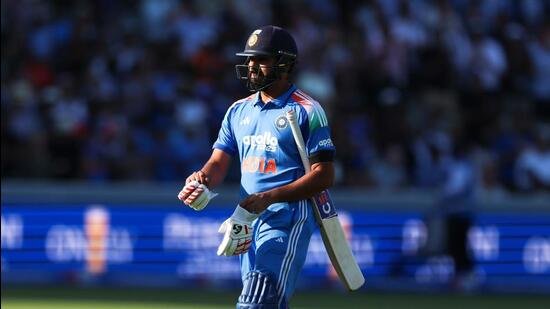
After his hundred at Lord’s, Rohit Sharma made a telling comment about Indian cricket. We are inside, he said, and there is an outside that creates noise.
It was obvious that Rohit doesn’t think much of all that is outside. And he is dismissive of the noise (critical comment) around the team, coming largely from the media that is considered unfriendly.
Rohit is partly right. Indian cricket has two opposite sides, separated as though by a wall. The ‘inside’ consists of India players and the current stars. These top guys, privileged and entitled, live in an exclusive celebrity bubble of riches and hero worship. The ‘outside’ consists of everyone else – media, fans, random critics.
Rohit is also right about noise and negativity. Players have always been judged and criticised, but with the explosive growth of social media, the critical voices are now more in number, much louder. Those inside are intolerant of criticism because they think it comes either from agenda driven experts or cricket innocent fans on social media. All critical comment (‘outside noise’) is thus treated with contempt.
This is the usual playbook, but Rohit’s inside-outside understanding is flawed on many counts. It’s ok to say ‘what’s in the dressing room stays there’ but the ground rules have changed with players themselves supplying what once was private, privileged information. A lot of outside noise actually comes from inside, leaked conveniently by players, officials and selectors. Many rumours and speculative stories are not without substance, invented by creative outsiders, but rest on facts.
Moreover, the media will judge, assess and comment on the team and the performance of players. That’s their job and criticism, constructive and positive, is justified, par for the course. Also, Rohit perhaps missed the point that the character of inside-outside has changed.
The outside is bigger and louder, more assertive and invested. Because of social media growth, fans have a platform to connect, criticise and question. And with several past legends taking on active media roles the boundaries are blurred. Outside noise is getting louder, and more credible because cricket greats are looking in from the outside.
If Sunil Gavaskar describes something as ‘stupid- stupid-stupid’, or Ravi Shastri, Sanjay Manjrekar, Dinesh Karthik express their honest opinion, no dressing room is sound proof enough to shut out the ‘noise’.
We must also recognise that players themselves are happily baring themselves on social media in a race to gain followers. In the quest for personal endorsements, social media numbers are digital currency, as important as runs in the scorebook. When the inside is taking ordinary folks on a conducted tour to their private world where is the need to travel to the moon to get a glimpse of the stars. The biggest stars conveniently land on our devices and smart phones.
Players, popular public figures, are salesmen looking to close one more deal. Earlier, the inside operated on scarcity, with less being more. Now the business plan is to flood the market. The cricket stars have chosen scale (be present everywhere) and speed (get there first).
Strangely, even relatives/wives/parents of players, part of the extended insider group, are playing the game, and are active in the media space. Their opinion is usually harmless but occasionally some content is loaded. Parents of Shreyas Iyer, Sai Sudarshan, Abhimanyu Easwaran, Washington Sundar questioning national selectors and going public with their grievances is inappropriate.
Recently, BCCI urged players to show restraint on social media activities, perhaps concerned that the ‘inside’ is descending into a noisy kitty party. The large outside however is not in anyone’s control – it’s a beast players must live with and its noise won’t be lowered or silenced.
Actually, the redrawing of inside/outside boundaries is not a bad development. As cricket evolves, so must the relationship between key stakeholders. Players understand this and Rohit knows that his job is to go into the middle and make runs.
That’s why, after his great hundred at Lord’s, he said ‘it’s fun, I enjoy the noise’.


