



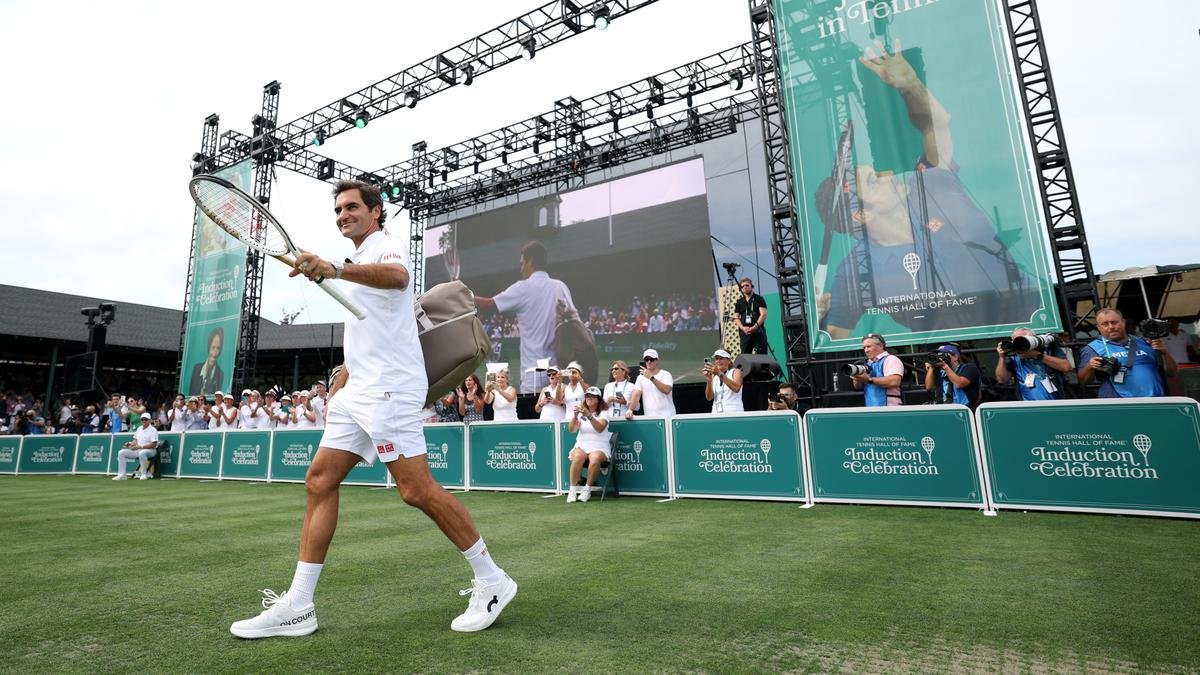
There should be a word for what Roger Federer did on a tennis court, because “played” barely covers it. Watching him felt like being granted a glimpse of the divine, and that’s no exaggeration. Your jaw went slack, your eyes bulged, and sounds escaped your body that no grown adult should make over a man hitting a felt ball with a string racquet.
Federer did not invent anything. Every shot in his arsenal had been struck before, by someone else in some other era. Yet, in his hands, the borrowed became the sacred, the familiar became revelation, as if the shot had been waiting its whole life for him specifically to unlock it.
And he didn’t do it once in some career-defining flash of magic. He did it for the better part of two decades. It was a residency in genius, not a hot streak. Pete Sampras once said Federer’s game had no weaknesses, and it stands true. What other players built entire careers on – a single jaw-dropping moment etched into a highlight reel – Federer treated as routine.
Except, of course, that routine came around roughly a thousand times, spread across four Grand Slams and every corner of the world, and it never once stopped feeling like the first time. That is the strange arithmetic of Federer’s greatness: repetition should have dulled the wonder, but it never did. Familiarity, in his case, only sharpened the awe.
ALSO READ | Decoding Eala Mania — the movement sweeping across tennis
Now the residency has its plaque. The felt ball has been put down, the sermons have ended, and what’s left is the reckoning every great career eventually meets – not a match, but a monument.
On Sunday, the world celebrated Federer once again as he was inducted into the International Tennis Hall of Fame. It is the sport’s great farewell and its eternal afterlife in the same breath, a place where a player’s brilliance is carved into permanence, even as it reminds them that greatness is never solitary.
The crowd said as much. Billie Jean King, Martina Navratilova, Stefan Edberg, John McEnroe, Andy Roddick and many others were on hand to celebrate one of tennis’s finest champions.
And closer still sat the ones who needed no introduction. His parents, Robert and Lynette. His wife, Mirka, and his four kids that the tennis world had watched grow up, one Slam at a time, in players’ boxes scattered across the globe.
Roger Federer holds the record for most consecutive weeks (237) as World No. 1 (February 2, 2004 to August 17, 2008)
| Photo Credit:
Getty Images
Mirka spoke first and introduced her husband with a line that outshone every statistic that followed. “What makes me proudest isn’t what Roger accomplished when the world was watching. It’s who he is when nobody’s watching,” she said.
He, too, glowingly praised the one person who has seen the highs and lows of his stardom from a touch away, while also building a semblance of a normal life together.
“Mirka inspires me every day. She showed me how to stay focused on tennis and take joy in everything else. A wonderful mother to our four kids… she makes the impossible happen. We grab each other’s hands, and we run through walls.”
More than trophies
For once, the man who made the impossible look routine was undone by his own history. He tried, and failed, to hold it together – pausing a few times to wipe his eyes, half-laughing through his tears. At one point, he pleaded for tissues and sunglasses, but pressed on anyway, the way he always had.
When he steadied himself enough, he spoke not of the trophies or numerous records. He was more focused on the more than 5,000 headbands he wore, the more than 7,000 pairs of socks he went through, some 10,000 racquets strung over the years, and the thousands of sets played on the same two knees.
“I tried to show my love for the game. Because it really mattered to me, and I also wanted it to matter to you. To be worthy of your attention, worthy of your attendance, because people don’t have to come watch us play. They come to be entertained, inspired, excited. They could always decide to go somewhere else, but they chose tennis, they chose us,” he emphasised.
The 45-year-old even wandered back to where it all began, not in any packed stadium but in the shadows just off it.
“I remember being a ball boy in Basel, standing against the back wall, hands behind me, eyes on the ball. I’ll never forget how the game looked from there… the intensity, the adversity, the feeling of being so close to the players. I remember the next morning, my legs were gone… standing all day is a lot of work.”
ALSO READ | Alexander Zverev and the contours of tennis’ new ‘Big Three’
Federer, especially later in his career, had the power to make the smallest cog in the wheel seen and appreciated. His core memory helped him do the same once more at Newport.
“I really want to thank every ball kid who ever stood through my matches or all our matches, for that matter, for hours on end. I see you. I thank you. I was you.”
It’s a strange, fitting symmetry: that is precisely how everyone felt watching his career unfold. Standing still, eyes fixed on the ball, absorbing the intensity as though they were pressed against the back wall of the court – even from several hundred or several thousand kilometres away, on the other side of the television screen.
More than a hundred titles in his cabinet, and yet Federer insisted the number was never the point.
“They call this the Hall of Fame… but fame was never the goal. My goal was to spend my life doing something I love, with people who love it as much as I do.”
And he did – relentlessly, joyfully, for the better part of his life. Federer didn’t just win; he took tennis to altitudes it hadn’t reached before, wrote storylines the sport had never dared to script, and handed the world rivalries (with Rafael Nadal and Novak Djokovic) that will be studied and mythologised for generations.
Smashed racquet, softened man
There was a time when the future maestro was closer to a menace. As a boy in Basel, he didn’t play tennis so much as wage a war with it – swearing between points, smashing racquets and the whole kit and caboodle. At 16, he tore through a practice backdrop, understandably earning a week-long toilet-scrubbing sentence from his coach.
By his own admission, the unlearning took years and was no epiphany. The real turning point wasn’t a victory or defeat, but a tragedy – the death of his childhood coach Peter Carter in 2002, which recalibrated Federer for good.
Self-deprecation became an art form, just like most things would with Federer. The same man, on Sunday, would hold up two aging knees to a crowd of legends and grin, saying, “Still got them, by the way. If I fall, please catch me.”
Grass was Roger Federer’s most successful surface, where he won an Open Era record 19 titles (including a record 10 Halle Open titles).
| Photo Credit:
Getty Images
The once hot-headed boy is now at ease with laughing at himself, and became the most graceful man in tennis – on the court and off it. And he did it all with the same unhurried smile, even in the moments when the headband was fighting a losing battle against the sweat of yet another title run, even when his body was being pushed past what bodies are supposed to give.
“I’m still writing my love letter to tennis. My time as a player is done, but tennis will always stand at the intersection of everything I care most about… my family, our friendships, the past 40 years and the future we’re building. So this is not a goodbye,” he stated.
“We all leave the court eventually, but the sport keeps evolving. This boy from Basel thanks you… and I thank all of you for sharing the journey.”
ALSO READ | Linda Noskova: the calm warrior with heavy artillery
It is the tennis world, though, that owes its thanks to Federer. He carried the sport to spaces it had never been invited into before – into living rooms of people who couldn’t tell a forehand from a backhand, into the vocabulary of art critics and poets who had never once written about sport, into a kind of beauty that made the utilitarian business of winning feel almost secondary. He turned rivalry into reverence, opponents into co-authors, and a simple racquet into something closer to a paintbrush.
The ball boy became the main event. And the boy who once stood against the back wall, eyes fixed on the ball with hands behind his back, has finally taken his place among the very heroes he once watched from the shadows.
That, perhaps, is the only ending fitting enough: not a farewell, but a homecoming.


