






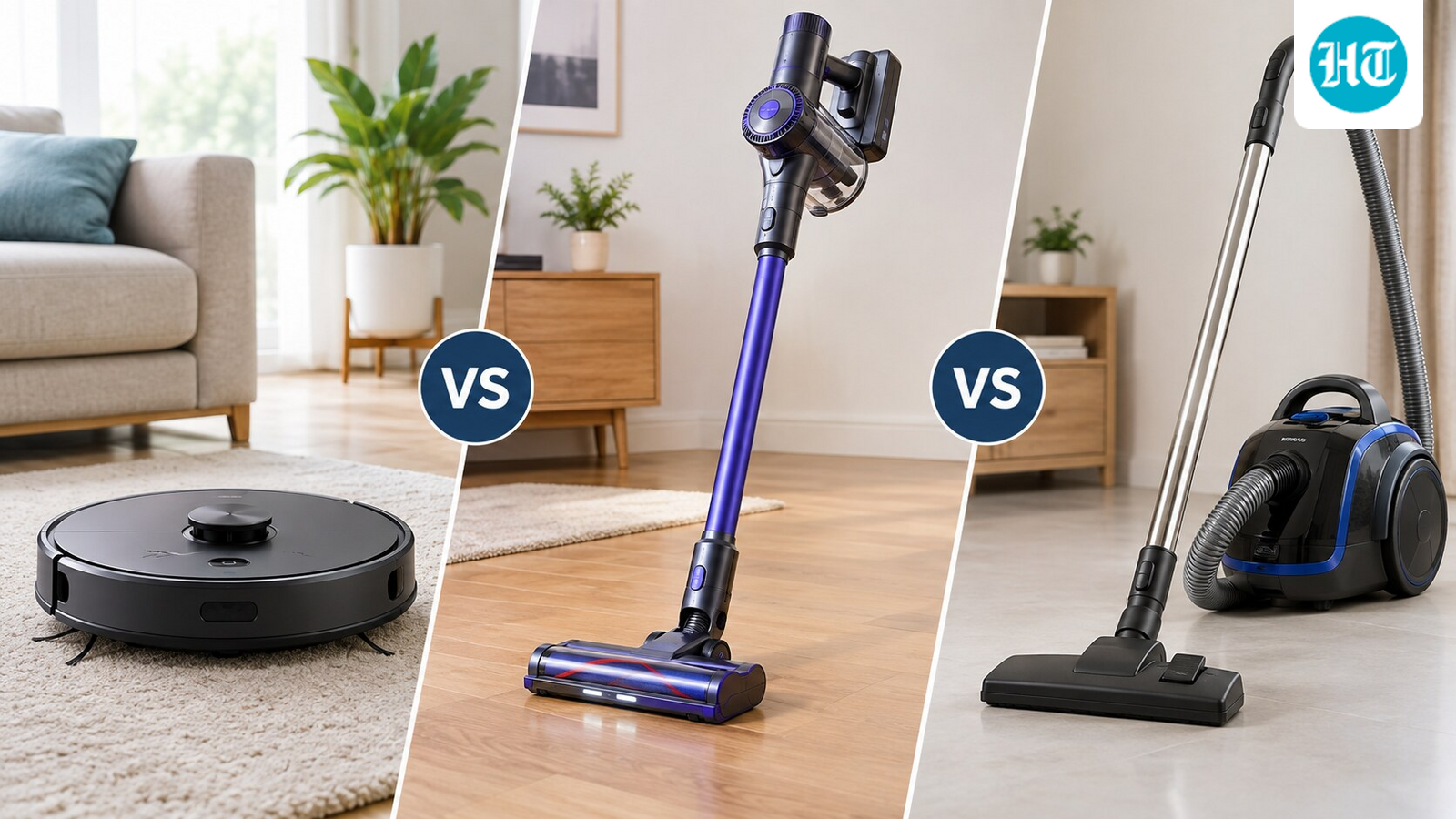
Vacuum cleaners have become an alternative cleaning solution in Indian homes. In some homes they are used for occasional cleaning needs, while in other homes they are used as regular cleaning companions. No matter what the use is, they remain an important appliance that help people keep their homes clean. This makes choosing the right vacuum cleaner an important task. That said, choosing the right vacuum cleaner isn’t just about suction power or dust collection capacity anymore. With robotic, cordless and traditional vacuum cleaners offering different cleaning experiences, deciding which one to buy can be surprisingly complicated. While robotic vacuum cleaners focus on automated cleaning and convenience, cordless models offer flexibility and easy handling, whereas traditional vacuum cleaners are often preferred for powerful, thorough cleaning sessions.
But which type actually suits your home? A robotic vacuum can save time by cleaning floors with minimal intervention, but its performance around corners, stairs and stubborn dirt may vary. Cordless vacuum cleaners, on the other hand, are convenient for everyday cleaning, especially when you need to quickly tackle dust, pet hair or accidental spills. Traditional vacuum cleaners, meanwhile, can offer strong suction and longer cleaning sessions without relying on battery life.
In this guide, we will compare robotic vs cordless vs traditional vacuum cleaners based on cleaning performance, convenience, battery life, maintenance, versatility and pricing in India. Whether you live in a compact apartment, have a large family or need a vacuum for deep cleaning, understanding these differences will help you choose a model that fits your cleaning habits and budget.
Robotic vacuum cleaner: vs cordless vs traditional vacuum cleaner: A simple comparison
Feature |
Robotic Vacuum Cleaner |
Cordless Vacuum Cleaner |
Traditional Vacuum Cleaner |
| Cleaning method | Automated floor cleaning, often with vacuuming and mopping | Manual cleaning using a battery-powered handheld/stick unit | Manual cleaning using a corded motor and hose/wand |
| Best for | Daily maintenance and keeping floors consistently clean | Quick, flexible cleaning of floors, furniture, stairs and hard-to-reach areas | Deep cleaning and larger cleaning jobs |
| Ease of use | Very high – can clean with minimal intervention | High – lightweight and easy to move around | Moderate – requires plugging in and moving the machine |
| Automation | Excellent – mapping, scheduled cleaning and app controls on many models | Low to moderate, depending on model | Low |
| Cleaning reach | Limited to areas the robot can physically access | Excellent – can reach furniture, corners, stairs and other surfaces | Good, particularly with long hoses and attachments |
| Stairs | Poor – generally cannot clean stairs | Excellent | Good, but carrying the machine can be inconvenient |
| Under-furniture cleaning | Excellent for suitably low furniture | Good, depending on the wand and head design | Moderate to good |
| Corners and edges | Good, but performance varies by design | Very good with appropriate attachments | Very good |
| Sofa/furniture cleaning | Poor | Excellent | Good with dedicated attachments |
| Car cleaning | Not suitable | Excellent | Good, but less convenient |
| Deep-cleaning ability | Good for routine dust and debris; varies by model | Very good, especially with powerful motors and suitable heads | Very good for sustained cleaning |
| Battery dependence | Yes | Yes | No |
| Dustbin capacity | Usually smaller | Small to medium | Usually larger |
| Maintenance | Moderate to high – brushes, filters, sensors and mop components need cleaning | Moderate – filter, brush and dustbin maintenance | Moderate – filter, dust bag/bin and accessories |
| Noise | Generally moderate | Moderate to high | Often higher |
| Storage | Requires floor space for robot and charging dock | Compact, especially stick models | Requires more storage space |
| Smart features | Strong – app control, mapping, schedules and navigation on many models | Limited to advanced models | Usually minimal |
| Mopping | Available on many models | Usually not available unless designed as a wet/dry cleaner | Generally not available |
| Initial cost | Generally highest | Moderate to high | Generally lowest |
Robotic vacuum cleaner: What’s it best for and who should buy it?
A robotic vacuum cleaner is best suited for everyday floor maintenance rather than replacing every type of deep-cleaning task. It can navigate around a home, pick up dust, hair, crumbs and other everyday debris, and many newer models can also mop hard floors. Its features such as room mapping, scheduled cleaning, app controls, automatic charging and obstacle avoidance can further reduce the amount of manual work involved.
Who should buy a robotic vacuum cleaner?
– Busy professionals who want automated daily floor cleaning.
– Families with children where crumbs and everyday floor debris accumulate quickly.
– Pet owners who need frequent removal of hair and dust.
– Large homes with mostly hard floors, where scheduled cleaning can save considerable effort.
– Smart-home users who prefer app-controlled appliances and automated routines.
However, a robotic vacuum cleaner isn’t ideal for every home. Stairs, tight corners, cluttered rooms, sofas, curtains and cars still require a conventional or cordless vacuum cleaner. If your priority is deep cleaning across multiple surfaces, a cordless or traditional vacuum may be more versatile.
Cordless vacuum cleaner: What’s it best for and who should buy it?
A cordless vacuum cleaner is best suited to quick, flexible cleaning where convenience matters as much as suction power. Unlike traditional corded models, it does not tie you to a power socket, which makes it easier to move between rooms, clean stairs, reach corners and tackle furniture or car interiors. These vacuum cleaners are ideal for quick everyday cleaning particularly for picking up dust, crumbs, hair and everyday debris without having to set up a bulky machine. It is also ideal for cleaning multiple surfaces such as floors, sofas, mattresses, curtains, shelves and other surfaces. Another advantage of using a cordless vacuum cleaner is that it is easy to use, especially when it comes to cleaning stairs or maneuvering around furniture owing to lack of cord management. It is also the ideal device for cleaning cars.
Who should buy a cordless vacuum cleaner?
– Apartment dwellers who want to clean small crevices of their homes efficiently.
– Families with children or pets.
– People who clean frequently.
– Buyers who want a single versatile machine for different surfaces.
Simply put, a cordless vacuum is mostly about freedom and convenience. If your cleaning routine involves frequent quick jobs across floors, furniture, stairs and vehicles, its portability can be more useful than the extra capacity and unlimited runtime of a traditional vacuum.
Traditional vacuum cleaner: What’s it best for and who should buy it?
A traditional vacuum cleaner remains a practical choice for buyers who prioritise consistent suction, longer cleaning sessions and deep cleaning over portability. These machines draw continuous power from an electrical outlet, so you don’t have to stop midway because the battery has run out. Their larger dustbins or bags and wide range of attachments also make them suitable for cleaning an entire home in one session.
They are best for deep cleaning homes where sustained suction is required, cleaning larger apartments, independent houses or homes with several rooms and for longer cleaning sessions. They are also ideal for cleaning carpets, upholstery and multiple surfaces as a lot of these traditional models come with different brushes, floor heads, crevice tools and upholstery attachments. These additional attachments enables one machine to tackle floors, sofas, curtains and other surfaces easily.
Who should buy a traditional vacuum cleaner?
– Large families with bigger homes.
– Buyers who vacuum infrequently but thoroughly.
– Buyers who prioritises sustained cleaning performance over portability.
– Buyers who don’t want to deal with battery degradation or charging.
Simply put, buyers should choose a traditional vacuum cleaner if their priority is long-duration, thorough cleaning rather than grab-and-go convenience. For a larger home where cleaning often involves several rooms and multiple surfaces, its continuous power and typically larger capacity can be useful.
Similar articles for you
I switched to a fully automatic washing machine: Here’s what changed
The Research
I’ve used and tested hundreds of vacuum cleaners. I’ve also been writing about consumer electronic devices and home appliances for over a decade.
To compile this guide, I’ve used a dozen robotic, cordless and traditional vacuum cleaner models and combed through Reddit pages that talk about their suction power, battery, overall performance, and factors that impact their overall performance. Like all HT journalists, I review products with complete editorial independence and recommend products based on my learnings.
Disclaimer: At Hindustan Times, we help you stay up-to-date with the latest trends and products. Hindustan Times has an affiliate partnership, so we may get a part of the revenue when you make a purchase. We shall not be liable for any claim under applicable laws, including but not limited to the Consumer Protection Act, 2019, with respect to the products. The products listed in this article are in no particular order of priority.


