



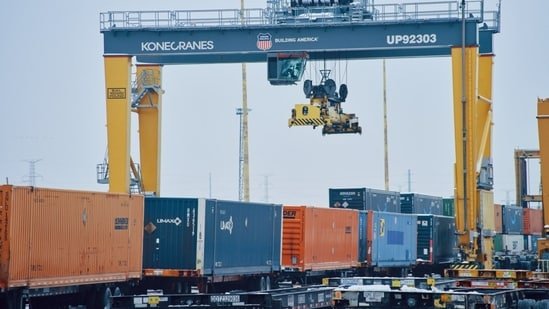
American retailers and manufacturers are learning to love trains again.


Companies abandoned the rails in recent years because trucking was a faster, more secure way of moving furniture, food and electronics across the country.
Now that trucking rates are climbing toward their highest levels in four years, some businesses are deciding a slower, cheaper route across the country suits them fine.
“Everybody’s exploring intermodal,” said Milton Magos, vice president of Mexico operations at freight brokerage Traffix. “They want to know how they can make their supply chain more reliable.”
North American intermodal transports, in which railroads carry containers and truck trailers, rose about 6% in May from a year earlier to an average of around 369,000 containers and trailers a week, according to the Association of American Railroads. That was the largest annual increase since March 2025, when companies were rushing in merchandise ahead of expected new U.S. tariffs.
Intermodal transport, which uses trucking for the final leg of delivery, is slower and more complicated than long-haul trucking. Trains stalled at rail yards and containers sitting at terminals can be targeted by thieves. But intermodal is also cheaper and more fuel-efficient, which has made the transportation mode particularly attractive as fuel prices have soared due to the war in Iran.
Trucking rates are climbing after four years in which carriers were squeezed by a combination of too many trucks on the road and not enough loads. An exodus of carriers has accelerated over the past year due to low earnings combined with a Trump administration crackdown on foreign drivers.
The rising cost to transport goods via truck has “forced more and more folks to think about whether intermodal is a viable alternative, as those savings start to look more like 10%, 15%, 20% potential,” said Mark Yeager, chief executive of Redwood Logistics.
The average spot rate for U.S. intermodal was $1.16 a mile for the week ended June 16, according to intermodal-service provider InTek Logistics, though most intermodal loads move under long-term contract rates rather than on the spot market. The intermodal spot rate was well below the $3.05 a mile average spot rate for the most common type of big rigs for the week ending June 13, according to DAT Freight & Analytics.
Magos of Traffix said intermodal shipping is especially in demand for moving goods across the U.S.-Mexico border as some truck drivers avoid the route for fear of getting swept up in U.S. immigration enforcement.
“Drivers are not necessarily willing, or as willing as in the past, to go and do these deliveries, so this is tightening capacity,” Magos said.
Logistics executives say investments by railroads and intermodal providers in making the transportation method faster and more reliable have helped shippers make the switch.
J.B. Hunt Transport Services, one of the country’s largest intermodal providers, reported its highest-ever first-quarter domestic intermodal volume. While companies are often choosing intermodal to rein in transportation costs, “the confidence in execution makes it then a more durable long-term change,” Spencer Frazier, executive vice president of sales and marketing, told investors this month.
The company in 2023 started a service with BNSF Railway that promises to deliver shipments a day faster on average than traditional intermodal.
Another contender, Schneider National, said it, too, has seen more demand for intermodal transport this year.
“As reliability has strengthened, more shippers are increasingly viewing intermodal as a viable, cost-effective complement to over-the-road freight,” said Jim Filter, the company’s incoming president and chief executive.
The company last year launched a product called Schneider Fast Track that gives customers priority placement on its most reliable lanes and speeds up average transit times. The service includes real-time shipment monitoring, as well as services to help recover freight if issues arise.
Write to Liz Young at liz.young@wsj.com


