



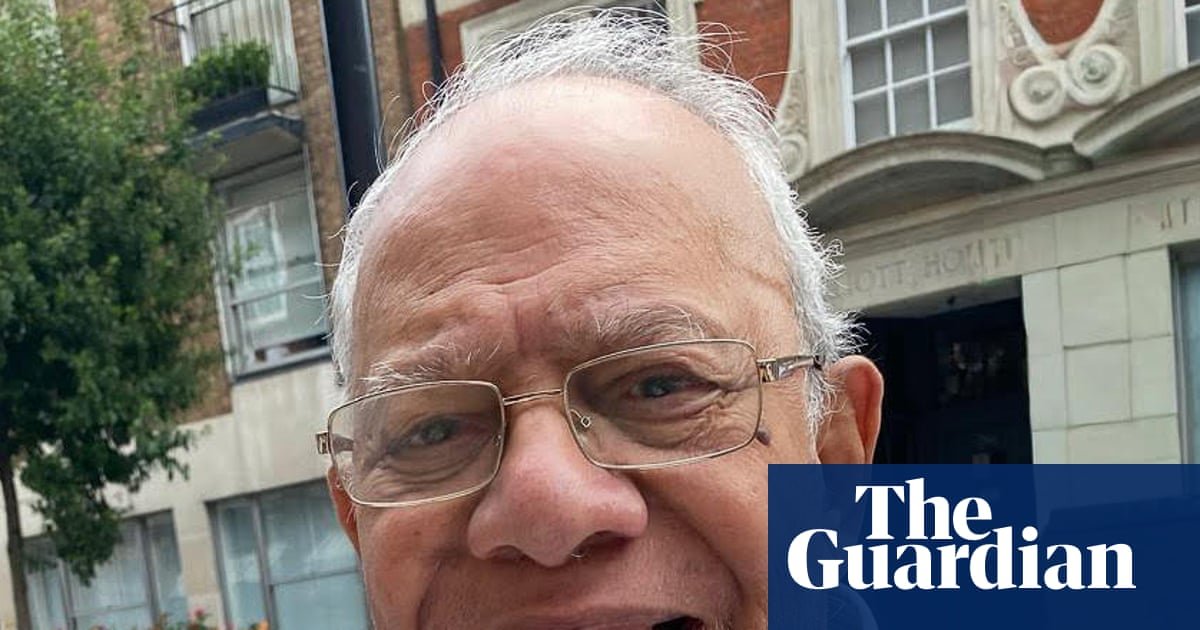
My father, Riaz Hasan, who has died aged 87, was a water resources engineer with a distinguished career working across 40 countries – in the 1970s with the British firm Halcrow and, from the 80s, at the UN and the World Bank.
Originally from Hyderabad, Riaz arrived in the UK in 1965 with £3 and an A–Z, invited, like many engineers in India at that time, by the government. After completing a master’s degree in water resources at Bradford University, where he developed a love of Yorkshire pudding and received his degree from Harold Wilson (which he described as a real privilege), he embarked on his career designing life-saving, long-term water and food solutions for the most vulnerable and those affected by war, famine and natural disasters.
Born in the small town of Warangal, near Hyderabad, to Mohammed, an English professor, and his wife, Khadija, Riaz went to Nizam college. He did his engineering degree at Osmania University, graduating in 1960, then got his first job at the Central Water Power Commission (CWPC) in Delhi.
On arrival in the UK, he worked for five years in various engineering jobs, including on a motorway construction site in Kent, in order to save money for his master’s degree.
He was then employed by the Halcrow Group, in Swindon, Wiltshire, operating in 10 different countries, including Yemen and Iran, before returning to London and beginning his UN role in 1984. He worked as a consultant hydrologist across three agencies: the Food and Agriculture Organisation, World Food Programme and World Bank, which took him on missions to countries including Sudan, Somalia, Ethiopia, Cambodia, India and China. After retiring in 2004, he wrote about his experiences in a book, The New Struggles for Survival (2014).
From his early days in London, he immersed himself in British life, walking to parliament to watch late‑night debates and attending Winston Churchill’s funeral in 1965. While he recollected the smiles of the Westminster security teams, my father also faced racism, including attacks on his home after he wrote a letter on Churchill’s wider legacy for a newspaper. Yet he refused to be silenced, believing it was a duty to speak up for truth and justice and his frank letters appeared in print, including in the Guardian, until recently.
His commitment to service shaped his private life too. He and my mother, Rukhsana (nee Moosavi), an NHS GP whom he married in 1973, supported family members in need all their lives, and quietly donated to several British and international charities. My father saw the world, however divided, as one global village with every resident equally worthy of respect and care. He believed you could be a loyal and proud Briton, Indian and Muslim, and his remarkable life exemplified this.
He is survived by Rukhsana, his children, Mehdi and me, and three grandchildren.


