



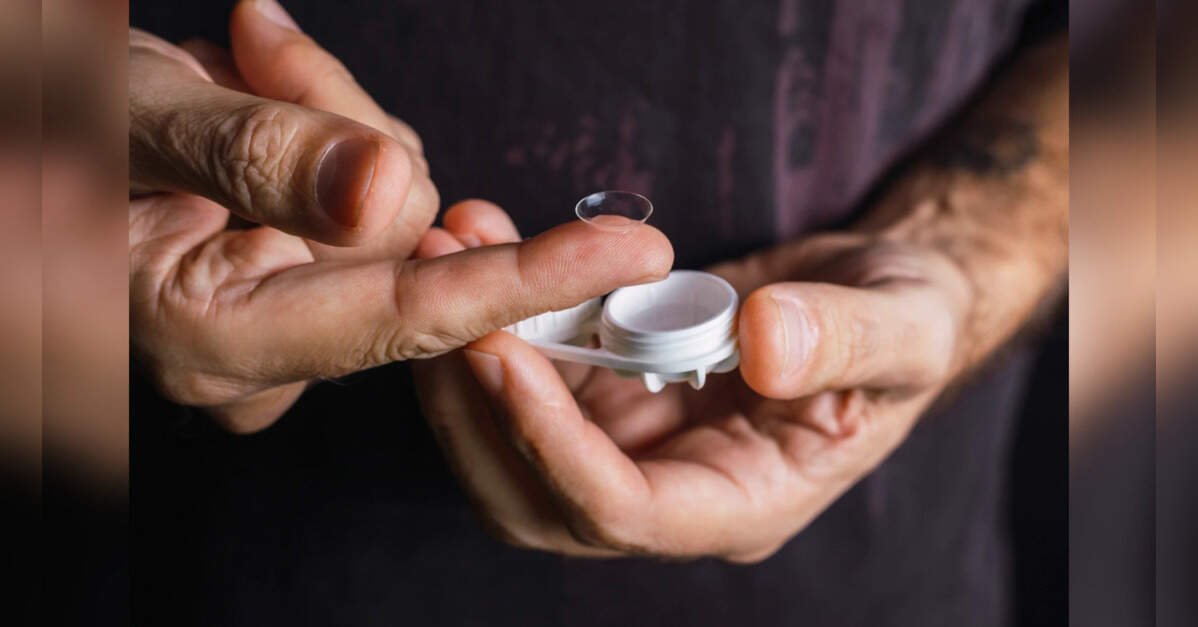
Made-to-order rigid contact lenses could one day be produced by 3D printers in as little as 20 minutes, researchers say.
That means customized lenses could someday be designed, manufactured and dispensed during a single visit to the optometrist, according to a report in Materials & Design.
“We are very excited about this work because it brings us closer to contact lenses that are truly personalized,” study leader Dr. Shirley Tang of the University of Waterloo in Ontario said in a statement.
“Our technology produces lenses with patient-specific surfaces for a precise fit while delivering the optical clarity and mechanical performance expected of commercial contact lenses.”
The inner surface of the lens will precisely match the patient’s cornea and the outer surface will be shaped to provide the required vision correction, her team said.
Silicone – the conventional material used in contact lenses – is generally not compatible with 3D printing, so the researchers developed a new silicone formulation.
Because 3D-printed objects are built layer by layer, tiny stair-step imperfections can form on curved surfaces and reduce optical clarity and wearer comfort. To address this issue, the team developed an ultra-thin, non-contact coating process that smoothes the surface without altering the customized shape of the lens or compromising its optical performance.
The lenses have so far been tested only in lab experiments. The researchers have filed a provisional patent for their hydrophilic silicone material and are preparing to test the lenses in actual eyes.
The project received a Gold Medal at the Shanghai International Exhibition of Inventions in June 2026.
SCIENTISTS PREPARE TO FIGHT EMERGING TICK-BORNE VIRUSES
New research is shedding light on how an emerging class of tick-borne viruses manages to evade the human immune system.
Several so-called nairoviruses are carried by ticks that bite humans and can cause high fevers and impair organ function, researchers reported in ACS Infectious Diseases.
The Crimean-Congo hemorrhagic fever virus, for example, is often fatal and is a threat to people in Africa, the Middle East and Asia.
Scientists already know that some nairoviruses evade the immune system by producing enzymes that make them undetectable. The enzymes remove small proteins attached to human proteins that would have alerted the immune system to an infection.
For the current study, researchers wanted to see whether this was true of some newly identified nairoviruses, including one called PCTNV that’s so far been found in ticks on the U.S. Pacific Coast but not in humans.
Their experiments suggested that PCTNV might be well equipped to evade the human immune system using these enzymes – and because PCTNV is carried by a human-biting tick already known to transmit Rocky Mountain spotted fever, people along the U.S. West Coast could be at risk for exposure.
“This study reinforces the need to be vigilant about not just tick bites but the type of ticks that an individual has been bitten by as they may carry diseases beyond what we have been used to looking for,” study leader Scott Pegan of the University of California, Riverside said in a statement.
Learning how these viruses skirt host immunity will aid development of countermeasures and biosurveillance tools, he added, noting that his team has been able to train computers to identify disease-causing nairoviruses using models that could ultimately contribute to a biosurveillance system.


