





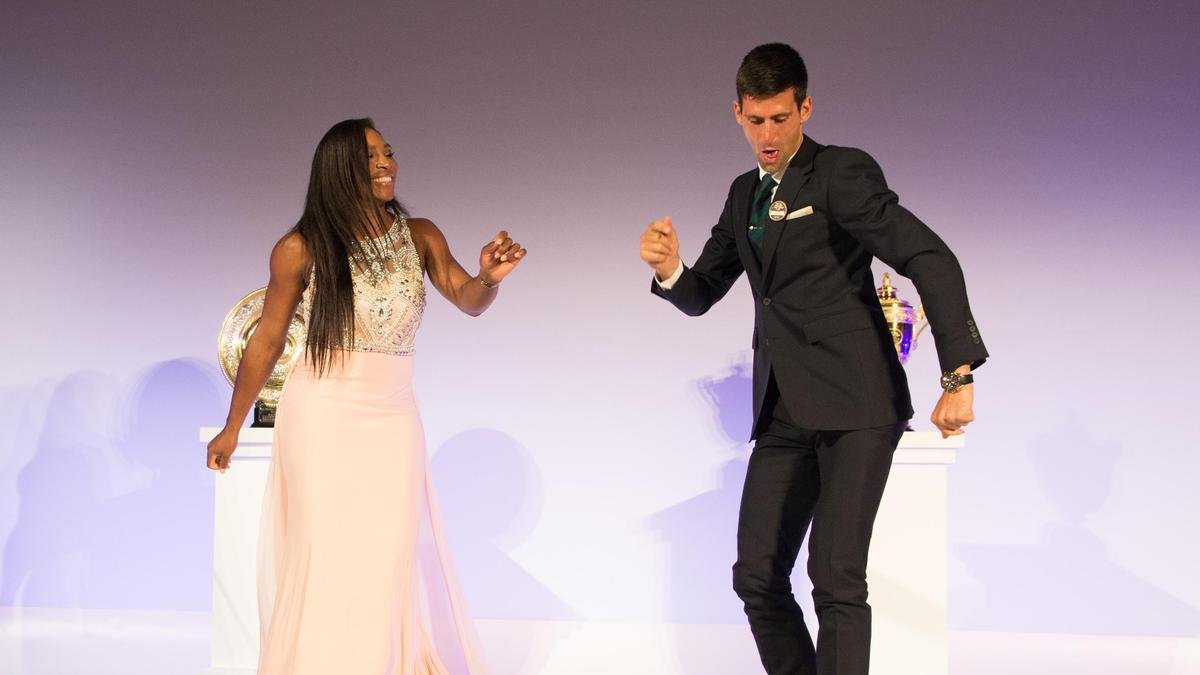
If you are looking for the most complete CVs in world tennis, you shouldn’t be going beyond Serena Williams and Novak Djokovic.
Serena has 23 singles Majors – an Open Era record – and 14 in doubles. She has won every Slam at least thrice in singles and twice in doubles.
The American has clinched the Olympics singles gold once (London 2012), the doubles gold thrice (Sydney 2000, Beijing 2008 and London 2012), and the erstwhile Fed Cup (now Billie Jean King Cup) in 1999. Since 1990, no player has won more singles titles on the WTA Tour than Serena’s 73.
Djokovic has an all-time men’s record 24 singles Majors, secured every Slam at least thrice, and bagged all nine Masters 1000s and ATP Finals at least twice. He won the Davis Cup for Serbia in 2010, and when he pocketed the Olympics singles gold at Paris 2024, following a sensational victory over Carlos Alcaraz, it filled the last existing gap.
It is natural for everyone to expect that the two legends will now be resting on their incredible laurels, vacationing year-round, soaking in the sunshine, swimming the sea, and taking long and calming strolls with their partners and children in tow.
Back to the grind
But from Monday at Wimbledon, Serena and Djokovic will be seen hitting tennis balls again, not for fun but in all seriousness as full-blooded professionals. The former is closing in on 45, and is a mother of two, with the second child yet to turn three. The latter has just stepped into the 40th year of his life and is also a father of two.
Yet, here they are, sparring with players a decade or two younger, and looking to shoe-horn another high-impact bullet point into their already exceptional resumes.
Serena, a seven-time winner and four-time runner-up at Wimbledon, is making a comeback to competitive singles for the first time since US Open 2022 while Djokovic, a seven-time winner and three-time finalist at SW19, will be on his 21st successive visit to the All England Club.
What is their motivation? Serena, in her own words, has said that it is an opportunity to show her two daughters what it takes to perform on the biggest stage. She has also been inspired by her sister Venus, 46, who made the doubles quarterfinal at the 2025 US Open. In fact, Serena and Venus will also be playing doubles at Wimbledon, having been granted a wild card.
“I had nothing better to do,” Serena said at the Queen’s Club in London recently, eliciting great laughter from the crowd which watched her pair up with Canada’s Victoria Mboko and win a round. “I got tired of sitting at home. My kids are out of school for the summer, so why not?
“I don’t need to win. I’ve won more than most people have in their whole lives. I don’t have anything to lose. Everything is a gain,” she observed.
For Djokovic, it is the “thrill of competition”. At the Australian Open earlier this year, he beat the then World No. 2 Jannik Sinner over five sets in the semifinal, and pushed No. 1 Alcaraz hard in the final before succumbing in four sets. A month later at Indian Wells, he stated that he would keep going as long as he has the “flair and quality, and the motivation”.
“I still enjoy getting out there in front of the fans and being competitive,” Djokovic said. “I have proven to myself primarily, and to others, that I can still compete at the highest level. I still have that edge, and I’ll keep on going as long as I feel like it.”
Serena certainly looks leaner and fitter than when she last played on the Tour, thanks to the effectiveness of new-age weight-loss drugs. After her second pregnancy, she couldn’t “beat the weight” and turned towards GLP-1 medication.
Glucagon-Like Peptide 1 (GLP-1) is a naturally occurring hormone that nudges the pancreas to release insulin, slow down digestion and reduce hunger. Semaglutides and Tirzepatides perform this function when ingested in the form of medicines, reducing food intake and leading to significant weight loss.
These two drugs have been on the World Anti-Doping Agency (WADA) monitoring programme since 2024 and there is a raging debate whether they can be bracketed as performance-enhancers. How Serena benefits will further this discussion.
But this is only one part of the story. Playing tennis is part of Serena’s muscle memory and that aspect is not going away. At her peak, she had the most devastating serve on Tour, and even a watered-down version will give her the first-mover advantage on a slick and fast surface like grass.
There is also her on-court aura, the overarching nature of which can make opponents shrink. Only a handful have risen to the challenge, like Naomi Osaka and Bianca Andreescu did when they beat Serena in their maiden Major finals at the 2018 and 2019 US Opens respectively.
“I see her in the gym more than I have seen her when she was at her prime,” Djokovic said last week at Wimbledon. “It’s admirable, honestly, the effort she’s putting in. For her to come back after years of being absent, two children later, and to give so much effort not just for her own satisfaction but to also give all of us the pleasure of seeing her is remarkable.”
However, there are challenges galore. A similar comeback in singles was once attempted by Martina Navratilova in 2002 when she was nearly 46. That lasted only 10 matches over three years, and featured just three wins. Navratilova did go on to have a wonderful second wind in doubles, but Serena has said that anything other than singles is “not my journey right now”.
Lacking the edge
Having not experienced a competitive environment for nearly four years, Serena is bound to be rusty. Even before that, she was in a state of semi-retirement, playing just eight singles matches from Wimbledon 2021 and tasting defeat in five.
Present-day singles is also more powerful and explosive than at any other time. A reality check may well await Serena, who once dominated the Tour with her athleticism and superior heft of stroke.
Unseeded and unranked as she is, the early rounds will not be easy. Against World No. 87 Maya Joint, Serena may have a softer-than-expected opening, but she is drawn to meet the fast-rising 21-year-old from Philippines Alexandra Eala, the big-serving Czech and 2021 finalist Karolina Pliskova, and defending champion Iga Swiatek in the subsequent rounds.
In contrast, Djokovic, by virtue of still being in the top-10, has the ranking protection to ease in. Unfortunately, the seventh seed has also been dealt with a banana skin of a draw.
After China’s Wu Yibing (No. 102), the Serb can potentially meet Stefanos Tsitsipas, a two-time Slam finalist and former World No. 3 but now down to 87, Joao Fonseca, who beat him in the third round at French Open and is now No. 27, and 12th seed Andrey Rublev in the second, third and fourth rounds respectively.
Since the run to the final in Melbourne, Djokovic has done precious little, playing just seven matches and losing three. After winning the ATP Finals in November 2023, which came two months after he secured the last of his 24 Majors, he has just two Tour titles – ATP 250s in Geneva and Athens, both last year.
In fairness, Djokovic’s struggle has not been in beating mid-level players but the elite ones in Sinner and Alcaraz. As they are almost always ranked in the top-two, every player who dreams of a Slam invariably has to beat both.
Prior to the success over Sinner at the Australian Open, Djokovic had lost five straight times to the Italian, with three of those at Majors. Against Alcaraz, he has lost four of his last five Slam contests, with three of them coming in finals.
While there is little doubt that the duo has elevated the quality of tennis, the physicality in the game has gone through the roof. So much so that Djokovic, who once raised fitness standards to such levels that it triggered massive shifts in the way Roger Federer and Rafael Nadal prepared, is now struggling to keep up. It doesn’t help that Sinner and Alcaraz are nearly 15 years younger.
Playing catch-up
“It’s just age, the wear and tear of the body,” Djokovic said after losing to Sinner in the semifinal at Wimbledon 2025. “As much as I’m taking care of it, reality hits me. It’s tough for me to accept that because I feel that when I’m fresh and fit, I can still play really good tennis. I have proved that.
“But playing best-of-five [sets] has been a real struggle physically. The longer the tournament goes, the worse the condition gets. These guys are fit, young and sharp. I feel like I’m going into the match with a tank half-empty. It’s just not possible to win a match like that.
“But it’s one of these things I accept and embrace, deal with the reality the way it is, and try to make the most out of it.”
Wimbledon 2026 will give Djokovic the best opportunity to do this. In Alcaraz’s absence, he has just one big worry in Sinner. Alexander Zverev is the second seed, but the reigning French Open champion has a history of stumbling on grass and never gone past the fourth round at The Championships.
Though Djokovic’s best surface was hard for long, the lush green lawns of south-west London have been immensely hospitable. Over the years, he has mastered the art of moving on the slippery turf, improved his volleying to a significant degree, and spot-serves like the best in the business.
Remarkable record
In his last seven visits to Wimbledon, he has earned four titles, made two appearances in the final and one in the semifinal. The dash to the 2024 summit clash, in particular, was astounding, because it hadn’t even been six weeks since Djokovic had gone under a surgeon’s scalpel to mend a torn meniscus in his right knee.
“I think I’m better prepared than I was for Roland-Garros,” Djokovic said looking ahead. “Obviously, playing on grass, compared to clay, you don’t need to exert as much physical effort. And I always loved playing on grass. I have a very good history at Wimbledon.
“Roland-Garros was physically very draining, demanding, but the effort was there. Anyway, I was planning to peak at Wimbledon after the shoulder injury kept me away from the Tour. I knew that going straight into Roland-Garros was going to be quite difficult… maybe too big a challenge for me, and that’s what happened.
“But I knew that’s going to give me a bit more time to prepare for Wimbledon. So, hopefully, I’ll have a good tournament here.”
With a combined 47 Grand Slam singles trophies, Serena and Djokovic are tennis royalty. Can they be at their regal best at the crown jewel of the sport?
EOM


