



Americans will never accept the Democratic party’s slide to the left, or so desperate Republicans are hoping.
With the midterm elections fast upon us, Zohran Mamdani’s promise of a few city-run bodegas in New York City will scare the bejeezus out of middle America. Disgust over the democratic socialists’ unicorn-and-puppy promises of a world without capitalism will keep the Republicans in power.
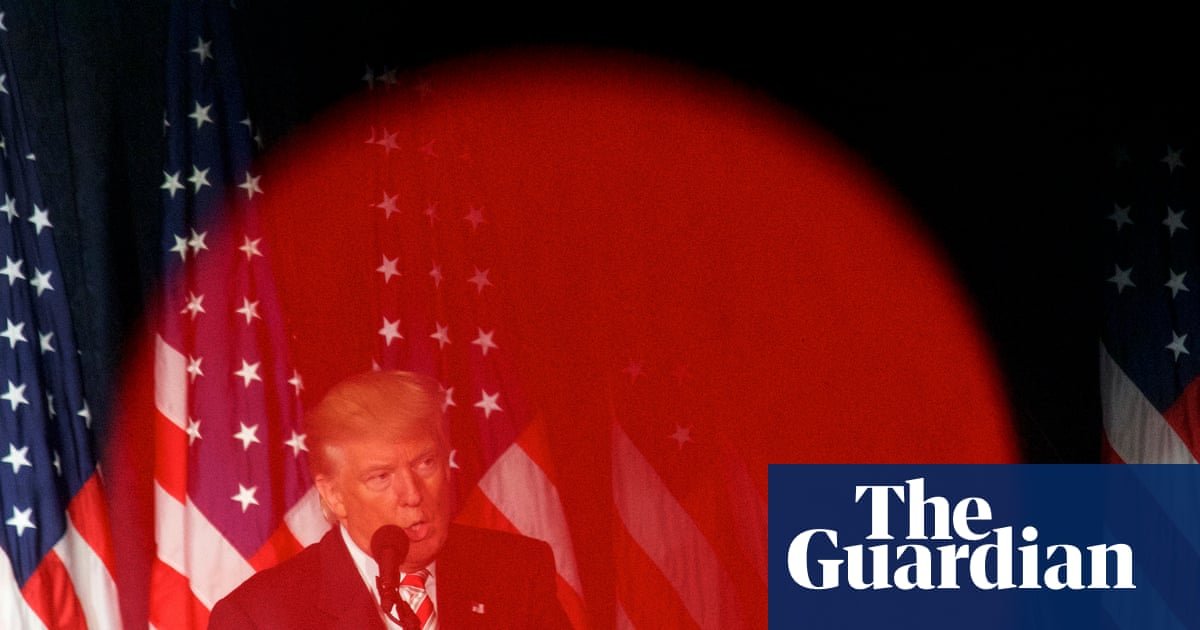
Leading the charge against the new reds-under-the-bed is Donald Trump. “Together, we will defeat communism,” Trump promised in his recent TV ads.
Trump’s supporters might be surprised to discover that the United States is, indeed, sliding in the direction of a command and control economy. But the state takeover of the means of production is not being driven by the left. The grab for the US’s productive resources is the project of none other than Trump – who, it’s a fair guess, has never read Lenin.
The latest evidence comes in data crunched by the V-Dem project in Sweden, which measures the erosion of democracy around the world. It built a scale to gauge “state ownership of the economy”. As noted by Cullen Hendrix from the Peterson Institute for International Economics, from 2002 to 2024, the US ranked among the four countries with the least state control. In 2025, the first year of Trump’s second term, it dropped from second place to 16th.
By November of last year, the Trump administration had spent more than $10bn taking stakes in companies he deemed essential for national security, from Intel to a range of ventures mining for critical minerals. It also acquired an option to take a stake in Westinghouse, which makes nuclear reactors. And it blackmailed Nippon Steel into granting Trump’s Washington a “golden share” in exchange for the go-ahead to purchase US Steel.
To be fair, Trump’s acquisitiveness notwithstanding, the US is not even close to flirting with the flavor of socialism favored by the Soviet Union and its satellites in the second half of the 20th century. By the V-Dem accounting, Washington’s stake in the economy is still smaller than in 163 countries.
Government-run companies are a standard feature in many market economies. The Norwegian government has a majority stake in its massive oil company, which puts the country in 18th place. Even “communist” countries are pretty capitalist: private companies contribute 60% of China’s GDP.
And in a geopolitical landscape shaped by competition with China, there is a reasonable case to be made for Washington to take equity stakes in industries that are critical for American leadership and security, and which might not develop autonomously in competition with rivals heavily subsidized by Beijing.
Yet Trump’s wanton lunge for private assets lacks the discipline required for this kind of strategic positioning.
The president’s statist leanings mark a dramatic break with the market-focused presidencies of his recent predecessors, Democrat and Republican. The question is, what motivates him? His appetites are embedded in a body of thought that is skeptical, if not outright hostile, towards essential building blocks of the global market economy. He has pushed back against globalization since his first term in office, seemingly drawn to the Marxist-inspired dependency theory, which washed across Latin America in the 1960s and 1970s proposing protectionism and state industrial policy as a path to economic development.
His lust to control the economy is there for all to see. Though the supreme court already slapped down his attempt to take over trade policy from Congress, he is still threatening to “STOP TRADING WITH COUNTRIES WITH WHICH WE HAVE A DEFICIT”. His promise to give $5,000 to every American if Republicans maintain control of Congress in November’s elections underscores how he views the state’s coffers as his private piggy bank. Even his commie-bashing ads were paid for by taxpayer dollars.
Still, he clearly has no interest in the dictatorship of the proletariat, caring little if at all for the fate of the downtrodden. His preferred flavor of redistribution takes from those on the bottom to give to those on the top.
If anything, Trump reminds us that socialism is not the only ideological justification for state projects to take control over resources and wealth.
Watching the US president bow to Xi Jinping last week, it’s tempting to think that Trump wants to emulate China’s leader. Xi gets to rule unimpeded over more than one billion Chinese. He gets to shape China’s society and economy at will – purging this rival, raising that sycophant to power.
But Xi’s China is too disciplined for Trump. The Chinese leader still relies on hordes of technocrats to execute a coherent strategy aimed to achieve technological superiority. The US president doesn’t have the attention span for this kind of thing.
Rather, Trump’s model might be Vladimir Putin, who rules Russia like a fiefdom. Or maybe one of those dictators the US used to support in Latin America during the cold war: Haiti’s Papa Doc Duvalier or Anastasio Somoza in Nicaragua, who saw government as a tool to enrich their families and cement dynasties in power. If nothing else, Trump’s dealings with crypto suggest he views his administration as a road to family riches.
Karl Marx may not be Trump’s guiding light. But his writings can help understand Trump’s place in history. Marx proposes that his tome The 18th Brumaire of Louis Bonaparte, about the 1851 coup that brought Louis-Napoléon Bonaparte to power in France, was meant to “demonstrate how the class struggle in France created circumstances and relationships that made it possible for a grotesque mediocrity to play a hero’s part”.
Americans may be grateful that their most recent class struggles didn’t produce a homegrown Lenin. But they did deliver Donald Trump.
Perhaps this does not condemn the US to an autocratic future. Hendrix points out that while Trump “clearly wants to be king”, the US’s political economy may not let him. Putin managed to establish autocratic rule over a fairly primitive, oil-based economy. This kind of control “is much harder to achieve in a modern complex economy” such as that of the United States, Hendrix noted. You can’t simply seize the oil to run the place.
Though Trump may fail, Americans’ acquiescence as he grabs for power raises a question for those who freak out over Mamdani’s city-run bodegas: why is Trump’s lurch to take over the American economy any better than what they hear from the Democratic Socialists of America?
Eduardo Porter is a journalist focused on economics and politics. He writes the newsletter Being There on Substack
