





Hello and welcome to Regions Calling, your guide to developments from beyond the Russian capital by The Moscow Times.
Nearly a month on, Russians are still reeling from fuel shortages triggered by Ukrainian attacks on Russia’s energy infrastructure.
Though fuel availability varies widely from region to region, the ripple effects of the crisis can still be felt even in areas where shuttered gas stations have reopened. Meanwhile, people are reporting rising food and transportation costs driven by the shortages and small farmers are sounding the alarm about the future of their farms.
To gauge the trajectory of the ongoing crisis, we are zooming in on the republic of Bashkortostan, the country’s leading producer of diesel fuel and gasoline.
But first, the latest news:
The Headlines
- Two business owners from the republic of Sakha (Yakutia) are facing backlash after posting photos from a trophy hunt in South Africa in which they killed a male and female lion, with critics saying that the trip violated the hunting code of the republic’s Indigenous people.
“Any Sakha knows that killing an animal for anything other than food is a grave sin,” Sakha blogger Daina wrote. Residents are calling for a boycott of businesses owned by the couple.
- At least 630 dead dolphins have washed ashore in the southern Krasnodar region in the first half of 2026, according to data published by the local dolphin rescue center Delfacenter. The number equals the combined total for 2025 and 2024, which were two of the deadliest years on record, according to volunteers.
Experts cited acoustic stress from underwater explosions, sonar and military vessels as potential causes of internal injuries.
- Authorities in the Novosibirsk region, located over 2,500 kilometers (1,500 miles) from Russia’s border with Ukraine, issued their first-ever drone threat alert on Monday, in the latest signal that Ukrainian drone attacks can reach as far as Siberia.
Earlier the same day, a Ukrainian drone strike targeted Russia’s largest oil refinery in the neighboring Omsk region.
- The Siberian republic of Buryatia has increased the one-time monetary reward for signing a contract with the Russian army by 500,000 rubles ($6,500), bringing the total sign-up bonus to 2.1 million rubles ($27,500). Buryatia’s 2026 draft budget allocates 2.4 billion rubles ($31.5 million) for recruitment payments, suggesting that authorities plan to enlist about 1,600 new contract soldiers.
One of Russia’s poorest regions, Buryatia has suffered disproportionately high military losses in the war in Ukraine. - Authorities in Siberia’s Krasnoyarsk region are investigating a large oil spill on the Yenisei River after residents of the region’s capital Krasnoyarsk complained of an iridescent slick stretching across the water and a strong gasoline smell.
The Yenisei River, which originates in Mongolia, is one of the three major Siberian rivers emptying into the Arctic Ocean.
The Spotlight
Situated on the southern slopes of the Ural Mountains, Bashkortostan, Russia’s most populous ethnic republic, is the country’s leading producer of diesel fuel and gasoline.
The republic’s four refineries boast a combined annual capacity of 34.1 million metric tons, more than any other region in Russia. But not even this refining powerhouse has been able to weather the nationwide fuel crisis.
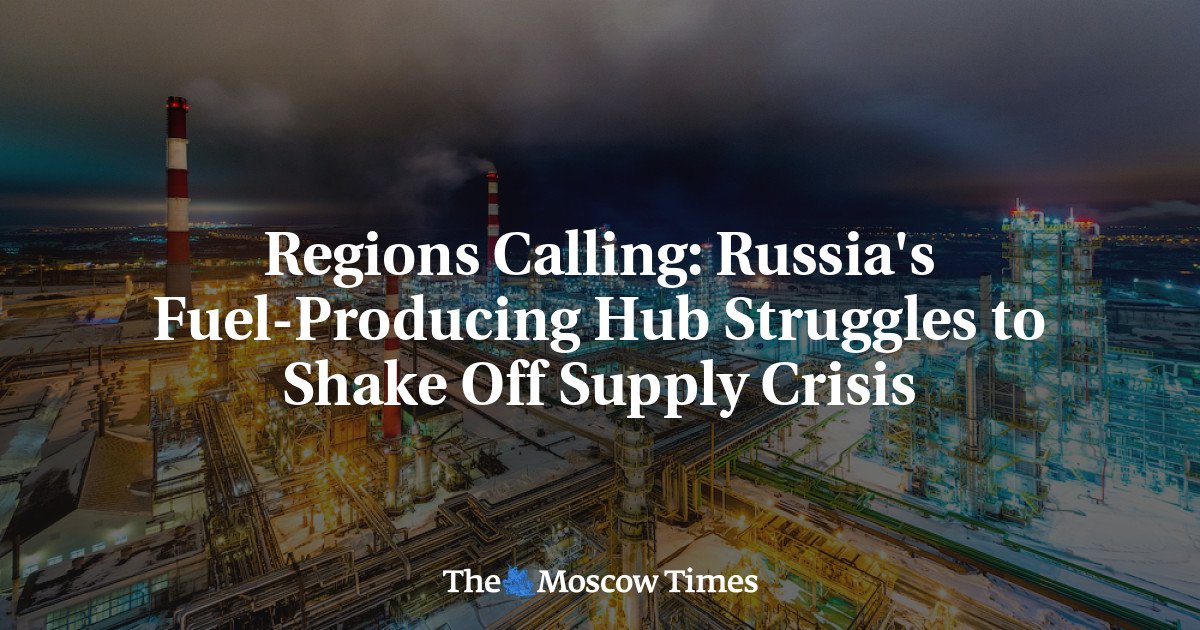
In the republic’s capital Ufa, whose skyline is dominated by the brightly lit towers and pipes of oil refineries, people waited in line for hours to buy gasoline, with purchases rationed at 30 liters per customer. Many gas stations were forced to close altogether.
“The issue isn’t that there is no fuel, but rather that [the government] failed to address logistics and planning for timely delivery to all consumers,” an economist from Bashkortostan told RFE/RL’s Volga-Ural service Idel.Realii.
Last month’s shutdown of a Gazprom Neft-operated refinery in southeast Moscow following a major Ukrainian drone attack triggered fuel shortages in the capital in addition to the already struggling annexed Crimea.
“Instead of promptly using strategic reserves, [authorities] began shipping fuel from all over Russia to Moscow, diverting regional supplies to the capital, which triggered shortages in the regions,” the expert said, speaking anonymously due to Idel.Realii being labeled an “undesirable” organization by Russia.
“The reserves have finally been released, but it will take time for the situation to calm down,” they added.
Bashkortostan’s Deputy Prime Minister Alexander Sheldyayev also confirmed that the republic was tasked with “ensuring energy security of the entire country.”
The republic has been supplying “neighboring regions” with fuel, he said, which in turn caused shortages at home despite Bashkortostan’s refineries “showing 10% year on year growth in output.”
Authorities said lines at Ufa’s gas stations were up to 800 cars long at their peak.
By Monday, this number had dropped to an estimated 170, “meaning five to seven cars per gas station,” Bashkortostan’s Deputy Trade and Energy Minister Oleg Tyshenko said.
Hundreds of kilometers south of Ufa, in the republic’s mountainous and predominantly rural districts, gas stations are starting to reopen after being shuttered for weeks, according to The Moscow Times’ sources.
Though fuel is back, locals said they have noticed that prices for basic goods in village stores have risen.
Russian trucking companies have already warned customers of higher shipping costs and delivery delays caused by the fuel crisis, while some smaller carriers have suspended interregional operations.
Higher transport costs are also bad news for Russian farmers, who rely on external shipping providers to move grain to storage facilities and ports.
Road freight rates for grain have already increased by an average of 20-30%, according to analysts cited by the Kommersant newspaper.
The start of the harvest season in southern Russia has been delayed by up to two weeks this year. However, experts say a cold spring followed by prolonged rains was the primary cause rather than the fuel crisis, Kommersant reported.
“There is a minimal delay due to the slightly later development of plants…A fundamental weeks-long delay specifically because of diesel shortage is extremely unlikely,” said Andrei Sizov, managing director of agricultural research firm SovEcon.
“It is extremely unlikely that [any farmers] are approaching this key stage of the [crop period] with zero fuel reserves…It usually takes months to prepare for harvesting: equipment, vehicles, people, spare parts, fuel,” Sizov said in a Telegram post.
While large agricultural producers can rely on stockpiled fuel to complete the harvest, the same cannot be said for smaller farms, whose owners are forced to buy diesel at exorbitant prices.
Supernova+ / Telegram
In the southern Krasnodar region, an agricultural hub where shortages remain widespread, additional fuel costs for farmers this year could reach approximately 14 billion rubles ($184 million), according to the regional farmers’ association People’s Farmer of Kuban.
In Bashkortostan, the crisis could threaten farms trying to preserve rare indigenous agricultural practices.
“For now, I’m living on [fuel] supplies that I managed to buy in winter, thank God. But then the forage harvesting will start [and if] there is no diesel fuel, that will be it. I still don’t understand what to do next,” farmer Sagitzyan Idiyatullin told regional news outlet UFA1.RU.
Idiyatullin, who breeds world-famous Bashkir horses at his livestock farm, became a local celebrity after 1,500 of his purebred horses appeared in a music video by the viral Bashkir folk band Ay Yola.
He said his farm would have to spend around 100,000 rubles ($1,300) per day on fuel once the reserves run out, with one metric ton of diesel costing 130,000 rubles ($1,700) compared to 55,000 rubles ($700) last winter.
“There is no way we can afford diesel. When the price approaches 100,000, agriculture stops being profitable,” said Idiyatullin. “A kilogram of meat should have cost 1,000 rubles [$13] a long time ago. But I understand: if we raise the price to that level, no one will buy it. The meat will turn to gold.”
Bashkortostan’s Agriculture Ministry previously acknowledged that local farmers are likely to face fuel procurement problems this summer. It said it is now in talks with regional oil giant Bashneft to increase monthly retail fuel quotas for farmers to 4,000 metric tons.
With nationwide elections approaching, the economist interviewed by Idel.Realii said authorities are likely preparing to work overtime to ensure that farmers are supplied with enough fuel at a more or less favorable rate.
“As a general rule, rural voters support the current government, so I believe that there will be fuel for agricultural work,” said the expert.
The authorities themselves echoed that sentiment.
“We’ll begin harvesting in about three weeks,” said Bashkortostan’s Deputy Agriculture Minister Ramil Nuriakhmetov. “We’ll do our best to ensure our farmers have fuel and lubricants during the harvest.”
Photo of the Week
A woman places a floral wreath on the water during government-backed celebrations of Kupala Night, an ancient Slavic summer festival, in Zelenodolsk, republic of Tatarstan, on Saturday.
Coinciding with the East Slavic feast of St. John’s Eve, the holiday is traditionally celebrated on the summer solstice in eastern Europe, but Russia and Belarus observe it on the night of July 6-7 following the Julian calendar.
A Message from The Moscow Times:
Dear readers,
We are facing unprecedented challenges. Russia’s Prosecutor General’s Office has designated The Moscow Times as an “undesirable” organization, criminalizing our work and putting our staff at risk of prosecution. This follows our earlier unjust labeling as a “foreign agent.”
These actions are direct attempts to silence independent journalism in Russia. The authorities claim our work “discredits the decisions of the Russian leadership.” We see things differently: we strive to provide accurate, unbiased reporting on Russia.
We, the journalists of The Moscow Times, refuse to be silenced. But to continue our work, we need your help.
Your support, no matter how small, makes a world of difference. If you can, please support us monthly starting from just $2. It’s quick to set up, and every contribution makes a significant impact.
By supporting The Moscow Times, you’re defending open, independent journalism in the face of repression. Thank you for standing with us.
Continue
Not ready to support today?
Remind me later.
×
Remind me next month
Thank you! Your reminder is set.


