



Hello and welcome to Regions Calling, your guide to developments from beyond the Russian capital by The Moscow Times.
This week, we are zooming in on the Siberian republic of Altai to explore how life there has changed one year since historic protests against a Kremlin-backed local government reform.
But first, the latest news:
The Headlines
- At least 24 Russian regions, including the central Novgorod region, the Siberian Krasnoyarsk region and the Far East Kamchatka region, have introduced rationing measures at local gas stations amid Ukrainian attacks on oil refineries. Fuel prices rose across 73 regions over the past week, led by a 3.2% spike in the republic of Tyva.
- The governor of the southern Krasnodar region, home to Russia’s Black Sea resorts, ordered an indefinite ban on out-of-region travel for his deputies and heads of regional ministries, districts and towns except for business trips.“Given the challenges we face today, we must all work in a heightened state of readiness…Residents and tourists will be able to relax [this summer] and we will ensure their safety,” Governor Veniamin Kondratyev was quoted as saying.
- In a first for Russia, dozens of small businesses in the North Caucasus republic of Dagestan have been fined for publicly sharing information about their Instagram accounts. Russia has banned Instagram’s parent company Meta as an “extremist” organization since March 2022.
- Members of the Russian Academy of Sciences’ Institute of Ethnology and Anthropology have backed Indigenous Shore people as they seek to halt a new resort development on the Mustag mountain in Siberia’s Kemerovo region. The ethnographers called the mountain’s sacred meaning for Indigenous Shores “an indisputable scientific fact” and suggested the site should be legally protected from development.
- In the Siberian city of Irkutsk, parents and activists launched a social media campaign to boost enrollment of incoming first-grade students at the region’s first school to offer Buryat language and culture lessons. Though local authorities earlier vowed to support the teaching of Buryat, the language of the region’s Indigenous Mongolic ethnic group of the same name, parents said school administrators introduced an array of bureaucratic obstacles that threatened the program’s launch. Most recently, the officials said they must receive applications from at least 25 first-grade students by the end of the month before the pilot program can proceed.
The Spotlight
One Year Since Historic Protests, Altai’s Future Is in Jeopardy
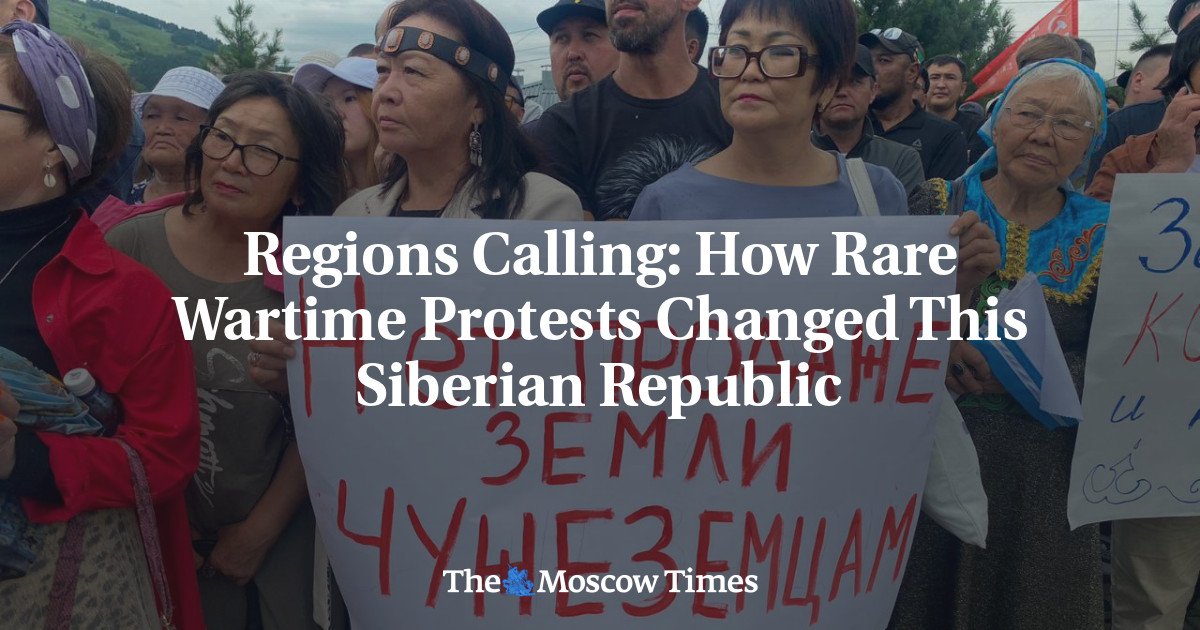
Russia’s republic of Altai, a mountainous Siberian region the size of Portugal with just 210,000 inhabitants, made headlines last June when it was rocked by protests against a municipal self-governance reform.
In a country where even the smallest public gatherings are effectively banned under a wartime crackdown, the Altai protests were a historic event for the republic, with nearly 2% of its population rallying in the capital Gorno-Altaysk at their peak.
Yet one year later, it is clear that the protests failed to protect Altaians’ historic lands against political and economic encroachment from Moscow.
Though the protests centered on the Kremlin-backed reform abolishing local government bodies in rural communities, they also exposed deep-rooted fears of a possible merger with the neighboring Altai region and a loss of Indigenous lands due to the influx of Kremlin-backed tycoons.
The full complexity of these grievances shone through in the speeches and social media posts of local human rights activist Aruna Arna, an ally of widely polarizing opposition figure Svetlana Lada-Rus.
Arna, 40, was the star speaker of the large June 21, 2025, rally in Gorno-Altaysk, where she proclaimed residents’ fight against the controversial reform “the final battle” and called for the resignation of the republic’s Kremlin-appointed head Andrei Turchak.
Arna and fellow activist and lawyer Dmitriy Todoshev challenged the municipal reform bill, which was hastily passed by the local parliament shortly after the rally, in Altai’s highest court.
After the court dismissed the activists’ appeal last August, Arna accused Turchak of violating Altai’s constitution by failing to take his oath of office in Southern Altai, the republic’s second official language.
That same month, state financial watchdog Rosfinmonitoring added Arna to its register of “terrorists and extremists.”
She was soon arrested and charged with inciting terrorism for sharing videos set to well-known socialist anthems “Varshavyanka” and “The Internationale” on her Telegram channel. Neither of the songs is banned in Russia.
This month, Arna, a mother of three, was sentenced to five years in prison.
“Five years! They [Russian judges] give less for killing a person. What is happening in our country?!” Arna wrote in a letter from a pre-trial detention center last week. “I consider this ruling unlawful, outrageous and, of course, cannot simply let it be.”
The protests in Altai, which began with a localized blockade of the region’s key highway on June 12 and culminated with a 4,000-people-strong rally in the capital, have fizzled out after Arna’s arrest.
SOTAvision
By November 2025, a rally organized by Communist Party supporters in the small village of Ust-Kan drew just a few dozen people, marking a bittersweet finale to the Altaians’ seemingly futile resistance.
In May, President Vladimir Putin greenlighted construction of a special gambling zone, a project that had been fiercely opposed by last year’s protesters.
The casino complex will be developed by Sberbank, the country’s biggest lender which also owns the nearby mountain resort of Manzherok.
Authorities claim that the casino will bring upwards of 300 million rubles ($4 million) to the republic’s budget, while locals say that the project will exacerbate social problems associated with gambling addiction.
Casinos aside, many residents also view the growing presence of large outside investors like Sberbank as a direct threat to the traditional livelihoods of Altaians, more than 70% of whom live in rural areas and primarily subsist on farming and animal herding.
The influx of Moscow investors means that every inch of land used by Altaian farmers is becoming more expensive every year, accessible grazing lands are shrinking and land grabs by new arrivals are becoming more common.
@this_is_Barnaul / Telegram
Properties in Gorno-Altaysk, the republic’s only city, are already out of reach for locals. According to Sberbank data, apartment prices increased by 9.2% per square meter over the past year, pushing the median price to 12.4 million rubles ($172,500).
For comparison, local agricultural workers’ salaries are the lowest in Siberia at a monthly average of just 42,700 rubles ($590).
Some opponents of the municipal reform argued that retaining local government bodies in rural communities could create additional obstacles for tycoons eager to profit off of the republic’s UNESCO-inscribed landscapes.
Although the reform is now fully implemented, not all in the region have lost hope.
“My dear Altaian land, I fearlessly defended you and your people! I know that there is a great, strong spirit inside us. It is time for it to wake up,” activist Arna said in her latest letter.
“And everyone should understand, it is impossible to hide your head in the sand for your whole life.”
Photo of the Week
An animal rescue team in Russia’s Far East Sakhalin region used a remotely administered anesthetic injection to save an injured Steller sea lion. Lentochka, as she was later nicknamed by volunteers, was spotted with her head tightly wrapped in a plastic band among hundreds of sea lions that gather on the local breakwater structure every year in the coastal town of Nevelsk.
For the first time in Sakhalin’s history, rescuers received permission to immobilize a wild animal to save it from plastic by firing a dart with an anesthetic. Rescuers removed the plastic ring from Lentochka’s head, administered a reversal agent and then monitored the animal until its full recovery and a safe return to the water.
A Message from The Moscow Times:
Dear readers,
We are facing unprecedented challenges. Russia’s Prosecutor General’s Office has designated The Moscow Times as an “undesirable” organization, criminalizing our work and putting our staff at risk of prosecution. This follows our earlier unjust labeling as a “foreign agent.”
These actions are direct attempts to silence independent journalism in Russia. The authorities claim our work “discredits the decisions of the Russian leadership.” We see things differently: we strive to provide accurate, unbiased reporting on Russia.
We, the journalists of The Moscow Times, refuse to be silenced. But to continue our work, we need your help.
Your support, no matter how small, makes a world of difference. If you can, please support us monthly starting from just $2. It’s quick to set up, and every contribution makes a significant impact.
By supporting The Moscow Times, you’re defending open, independent journalism in the face of repression. Thank you for standing with us.
Continue
Not ready to support today?
Remind me later.
×
Remind me next month
Thank you! Your reminder is set.


