



Long before the day’s catch reaches markets, it has often already made its way to millions of phone screens. A silver stream of anchovies; starfish in a single-file formation; an arrangement of squids, big and small; brimming baskets of seer fish and mackerels; an occasional massive lobster. From celebrations aboard trawlers, frenzied auctions on shore to simple meals cooked at sea, these are the everyday sights and sounds that fishermen-turned-content creators share with their millions of followers.
Some days it’s a clever fishing hack. Other days, it’s a mesmerising marine species spotted in the deep or a sudden bountiful haul. By documenting their raw, unfiltered lives at sea, creators from Tamil Nadu, such as Ungal Meenavan (Your fisherman; 1.3m subscribers), Thoothukudi Meenavan (Fisherman of Thoothukudi; 1.7m subscribers), Fisherman Voice (2,32,000 subscribers) and Colachel Meenavan (Fisherman of Colachel; 79,600 followers) are reeling in followers on YouTube and Instagram.
Ungal Meenavan is run by K Kingston, 36, from Mookkaiyur in Tamil Nadu. His most viral video from 2019 with 3.5 million views on YouTube shows about 50 fishermen, breaking into Tamil sea songs as they heave a five-tonne catch aboard. Another showcases how fishermen chance upon different species of conch shells, such as sangu mullu (Murex aduncospinosus), a poisonous gastropod or the beautiful, striped pillaiyar sangu (Turbinella pyrum) that the locals believe resembles the face of Ganesha. In yet another video with 4.3 million views, Thoothukudi Meenavan, run by M Sakthivel, shows how the fishing crew sleeps on the boat, huddled together on tarpaulin sheets, until their catch is ready to be hauled at dawn.
Kingston says the idea for a channel came from a simple realisation: the rest of the world knew very little about life at sea. These were the experiences he had begun gathering ever since he first ventured into the waves at 14. He would hop on trawler boats with 15 to 20 others at midnight, toying with big trawling nets, to bring back the day’s catch. And every night out, he learned something new. How does one identify a valuable catch? Which fish should be left undisturbed in the deep seas, and what are the countless tricks needed to survive the arduous journey?
He began experimenting with short-format videos in 2019, when he bought himself his first smartphone. A video of having caught a shark, weighing no more than a kilogram, set to peppy music, surprisingly garnered 10,00,000 views within a day. Since then, he has posted almost every day, particularly during the pandemic, when followers flocked to his page to seek a glimpse of a life lived largely at sea. “I didn’t quite understand at first why people were so fascinated by something that felt so ordinary to us,” recalls Kingston, laughing.
His videos, packed with information about starfish regenerating lost limbs or survival techniques fishermen use to prevent boats from capsizing during extreme weather, became an alternate source of income, eventually helping him expand his fish sales out of his town and across the state.
The comments on these videos are warm and encouraging, with some calling them “real heroes” for their courage and perseverance. “Watching this video makes me feel like we are out at sea,” a viewer writes. Others say they turn to these videos with calming visuals and music to unwind after a long day.
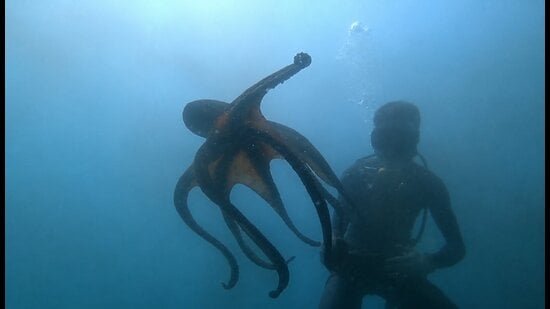
About 200 kilometres away, in Tuticorin, Thoothukudi Meenavan’s Sakthivel, 35, offers a rare glimpse of the breathtaking underwater world. Hailing from a family of pearl divers and conch divers, he dives as deep as 150 ft below water, without oxygen cylinders or other modern equipment, to catch fish such as cuttlefish and octopus using traditional spears.
“We create our own apparatus, such as precisely sharpened arrows and aluminium plates we tie to our feet to walk along the uneven sea bed,” he says. Now armed with a GoPro camera as well, he documents colourful marine life such as corals and giant octopuses that lie beneath the waves.
His father, a pearl diver, first took him on his first dive at the age of five. Once commercial pearl diving in the Gulf of Mannar was banned in the 1960s, the family switched to deep-sea fishing. But even this is a dying practice as big trawler boats offer better convenience and bigger yield. The channel is an attempt to document fishing traditions and a way of life that he fears could completely disappear one day. Many in his hometown refer to his videos as their “nature documentaries”. “When people say that my videos look like the ones that they once watched on the Discovery Channel, it makes me very happy,” he says.
Fisherman Voice on YouTube, run by Rameswaram’s Anton Dheena, 36, is a window into how the fishing community eats on long sea voyages, when resources are scarce. He documents recipes such as the pazhaya kanji or a gruel made of fermented rice with raw or roasted fish without any spices. The simple dish, with basic ingredients, is such a draw among the local community that he has since set up a restaurant that serves the dish as well.
His videos showcase traditional seafood dishes and day-in-the-life vlogs from the coast as well as traditional fish preservation techniques that have been passed down through generations. For instance, unlike standard sun-drying, Rameswaram’s coastal villages practice Pattarai Karuvadu (or dry fish in pits), where varieties such as kingfish and mackerel are seasoned with salt and turmeric, wrapped in mats and buried in sand for 10 days, where they gradually dehydrate and cure.
Many of these videos are intriguing depictions of fishing ingenuity, revealing techniques rarely seen outside coastal communities. Sometimes they use palm fronds to startle fish or construct birdcage-like devices to trap them more effectively. “I feel proud that consumers are now more aware of the realities of fishing in coastal communities,” Dheena says. It makes them more conscious about what they choose to buy and when.
The fishermen have also branched out beyond content, having set up seafood businesses and restaurants. “Content creation is only sustainable if one is willing to constantly reinvent themselves,” says Sakthivel, who now also produces family skits and daily vlogs. Kingston, meanwhile, has four seafood stalls that are set to launch this year. “I just want my business to find its legs, and then of course, I return to the sea.”


