



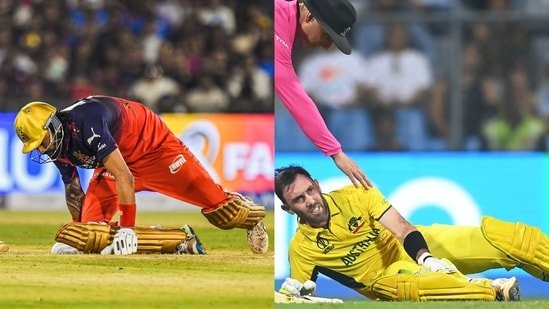
Krunal Pandya lay flat on the pitch in Raipur, body locked in cramps, breath heavy, legs refusing command, and Royal Challengers Bengaluru’s chase still alive by a thread.
The frame carried cricket memory back to Wankhede in 2023, when Glenn Maxwell stood on ruined legs against Afghanistan and dragged Australia from a World Cup grave. Raipur did not produce another Maxwell 201. It produced a smaller but rawer, IPL-shaped echo of the same impossible image: a batter trapped inside a failing body, still swinging hard enough to bend the match.
The night Maxwell turned pain into folklore
Maxwell’s 201* against Afghanistan already belongs to cricket’s permanent theatre.
Australia were 91/7 chasing 292 in a World Cup match. Afghanistan had the game in their hands. The chase had collapsed. Pat Cummins walked in with the primary job of surviving. Maxwell’s body then began to betray him. Calf, shin, hamstring, toes, back. Every part seemed to rebel.
From that point, the innings stopped looking like conventional batting. Maxwell could barely move into position. Running became a negotiation with pain. Footwork disappeared. The bat became his only moving part.
He kept hitting.
Afghanistan bowled at a man who could barely run and watched him turn immobility into a weapon. Glenn Maxwell found arcs, cleared ropes, refused singles, and built an unbeaten 202-run stand with Cummins. The captain made 12 off 68 balls. The scorecard will always make that look small. In truth, Cummins became the wall that allowed Maxwell to become the storm.
Australia won by three wickets. Maxwell finished unbeaten on 201 off 128 balls. The innings carried Australia into the semi-finals and entered the strange class of sporting events that feel less remembered than witnessed.
Krunal’s Raipur night found its own pain language
Krunal’s 73 against the Mumbai Indians lived on a smaller canvas, but it carried a similar physical grammar.
RCB were chasing 167. The innings had already cracked by 39/3. Virat Kohli was gone for 0, Devdutt Padikkal had fallen, Rajat Patidar had gone early, and the Mumbai Indians had the opening they needed to keep their playoff hopes alive.
Krunal walked into that pressure and rebuilt the chase with a rare mix of control and violence. His innings had four fours and five sixes, but the numbers alone miss the theatre. The body began troubling him early. The physio came out. Stretching followed. The running grew harder.
Then Deepak Chahar struck him on the stomach with a slower ball that stayed low. Krunal Pandya went down. The discomfort deepened into a hamstring issue. The chase entered its final stretch with RCB needing his bat and Krunal needing his body to obey for just a few more minutes.
It did not.
He pulled a ball to deep square leg and could not run. Soon after, he was down again, flat on the pitch. The scene was uncomfortable and magnetic at once. A batter prone on the surface, legs gone, the crowd caught between concern and disbelief. Then he got up and slog-swept Ghazanfar for six.
That was the Maxwell frame. The ball disappeared. The body stayed broken, but the game moved.
One miracle, one echo, same brutal cricket image
Maxwell’s innings was a mountain. Krunal’s was a cliff-edge rescue.
The comparison works because cricket rarely gives the same visual twice with such force. A batter loses the ability to run, the fielding side knows it, the required runs keep pressing, and every delivery becomes a private war between pain and timing.
Maxwell took that image to its wildest end. He finished the chase himself. He turned 91/7 into one of the greatest ODI innings ever played. His unbeaten double hundred sits outside normal comparison.
Krunal gave RCB a version shaped by T20 urgency. He did not finish the match. He fell for 73 with RCB still needing 18 off 12. Tilak Varma’s boundary catch ended his innings and gave Mumbai another opening. Bhuvneshwar Kumar then struck the final blow with the six Krunal himself later called the shot of the match.
Still, Krunal had carried RCB from danger to striking distance. He had absorbed the early collapse, survived the body blow, fought through cramps in both legs, and left the chase close enough for one final act.
That is where the parallel sits. In the image. In the refusal. In the strange power of a batter who can no longer move freely, yet keeps deciding the match.
Raipur got its own wounded hero story
Great cricket innings often leave behind one number. Maxwell left 201*. Krunal left 73.
The better memory is visual.
Maxwell, almost statue-still at Wankhede, launching Afghanistan into disbelief. Cummins standing at the other end, guarding time itself.
Krunal, flat on the Raipur pitch, rising again, dragging his body into one more swing, sending the ball over the rope while Mumbai’s playoff hopes tightened after every delivery.
Maxwell’s knock became folklore because it defied the sport’s normal limits. Krunal’s knock will live differently, inside RCB’s season, inside that final-ball chase, inside the night Mumbai Indians were pushed out. It was not immortal in scale. It was unforgettable in texture.
A cramping batter turned a chase into a superhuman act. A wounded left-hander gave RCB enough oxygen to survive. A match that should have belonged to Mumbai’s late squeeze ended with Bengaluru stumbling, swinging, and somehow crossing the line.
Wankhede had its miracle. Raipur got its echo.


