



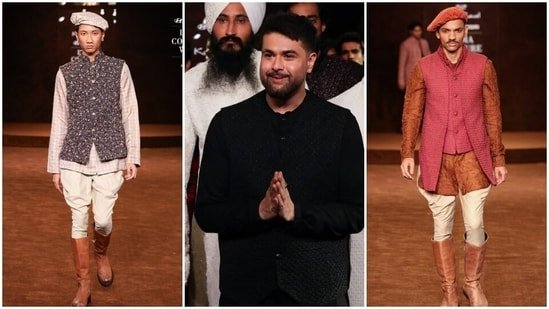
Fashion designer Kunal Rawal presented a contemporary take on desi couture with his most expansive menswear collection yet at FDCI presents 2026 India Couture Week. Called Rawalgarh, the collection – with over 140 looks – revisited the house’s earliest design codes through a contemporary lens, presenting silhouettes that included thoughtful tailoring, versatility, military-inspired pieces, and elements of androgyny, ranging from Indian Black Tie, occasionwear, eveningwear, and weddingwear.

After the show, in an interview with HT Lifestyle, Kunal Rawal opened up about ‘Rawalgarh’ – a tongue-in-cheek name he gave to his collection to create an imaginary world of beauty and menswear – the evolution of his design language, how androgyny plays a part in it, and more.
Here are the excerpts from the interview:
Rawalgarh introduces an AI-powered presentation at the beginning of the show. As technology increasingly finds its way into fashion, where do you personally draw the line between using AI as a creative tool and ensuring the human craft remains at the heart of couture?
I enjoy AI, but I am a big believer that AI cannot replace human craft or human talent. Even if we’ve used AI [in the video], we’ve got teams, departments, people who are using AI that really helps you shoot better. It helps; there are many advantages to technology and AI. Of course, there are many disadvantages as well. So you need to learn how to sort of use it, and that’s the phase we’re all in.
You’ve spoken about manipulating Indian textiles such as chikankari, Banarasi, Ikat, and more for this collection. How do you strike a balance between innovation and preserving the identity of these traditional crafts?
I am a big believer in contemporary occasion wear. We do contemporary fashion, I love tradition and traditional clothing, but it’s very important to contemporise it. I want to make crafts that people today want to wear, especially men. So that’s why we are working on so many exciting crafts, techniques, and cusps. [On the runway], you saw Banarasi with Bhandani, you saw Ikat with Chickankari. I just love mixing and matching things and having fun, and I take the contemporary side of our aesthetic and the brand to heart, trying not to hold myself back. I believe trial and error is the king of life.
When you revisited your archives for this collection, was there a moment or a design that made you realise how much your philosophy of menswear has evolved over the years?
To be honest, we have been pretty clear about the things we’ve been wanting to do, and it gives me great solace knowing that today, too, we want a lot of the things we wanted when we started off, and that shows vision, that shows that we’ve not danced around to make our way here. We’ve been clear about what we want to do and how we want to do it. That being said, I am a coming-of-age story. I’m continuously evolving. I’m continuously trying to get better; just post the show, I’m trying to find cues on how I could have done better. So, that’s me – I’m always going to be coming of age.
Do you think today’s Indian groom is finally becoming as experimental and fashion-conscious as the bride, or is there still a gap?
I believe men are having a blast with what they wear today. They’re enjoying what they wear, and that’s the way it should be. I believe in ‘You do you, live and let live.’ You like something, you must wear it. Why should somebody else tell you what to wear, what not to wear? So I think boys are enjoying what they wear. They are far clearer about what they want.
When I started, I was talking to the embroidery expert in the family – the aunt, the mother, the uncle, the father, or the brother. When I started this occasion wear brand, I did a study, and I asked a bunch of boys, and everybody said, “I like pop collars. I’m an Oxford guy. I love my blazers.” But when I asked, “What about Indian wear? What about occasion wear?” They often said, “Oh, that’s not my jam. Someone else decides.”
And that was something that really worked me up, because how can someone else decide? So, then the idea became – and I’ve been telling my store teams, too – talk to the guy, put the details in to excite the groom, talk to the groom, and it’s been such an amazing evolution. And today, we have grooms coming in with Pinterest boards, knowing the collection names, the concept names, and exactly what colour they want. They come in saying, “Listen, I saw this, and I would love to wear this colour.” And I’m like, “Wow.” I love customisation and personalising things.
Your work has consistently blurred the lines between traditionally masculine and feminine design codes. Do you think men’s wedding wear has evolved to embrace androgyny, or is it still largely confined to the runway and celebrity wardrobes?
Absolutely. It’s been a while. From the time I was in school, I remember getting these chart papers with people from different parts of India and their traditional attire. I think I was five or six, and from then, I wanted to wear all of it, the men’s wear, the women’s wear, all of it, but just do it in a way where it’s relevant to me – contemporise it. Make it a bit more aesthetically relevant because it felt textbooky. It felt ancient. It felt not relatable. But there was so much there that I could not wait to want to. So, I’ve always been androgynous in my choices. I take from my father’s wardrobe as much as I do from my mom’s. So, I enjoy myself, and I use my clothes to show it.


