



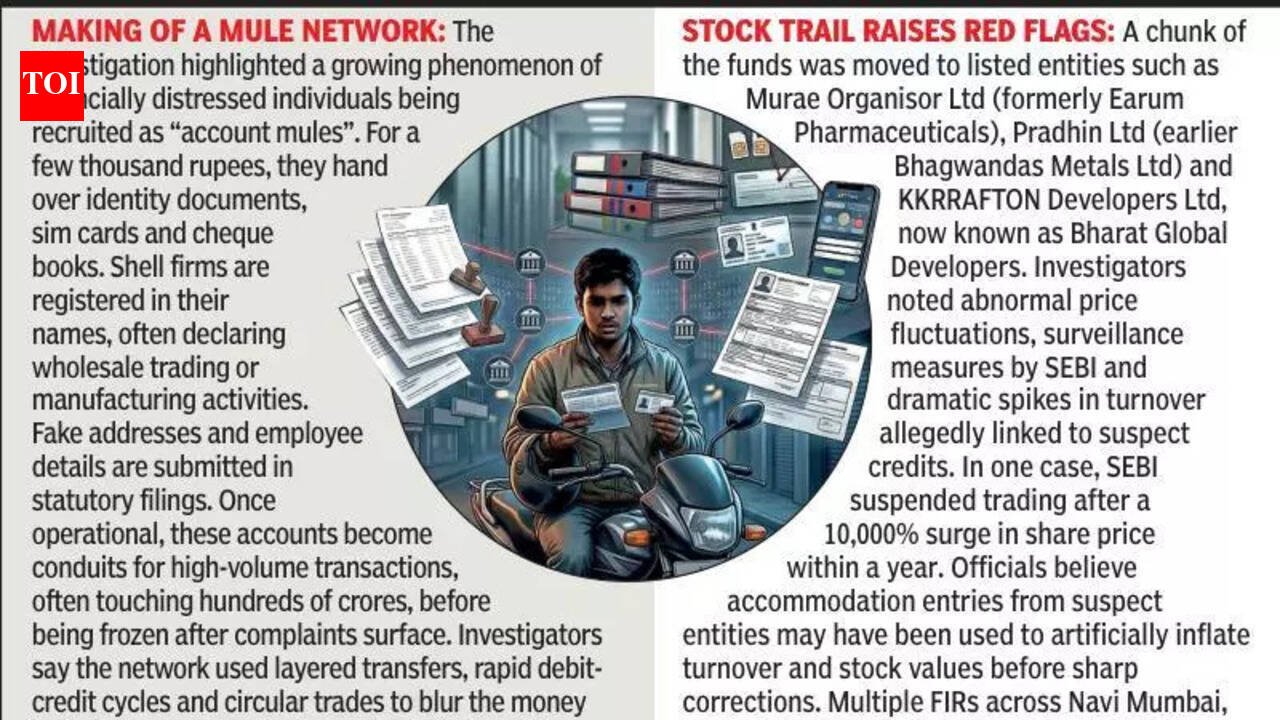
Ahmedabad: A 28-year-old Rapido bike driver earning barely Rs 10,000 to Rs 12,000 a month has emerged as a key player in a Rs 550 crore money laundering case, after the Enforcement Directorate (ED) alleged that his bank accounts were used to route illegal online betting proceeds and manipulate stock prices.The ED on Tuesday filed a criminal complaint with the Detection of Crime Branch (DCB), seeking registration of an FIR in connection with the alleged money laundering network. What began as a routine financial probe snowballed into what could be one of the most complex money trail investigations in Gujarat, exposing a web of bogus firms, rented identities and suspected stock price manipulation linked to illegal online betting proceeds.The complaint, filed by Hridesh Kumar, assistant director, ED Ahmedabad, details findings made under the Prevention of Money Laundering Act (PMLA) during searches connected to the “1xBet illegal betting racket”. In a communication dated Nov 27, 2025, the ED informed the Ahmedabad city police commissioner about its findings and sought registration of a criminal case under provisions of the Bharatiya Nyaya Sanhita (BNS), the IT Act and other relevant laws.At the centre of the probe is Pradip Od, a Rapido rider, whose bank accounts and a proprietorship firm — M/s Pradip Enterprises — were allegedly opened and operated by others using his PAN and Aadhaar details. In his statement recorded under Section 17 of the PMLA, Od claimed he was paid Rs 25,000 per account and Rs 400 for signing cheque leaves. He maintained that he had no control over the transactions carried out through the accounts.The ED alleges that three firms — Pradip Enterprises, Kamlesh Trading (in the name of Kamlesh Kumar Kalal) and Ronak Traders (in the name of Ronak Ramesh Od) — were floated in 2024 using forged KYC documents, dubious addresses and manipulated Udyam registrations. Investigators have pegged the combined credit and debit entries in these accounts at around Rs 550 crore within a year.According to the complaint, the accounts were allegedly used for layering and laundering proceeds of crime generated from illegal betting operations, circular trading to artificially inflate penny stocks, and meeting personal expenses. These included marriage-related payments of a Gandhidham-based businessman, Aditya Zula. Donations routed to crowdfunding platform Impact Guru also came under scrutiny during the probe.The alleged kingpin, Kiran Parmar alias Lala, is accused of controlling the operations. Others named in the complaint include Mahadev, Jugal, Ravi and Jeevraj, who allegedly played roles ranging from arranging sim cards and managing cheque books to supervise bank account activity.Acting on the ED’s complaint, the DCB police registered an FIR for forgery and use of forged documents, cheating and personation, criminal conspiracy, impersonation and identity theft under relevant provisions of the Bharatiya Nyaya Sanhita. Box 1: Stock trail raises red flagsA chunk of the funds was moved to listed entities such as Murae Organiser Ltd (formerly Eaurum Pharmaceuticals), Pradhin Ltd (earlier Bhagwandas Metals Ltd) and KKRRAFTON Developers Ltd, now known as Bharat Global Developers. Investigators noted abnormal price fluctuations, surveillance measures by SEBI and dramatic spikes in turnover allegedly linked to suspect credits. In one case, SEBI suspended trading after a 10,000% surge in share price within a year. Officials believe accommodation entries from suspect entities may have been used to artificially inflate turnover and stock values before sharp corrections. Multiple FIRs across Navi Mumbai, Ahmedabad, Gandhinagar and Bengaluru have already led to the freezing of bank accounts.Box 2: Making of a mule networkThe investigation highlighted a growing phenomenon of financially distressed individuals being recruited as “account mules”. For a few thousand rupees, they hand over identity documents, sim cards and cheque books. Shell firms are registered in their names, often declaring wholesale trading or manufacturing activities. Fake addresses and employee details are submitted in statutory filings. Once operational, these accounts become conduits for high-volume transactions, often touching hundreds of crores, before being frozen after complaints surface. Investigators say the network used layered transfers, rapid debit-credit cycles and circular trades to blur the money trail. In many cases, the named proprietors were unaware of the nature or scale of the transactions.


