



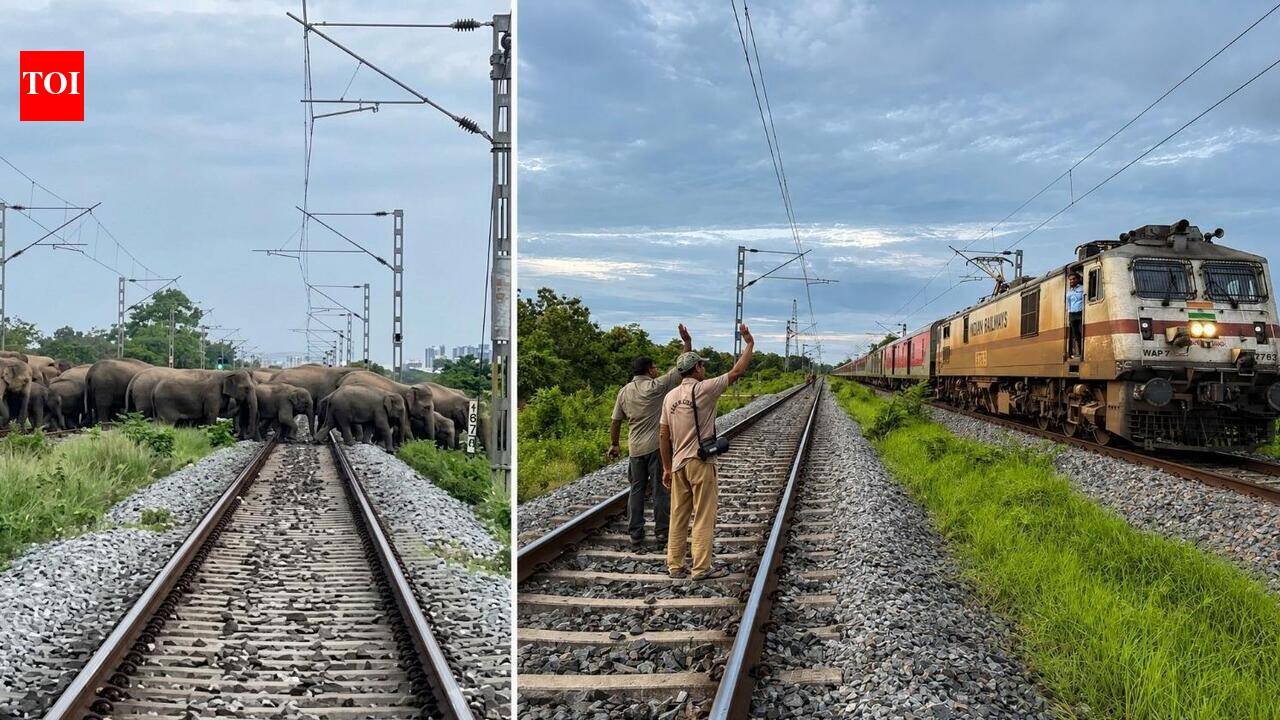
Guwahati: Dibrugarh-Delhi Rajdhani Express was stopped early on Wednesday, about 2 km from Habaipur railway station in Hojai district, to allow a herd of around 90 elephants, most of them calves, to cross the tracks safely. The herd was returning from West Karbi Anglong to Lumding Reserve Forest.Lanka forest range officer Manik Baruah told TOI that forest personnel were heading to Mylo, an elephant corridor, as part of their routine duty when they spotted the herd about 2 km from Habaipur station, towards the Guwahati end, at around 4.30-5 am.“We immediately informed the railways, but learnt that Rajdhani Express was approaching from the Dibrugarh side towards Guwahati. We divided the team into two. One team, led by forester-I Sashanka Roy, went to the spot and stopped Rajdhani, while the second team, led by me, took position about 100 metres away to stop any train approaching from the Guwahati end,” Baruah said.He said the railways also cooperated with the forest department to ensure the safe passage of the elephants.Baruah said the herd undertakes this seasonal movement during Aug-Sept and again in Jan. He added that there are three major elephant corridors under Lanka forest range.“The elephants travel from Lumding Reserve Forest to West Karbi Anglong around midnight, mainly in search of sugarcane in cultivated areas. They cross the railway tracks before returning to Lumding Reserve Forest in the early hours of the morning, again crossing the tracks. By the end of Jan, they move to Kumurakata forest. This is their annual routine,” he said.Baruah added that around 15 elephants are considered resident in Lumding Reserve Forest.“We call them resident elephants of the forest. They are familiar with train timings and cross the tracks when there is no train movement. However, forest personnel remain alert in the corridors to protect wildlife on the railway tracks,” he said.Northeast Frontier Railway chief public relations officer (CPRO) Kapinjal Kishore Sharma said the timely alert by forest department personnel, signals from the Intrusion Detection System (IDS) and speed restrictions imposed along the elephant corridor enabled Rajdhani Express to stop in time and allow the herd to pass safely.In a statement, Sharma said similar incidents were reported on Aug 15 and 16.“On Aug 15, the alertness of the loco pilot of Guwahati-Mariani Express enabled a herd of elephants to cross the track safely in the Lamsakhang-Patharkhola section. On Aug 16, the loco pilot of Narangi-Agartala Express took timely action to facilitate the safe passage of elephants in the Habaipur-Lamsakhang section,” he said.“These instances reflect the effective coordination between NFR and the forest department, along with the vigilance and sense of responsibility of railway running staff, in preventing elephant-train interactions and protecting wildlife in elephant corridors,” the CPRO said.He added that NFR had taken several measures to prevent elephant-train collisions in vulnerable areas. These included the deployment of an AI-based Intrusion Detection System using Distributed Acoustic System technology to provide real-time alerts on elephant movement near railway tracks.“Other preventive measures include night-time and temporary speed restrictions based on elephant sightings, enhanced patrolling, sensitisation of train crews, cautionary signage, vegetation clearance and real-time coordination with the forest department. The ‘Plan Bee’ system, which uses amplified honeybee sounds to deter elephants, has also been installed at vulnerable locations. NFR has further undertaken the construction of underpasses at identified locations to facilitate safer wildlife movement and keep elephants away from railway tracks,” he said.


