



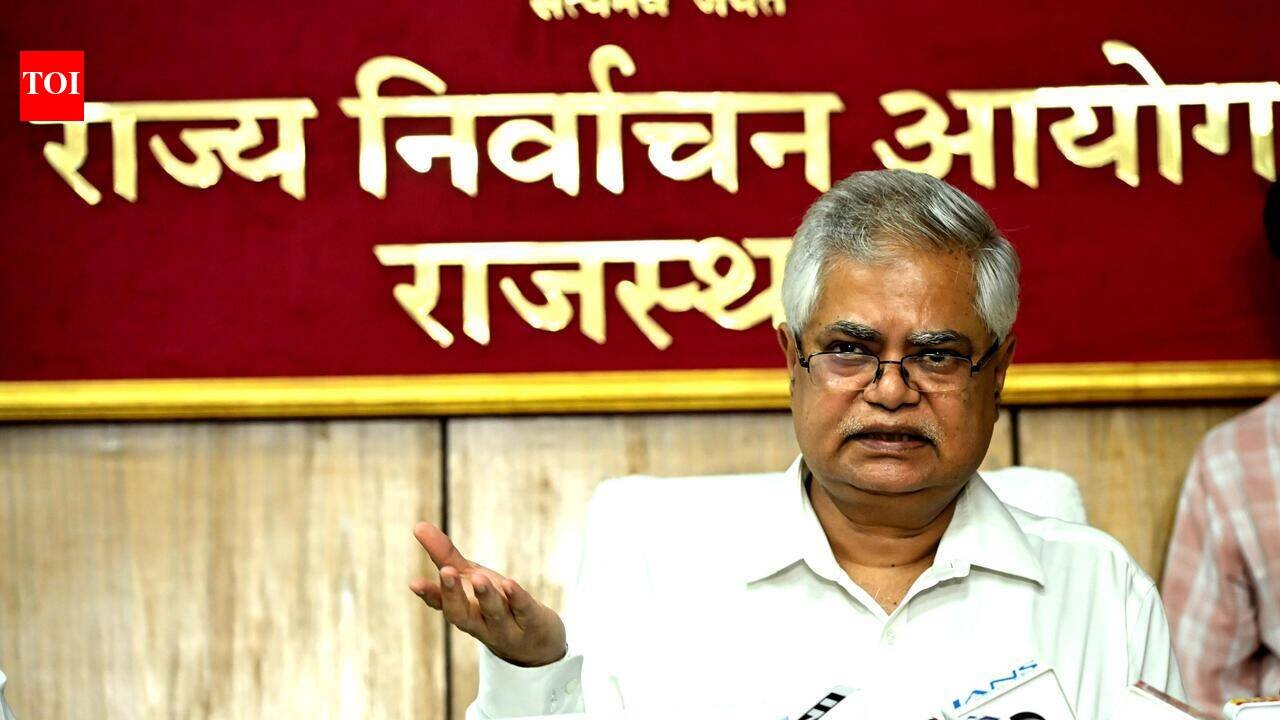
Jaipur: Elections to the state’s 309 urban local bodies will take place in two phases on Sept 9 and 11, state election commissioner Rajeshwar Singh announced Wednesday. Jaipur Municipal Corporation (JMC) will go to the polls in the second phase, while the remaining 18 urban local bodies in Jaipur district will vote in the first phase.Counting for all local bodies will be held on Sept 14.Singh said elections will be conducted for 10,245 councillor posts across 10 municipal corporations, 47 municipal councils and 252 municipalities. With the poll schedule announced, the model code of conduct has come into force in all 309 urban local bodies and will remain in effect until the election process concludes, restricting new development announcements in urban areas.The election notification will be issued on Aug 27. Nominations can be filed till Aug 31, while withdrawals will be allowed up to Sept 3. Once polling is over, elections for mayors, chairpersons and heads of urban local bodies will be held on Sept 21, followed by general meetings on Sept 22 for elections of deputy mayors, deputy chairpersons and municipal vice-presidents.Singh said over 1.4 crore voters are eligible to vote in the elections – 73.9 lakh men, 70 lakh women and 511 third-gender voters. JMC has the highest number of eligible voters at 24.2 lakh, while Indragarh municipality in Bundi district has the lowest number at 4,744.In terms of age, 29% of voters are in the age group of 36–50 years, 25.4% in the age group of 26–35 years, and 14.7% in the age group of 18–25 years.A total of 16,465 polling centres will be set up, with voting conducted through electronic voting machines (EVMs), Singh said.M-3A model EVMs of Election Commission of India will be used across Jaipur, Jodhpur, Alwar, Bharatpur and Kota, while EVMs from Rajasthan and Madhya Pradesh State Election Commissions will be used in the remaining 36 districts.The commission has also rolled out EVM-tracking software for online movement tracking and randomisation for polling-station allocation.Over 1.1 lakh personnel will be deployed for various election, counting-related and other duties, with two-tier training and randomised deployment.Security deployment for the elections is expected to include about 98,790 police personnel.Senior IAS and RAS officers will be appointed district-wise as observers to oversee key stages such as nomination scrutiny, withdrawals, polling and counting, Singh added.Addressing the delay in conducting local body elections, Singh attributed it to the OBC Commission’s late submission of the reservation report.He clarified that the postponement of the reservation lottery for Panchayati Raj institution polls was a state govt decision, and that inquiries regarding it should be directed at the govt. He added that the State Election Commission (SEC) will announce the schedule for these polls once the state govt completes the reservation lottery process.Regarding the ‘one state-one election’ concept, Singh said removing the one-year gap between Panchayati Raj and urban local body polls could help achieve the goal. “That is our interpretation of ‘one state-one election’. You are free to interpret it differently,” he said.On the model code of conduct (MCC) for the upcoming polls, Singh said any legislation proposed during this period would be reviewed by the SEC if necessary.The Polls In Facts & FiguresOver 1.4 crore voters are eligible to participate – 73.9 lakh men, 70 lakh women and 511 third-gender votersRandomised deployment of another 1.1 lakh personnel for various election, counting-related and other dutiesSenior IAS and RAS officers to be appointed district-wise as observers to oversee nomination scrutiny, withdrawals, polling and counting


