


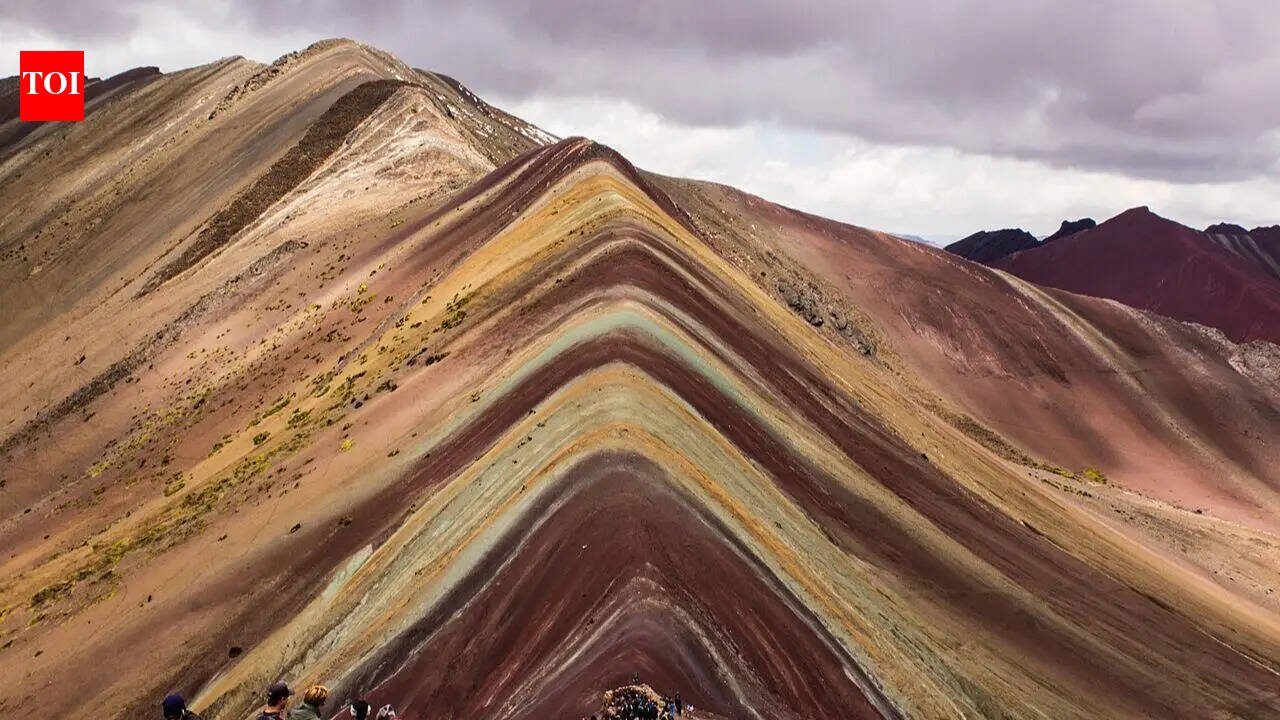
The first impression is usually confusion rather than awe. From a distance, the slopes look painted in bands that do not belong to ordinary rock formations, rust red beside ochre, pale green crossing into lavender-grey, streaks of yellow breaking through darker sediment. The colours appear too deliberate, almost artificial, especially against the thin mountain air of the Peruvian Andes.Yet the landscape is entirely geological. The mountain known as Vinicunca, often called Rainbow Mountain, sits high in the Cusco region of Peru at an altitude where weather changes quickly and walking becomes difficult after only a few steps. Tourist photographs tend to flatten the place into a bright postcard image, though the mountain itself is rough, exposed and colder than many visitors expect.
Hidden under snow for years: How Peru’s Rainbow Mountain finally revealed its colours
For much of recent history, the coloured layers remained concealed beneath snow and ice. The mountain only entered international travel conversations in the last decade, after glacial retreat gradually exposed the mineral bands beneath.As per information published by the official Vinicunca tourism platform, the mountain rises to more than 5,000 metres above sea level and forms part of the Vilcanota mountain range near Cusco. Routes to the summit pass through high-altitude valleys where alpacas and llamas are still common along grazing trails. The journey itself shapes how people experience the mountain. Vehicles can only travel part of the route, leaving visitors to continue on foot or horseback through steep terrain with limited oxygen. Even short distances feel extended at that elevation.
Why Peru’s Rainbow Mountain has natural colour bands
The mountain’s striped appearance comes from sedimentary deposits that formed over long geological periods. Different mineral concentrations settled into separate layers before tectonic movement gradually lifted the region upward.According to research presented through the European Geosciences Union in 2024, the colours correspond to variations in mineral composition within the exposed rock strata. Iron-rich sediments contribute to reddish tones, while other minerals create yellow, green and brown bands across the slopes.The arrangement is not perfectly uniform. Some sections appear brighter during dry weather, while moisture and cloud cover can considerably dull the colours. Seasonal light also changes the appearance of the mountain throughout the year. In photographs, the stripes often look sharply divided. On the ground, the transitions are rougher and more uneven, with loose sediment spreading between colour bands through erosion and foot traffic.
How Rainbow Mountain became one of Peru’s biggest travel attractions
Rainbow Mountain was relatively unknown outside local trekking circles before images began circulating online. Visitor numbers then increased rapidly, changing parts of the surrounding region within only a few years.Small settlements near the trekking routes adapted to the sudden tourism economy by offering transport, food stalls, horse rentals and guided walks. In some areas, temporary shelters and ticket checkpoints appeared faster than long-term infrastructure planning. That pace created visible pressure on the landscape. High-altitude ecosystems recover slowly from erosion, especially where large numbers of hikers follow the same narrow routes. Dust, waste management, and trail widening became recurring concerns as visitor traffic continued growing.The mountain’s popularity also shifted attention away from older trekking destinations near Cusco. Some travellers who previously prioritised longer Andean routes began choosing shorter Rainbow Mountain excursions instead.
Why altitude makes Rainbow Mountain difficult for visitors
The altitude shapes nearly every part of the experience. Headaches, dizziness and fatigue are common among visitors arriving from lower elevations without enough time to acclimatise. As per the official Vinicunca tourism information, temperatures can fall sharply even during daylight hours, and weather conditions may change within minutes. Clear mornings sometimes give way to snowfall or freezing winds by afternoon.The thin atmosphere affects perception as much as movement. Sounds carry differently across the open slopes, while distances become difficult to judge in the sparse terrain. Walking speeds slow naturally without much awareness at first.Animals adapted to the region move through the landscape more comfortably than tourists do. Herds of alpacas are frequently visible along the route, grazing across plains beneath the surrounding snow-covered peaks.
The changing landscape of Peru’s Rainbow Mountain
The mountain’s appearance is not fixed permanently. Exposure, rainfall patterns, erosion and climate conditions continue reshaping the visible surface year after year.The same environmental changes that revealed the coloured layers may also alter them over time. Some researchers have linked the mountain’s growing visibility to broader glacial retreat occurring across parts of the Andes.That leaves Rainbow Mountain in an unusual position, both ancient and newly exposed at the same time. The sediments themselves formed across geological timescales, though the world’s attention arrived only after the snow above them began disappearing.For visitors standing near the summit, the colours are usually not the only thing remembered. The wind, the altitude, the silence between crowds, and the surrounding white peaks tend to stay in memory just as strongly as the striped slopes themselves.
