



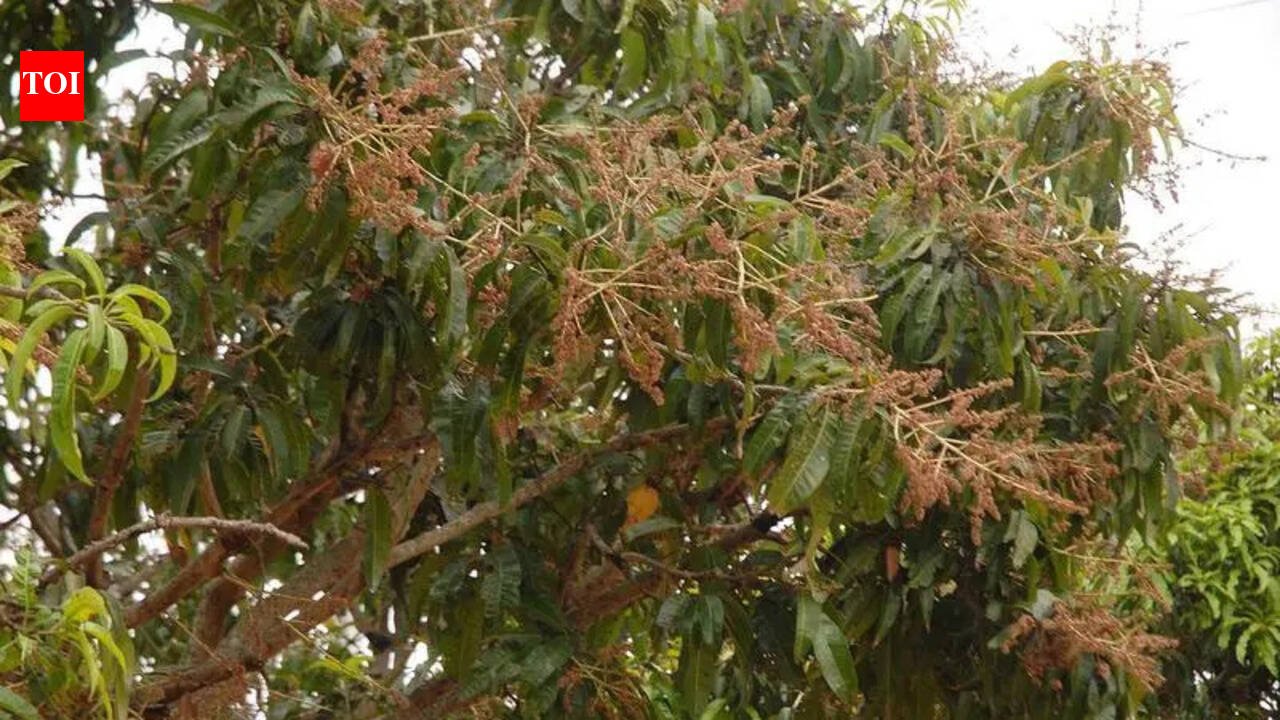
Lucknow: The heavy and sudden rain on Saturday, accompanied with high-velocity wind, has led to at least 40% loss of mango crop in Malihabad by now. The exact assessment of loss, however, may be known in a few days. Untimely rain may also trigger virus attack on fruits, very tiny in size at this time.If it continues, the early fruit set on the tree tops may drop more. The magnitude of loss may not be less for other mango-growing regions of the state either, as the growth cycle of mangoes is the same across.This year, Feb and Mar, two crucial months for mango crop, saw sudden weather changes. “It was a very high temperature at the end of Feb, going up to 32 degrees Celsius, which continued till about mid-Mar. It led to flowers opening fast, but also getting dropped because of high temperature. This affected pollination and fewer flowers converted into fruits,” said mango entrepreneur from Malihabad, Naseeb Khan.The freshly opened flowers also get pests, like gall midges, attacking them. “Because most flowers opened at the same time because of high temperature during this period, there were more insects attacking them too,” said Khan.Mango trees bear good crop every alternate year. The good-crop year is called on-year and the rest as off-year. This time it was the off-year for the Malihabad belt already, which means that about 40% of the trees in orchards, which did not bear good crop last year, would only give major production this time. But the sudden weather changes will now impact mango production in Malihabad.Flowering in mangoes takes place in three stages. The panicles or cluster of flowers, called ‘baur’, first appear on top branches of the trees, which are directly exposed to the sun. This may be done by mid-Feb when the temperature starts rising gradually. The flowering on branches in the middle and lower part of the trees complete by mid-Mar. “The gradual change of weather during this period is favourable for the crop,” said Khan.But, in the last few years, sudden weather changes between Feb and Apr are common. “This is also the time of mangoes, mainly the early varieties, like Dussehri, and it impacts the crop,” said another mango entrepreneur, Upendra Singh, adding, “By now Malihabad may have seen 40% loss due to erratic weather in Feb, Mar and now also Apr.”


