



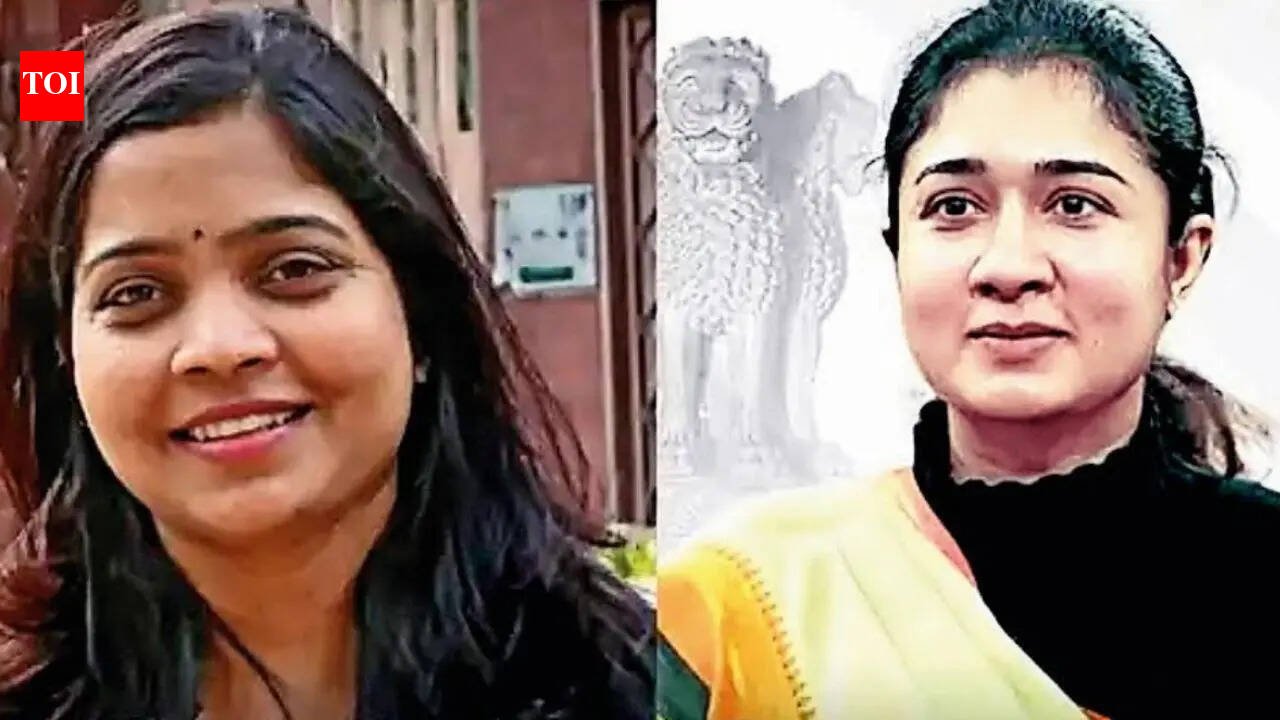
Pressure, pretence or mistaken identity? Most aspirants making false claims of selection to IAS are from UP & Bihar, finds out why…Rapturous celebrations, strings of felicitations and bytes laden with extreme emotions – these are familiar scripts for any successful candidate in the prestigious civil services examination. Only the actors in some of the cases are fake. There was a string of fraud claimants about success in the civil services examination after the results were announced on March 6. Out of more than half a dozen such aspirants, at least three were from Uttar Pradesh and two from Bihar. In an emotionally charged interview, Neera Ram, a retired driver, from Ghazipur told local reporters that he would love to drive for his daughter Priyanka Chaudhary, who had secured 79th rank in the examination. The story went viral across platforms till a civil servant from far off Himachal Pradesh claimed that Priyanka Chaudhary who had made the cut was his wife. In Bulandshahr, a woman, Shikha, claimed she had secured 113th rank. While the family was celebrating, the ‘real’ Shikha from Delhi wrote to the UPSC about the confusion and asked the commission to clarify. A district-level probe confirmed that the claimant had failed the mains examination. She later apologised, attributing the confusion to checking only the name and not the roll number. There were at least four more such cases in other states. What makes youngsters make such claims? All these can’t be cases of mistaken identities as both Priyanka and Divya hadn’t even cleared the preliminary examination while Shikha couldn’t clear the mains. Another fake candidate from Bihar hadn’t even appeared in the examination. Experts say the incidents highlight the immense prestige attached to UPSC success in the heartland, especially UP and Bihar, where becoming an IAS officer is often viewed as the ultimate achievement. While many like the real-life protagonist of Vidhu Vinod Chopra’s heart-warming ‘12th Fail’ come out with success stories, the pressure also gives rise to imposters eyeing their moment of fame when nothing else works for them. Even in the era of AI and availability of career options like never before, this speaks volumes about the pressure to crack the civil services in these two states, say psychologists. Case 1: Shikha Rani | Bulandshahr and Delhi A district-level administrative inquiry into a claimed success by Bulandshahr’s Shikha Rani revealed that the candidate in question could not qualify the examination. District administrative officials directed Sadar tehsildar Manoj Rawat to conduct a physical verification at Shikha’s residence. The tehsildar examined her academic and examination-related documents and found that her claim of clearing the UPSC examination was incorrect. According to officials, Shikha had not cleared the UPSC main examination and, therefore, was never shortlisted for the personality test (interview). Further discrepancies surfaced when her documents identified her as ‘Shikha Rani’, adding to inconsistencies in her claim. Officials said Shikha kept her family unaware of the actual result. When the UPSC results were declared, she informed her family that she had been selected. The announcement led to celebrations, with her grandfather breaking down in tears of joy. Villagers organised celebratory processions with drums, garlands, and public felicitation, while locals thronged her residence and took selfies with her. After the probe, Shikha and her family now admitted the mistake. The actual Shikha is currently serving as a block development and panchayat officer (BDPO) in Sampla in Haryana’s Rohtak district. “The name appearing at Rank 113 in the UPSC merit list is mine, and the roll number corresponds to my candidature. There is only one candidate with this name in the list,” she said. Bulandshahr’s Shikha Rani claimed that the confusion arose after she searched her name in the PDF file of UPSC results and instead of verifying the roll number, she saw her name and believed that she had succeeded. Her father, Prem Chand, said: “She saw her name and immediately informed us that she had cleared the examination. We believed her and shared the news.” Case 2: Akanksha Singh | Arrah & Ghazipur A controversy over All India Rank (AIR) 301 in the civil services examination emerged as a textbook case of identity confusion, document discrepancies, and misinformation, prompting an official clarification from UPSC. After the announcement of results, two candidates — both named Akanksha Singh — from Uttar Pradesh and Bihar separately claimed to have secured AIR 301. The candidate from Ghazipur, Uttar Pradesh, maintained that she had appeared in all stages of the examination and said her claim could be verified through her admit card and the QR code embedded on official documents. Another Akanksha Singh from Arrah in Bihar, granddaughter of slain Ranvir Sena chief Brahmeshwar Singh Mukhiya, also claimed success. She presented her preliminary examination admit card which appeared to carry the same roll number. A closer examination of documents revealed critical inconsistencies. While the Bihar candidate’s admit card displayed roll number 0856794, scanning the QR code showed a different number — 085659 — indicating mismatch. The Ghazipur candidate’s interview call letter and QR code both consistently reflected roll number 0856794, establishing the authenticity of her claim. Later, the Bihar candidate acknowledged discrepancies in her documentation. UPSC also issued an official statement clarifying that AIR 301 was secured by Akanksha Singh from Ghazipur, Uttar Pradesh. The Commission also specified her parentage — daughter of Ranjit Singh and Neelam Singh. Case 3: Priyanka Chaudhary | Ghazipur & Bikaner After the declaration of UPSC results, a story went viral claiming that Priyanka Chaudhary of UP’s Ghazipur, daughter of a former driver of SDM, has secured AIR 79. The narrative gained traction due to its strong human-interest angle, with her father, Neera Ram, expressing pride and stating, “It will be an honour to drive my daughter’s vehicle.” However, the celebration was short-lived. The actual candidate who secured AIR 79 was another Priyanka Chaudhary from Bikaner, Rajasthan, whose husband is an IAS officer posted as a collector in Chamba, Himachal Pradesh. Ghazipur’s Priyanka Chaudhary, however, told reporters that she had not made any claim on having cleared the UPSC examination. Priyanka, who has an excellent academic record, is currently serving as a GST inspector in Prayagraj. Case 4: Yashvardhan Singh | Satna & Hamirpur Yashvardhan Singh from Nagaud area of Satna district in Madhya Pradesh claimed that he had secured all India rank of 212. The announcement triggered celebrations in his locality, with residents gathering to congratulate his father Narendra Singh Parihar and mother Sangeeta. However, discrepancies emerged during verification. Officials noted that the candidate listed at rank 212 belonged to OBC category, whereas Satna’s Yashvardhan belonged to the General category. Further scrutiny revealed that the Satna claimant had not even cleared the preliminary examination. The actual candidate who secured rank 212 is Yashvardhan Singh from Rath area of Hamirpur district in Uttar Pradesh. He comes from an academic background and is the son of Dr Surendra Singh, a college principal. A medical graduate from KGMU, Lucknow, he had previously secured 728 and 571 ranks in earlier attempts and reached interview stage four times. What former officials say Former Uttar Pradesh/Assam DGP and ex-DG of Border Security Force, Prakash Singh calls for systemic reforms, suggesting simple procedural changes to prevent such incidents. “If two persons bear the same name, the Commission should devise a system to distinguish them — for instance, by assigning numerical identifiers like ‘one’ and ‘two’. Confusion is not uncommon and can be easily resolved with minor administrative adjustments in result presentation,” he says. Singh observes that the aura around civil services is a product of social perception rather than institutional design. “Prestige is not awarded by anyone; it evolves over time depending on how society views a job,” he says. Drawing a contrast with earlier decades, Singh recalls that there was minimal publicity around UPSC success. “When I topped the IPS in 1959, there was no media attention. It was treated as a normal achievement,” he says, pointing to how media amplification has significantly changed the landscape. “Being an IAS/IPS officer makes you worthy of getting a huge dowry, further adding to your ‘prestige’,” he remarks. Former DG, CRPF, AP Maheshwari says that traditional dominance of civil services and “generalist” administrators is likely to decline as India’s economy evolves and specialised professional sectors expand. Speaking on the fascination for govt jobs, particularly in UP and Bihar, Maheshwari notes that trend is deeply rooted in social mindset. “With development, more professional verticals will take over governance space, and dominance of generalists will gradually get diluted,” he remarks. “Governance itself is undergoing a shift. It must move into a facilitating mode rather than a controlling one. As a result, the perception of power associated with govt service will reduce over time,” he adds. He observes that in UP and Bihar, there is still a mindset favouring govt jobs (IAS/IPS) as the primary goal. “In states like Gujarat, Maharashtra, and Rajasthan, families encourage children to pursue business or continue traditional family occupations,” Maheshwari says. Former chief secretary Alok Ranjan calls for a comprehensive review of the civil services examination system, raising concerns over excessive attempts, rising age limits, and the growing mental health burden on aspirants. “Faking selection in UPSC should be made a criminal offence,” he says. “The increasing number of attempts — often extending up to 6-7 — and the upper age limit going beyond the mid-20s has unintended consequences. Candidates are spending nearly a decade preparing for the exam. In many cases, candidates continue attempts till 30-35, which delays their entry into productive careers,” he points out. Ranjan suggests that three serious attempts within a defined age bracket — roughly between 21 and 26 years — will be appropriate. Highlighting the human cost, he warns that repeated failures over several years take a toll on young aspirants. “Many candidates face severe stress, depression, and mental health issues after dedicating 8-10 years exclusively to UPSC preparation without success,” he adds. “By the time many exit the preparation cycle, they are already in their 30s, with diminished opportunities elsewhere. This results in a loss of valuable human capital for the country,” Ranjan says. Behaviour rooted in insecurity, fear of failure: psychologists Amid rising instances of individuals falsely claiming selection in the civil services, psychologists have highlighted deeper behavioural and mental health factors driving such conduct, linking it to insecurity, narcissism, and fear of failure. Criminal psychologist in Lucknow, Dhiresh Kumar, explains that such behaviour often stems from deep-seated internal insecurity. “Candidates who are unable to achieve a goal sometimes attempt to attain it through false claims. The social validation and admiration associated with prestigious positions like IAS become a strong psychological driver,” he says. Delhi-based psychologist, Raghav Madhurya, points out that narcissistic tendencies also play a key role. “Such individuals develop an inflated sense of self and try to project superiority over others. They create an imagined identity around themselves, which they begin to defend and promote,” he says. Madhurya highlights a more complex psychological condition associated with repeated false claims. “When one continues to lie consistently and receives social reinforcement, one may begin to believe their own narrative. This condition is known as pseudologia fantastica, where fiction gradually replaces reality in the individual’s mind,” he says. “Repeatedly claiming an identity that one does not possess can, over time, lead an individual to believe in that false narrative. When such claims begin to receive social recognition, the person starts living that fabricated reality — often blurring the line between truth and illusion. This can eventually push them towards criminal behaviour,” says Ajay Srivastava, who has worked with investigation agencies and CFSL. ‘Craze a result of feudal mindset’ Serving IPS officer and DG, cyber headquarters, Uttar Pradesh Police, Binod Singh, who hails from Bihar, attributes the craze for civil services in Uttar Pradesh and Bihar to a deep-rooted “batti culture” and feudal mindset, saying the perception of power continues to shape career aspirations in these regions. Singh says the attraction towards govt jobs is often linked to status and authority. “The craze in UP and Bihar is largely due to the love for ‘batti’ — the symbol of power. From the beginning, we have been raised in a feudal mindset where authority and status are highly valued,” he says. “Priorities have changed. For many, the first objective is to earn, and that has altered the way civil services are perceived. Hence, people even fake qualifying the examination,” Singh says. Banda superintendent of police, Palash Bansal, a 2017 batch IPS who hails from Lucknow, says: “Civil services must be about service, not status. Associating civil services with social prestige risks distorting the very purpose of governance.” Bansal says that for many aspirants and families, securing a position in the bureaucracy is increasingly seen as a symbol of status and social validation, hence often aspirants who don’t qualify even they claim. “When societal approval begins to outweigh the core intention of serving the public, it creates a dangerous shift in priorities,” he says. “The uniform or the designation is not meant to elevate an individual above society, but to make them more responsible towards it,” Bansal says, adding that there is a need to shift the narrative — from power and privilege to responsibility and service. “The intent behind joining the service matters. If the focus is on public good, integrity follows naturally. If the focus shifts to status, it can compromise both ethics and governance,” he says.


