


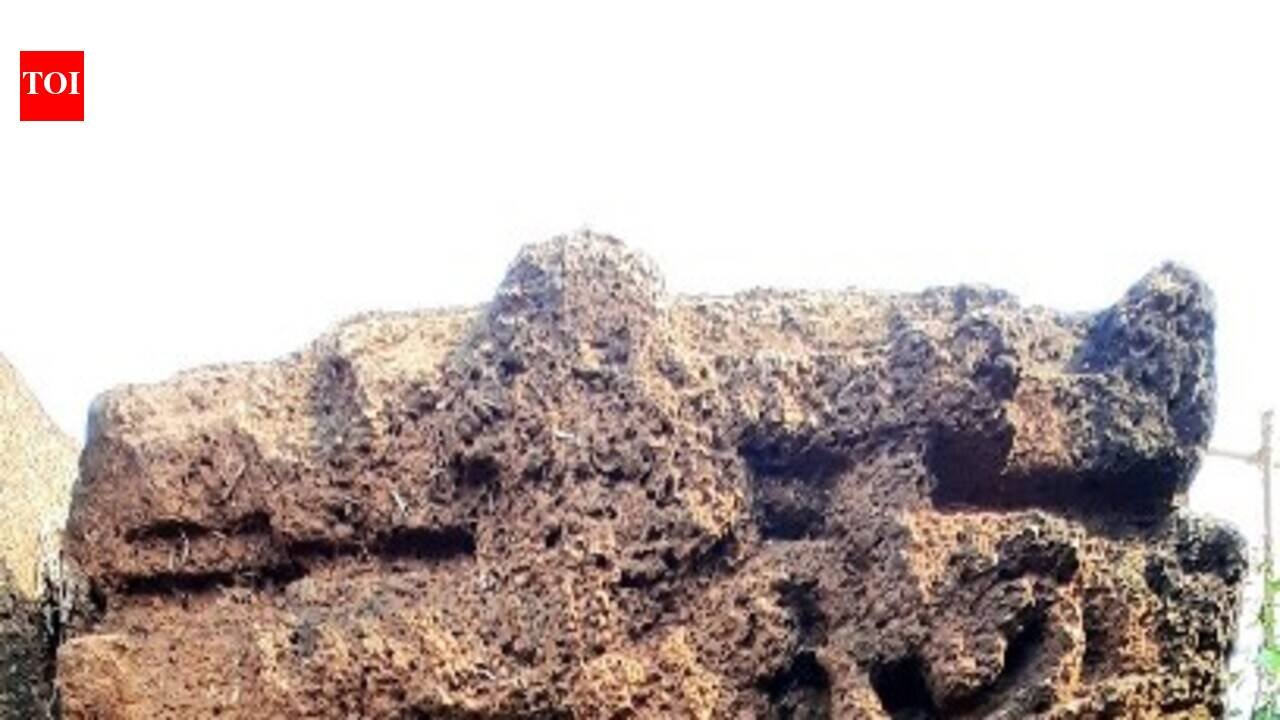
Balasore: On the northern frontier of Odisha, where the cultural landscape merges with Bengal, lie the sprawling ruins of Raibania Fort in Balasore district. Once regarded as the largest medieval fort complex in eastern India, this fortified zone, spread across 15 square kilometres (about 3,840 acres), stood as a powerful symbol of erstwhile Kalinga’s military strength. Today, its crumbling ramparts, overgrown gateways and silent water tanks bear witness to a remarkable chapter in Odisha’s history.Built during 13th century CE by King Langula Narasimhadeva I of the Eastern Ganga Dynasty, Raibania served as a strategic frontier fortress protecting the Odisha kingdom from invasions originating in Bengal. Unlike conventional forts, it was designed as a vast interconnected military zone with a sophisticated multi-layered defence system.Conceived as a gigantic pentagonal structure, the fort was protected by triple walls and wide moats. The ramparts, rising nearly 50 feet high and 112 ft thick at the base, were constructed using laterite stone, compacted earth and lime mortar. Broad enough for horsemen to patrol, they were reinforced by two consecutive moats.“Raibania’s triple-moat system is a marvel of medieval military engineering — no other fort in eastern India displays such layered defences,” said Srikanta Charan Patra, historian and author of ‘The Freedom Struggle of Raibania’ and ‘The Horizon of Raibania’.The the Eastern Ganga rulers had built at least four major forts — two each near Raibania and Phulta (Ganjam district) — with additional defensive zones at Phulta and Bardiha. Its gateways, including Singhadwar, Hatidwar and Sunamukhidwar, once served as entry points for armies and nobles. Today, only fragments of these survive.Raibania’s location made it exceptionally secure. Surrounded by Subarnarekha river on three sides and dense forests on the fourth, Raibania served as a launching point for campaigns into Bengal and as a defensive barrier against external invasions.Raibania was also an example of advanced water management. At least 26 rain-fed tanks, including Nandika, Deula, Bhunya and Kaliadahana, supplied water to soldiers and animals. The famed Joda Halia Kuan, a circular stepwell measuring 8.5 metres in diameter, and Gadakhai water body surrounding the fort reflect careful planning for both defence and daily life. Remains of ancient stone bridges secured with iron clamps further demonstrate the engineering expertise.The fort also holds deep religious significance. Local traditions speak of 161 fort goddesses, revered as Durga Devata or Ishta Devata, who were believed to guard the kingdom’s frontiers. Among them, Dasasharu, an aniconic manifestation of Goddess Jay Chandi, occupied a special place.
Raibania functioned as a major military centre housing nearly 5,000 soldiers, cavalry units and war elephants
“The Jay Chandi Temple inside the fort still attracts worshippers. It reminds us that Raibania was not only a military bastion but also a sacred space,” said Narayan Prasad Das, a member of the Raibania Durga Surakshya Committee.Folklore also links Raibania to the Mahabharata, and identifies it as the capital of King Virata. Copper-plate inscriptions of Narasimhadeva II confirm its strategic importance. The fort later played a role during the reign of Mukunda Deva, the last independent Hindu ruler of Odisha, before appearing in Mughal records such as ‘Ain-i-Akbari’, where it was referred to as “Rayn.”At its peak, Raibania functioned as a major military centre housing nearly 5,000 soldiers, cavalry units and war elephants. Observation towers, marketplaces and secret chambers reportedly used for storing weapons supported both military and civilian life.By the 16th century, however, the fort’s importance began to decline with the rise of the Mughals. Water tanks silted up, temples crumbled and sections of the ramparts were gradually reclaimed by farmland and vegetation.“For us, these ruins are not just stones. They are part of our identity, where our ancestors lived and fought,” said Ashish Kumar Ghosh, a resident of Raibania village.Efforts to preserve the site have gained momentum in recent years. In 2019, funds were released for the restoration of the ancient South Gate. In 2022, tourism department allocated Rs 6.5 lakh for preliminary renovation, while infrastructure development was supported under the National Urban Mission. In Dec 2023, the Odisha govt sanctioned Rs 16.87 crore for a broader heritage development project. The local residents, however, call for faster conservation and promotion of the fort as a heritage destination.“If properly restored, Raibania could become the crown jewel of heritage tourism in northern Odisha, drawing visitors from across India,” said Sunil Kumar Patnaik, archaeologist and historian.Without urgent conservation, Raibania will fade into memory, added cultural researcher and heritage activist Prasanta Padhi.More than an archaeological site, Raibania stands as a lasting symbol of the vision, resilience and ingenuity that once safeguarded Odisha’s northern frontier.
Attachment
Attachment
Attachment
Attachment
Attachment
Attachment
Attachment
Attachment
Attachment
Attachment
