


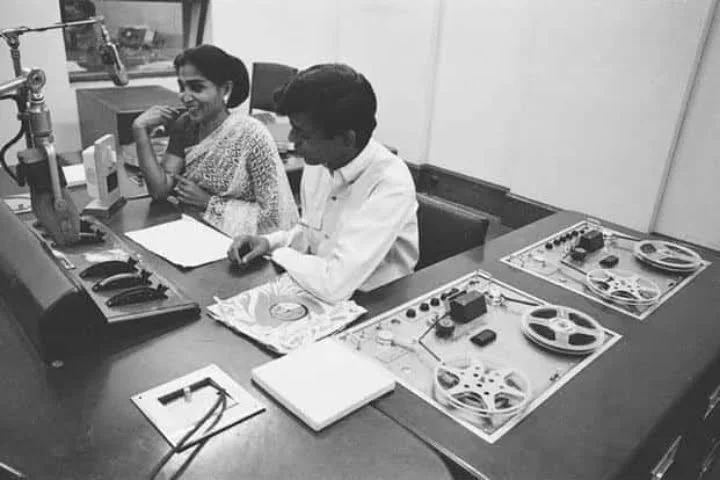
The history of broadcasting is actually linked to the history of journalism. Broadcasting owes to its origin to idea of journalism which has its genesis in the ancient communication system. The importance of news was recognized even before ink & paper were invented. It was important both for the rulers as well as the people. Rulers were required to be abreast with current happening for the purpose of administration and for people it was a means of obtaining information.
The invention of the printing press revolutionized the scenario, which became the most powerful means of dissemination of news & other information before the advent of radio. The invention of radio was preceded by the invention of wireless, telegraph. Guglielmo Marconi pioneered wireless communication between England & France in 1899 and across the Atlantic in 1901. Initially, there was no transmission of sound over wireless transmitters. It was only with the help of Morse Code that messages were transmitted on telegraph, which is still in practice.
Later it was discovered that sound could also be transmitted. It so happened that a ship was sailing in the sea near San Francisco, when a crew member heard the sound of some music on his wireless set. He was flummoxed & immediately went to his captain and asked whether he had gone mach as he was getting the sound of music. And then, it was found that some orchestra was being played near the shore. This incident clearly demonstrated that sound could be transmitted through a wireless transmitter and ultimately led to the invention of radio. In USA radio had its advent as early as in 1909, when a station in San Jose, California started broadcasting announcements & photographic music.
Amateurs were the first to start broadcasting in Bharatvarsha. The Bombay Presidency Radio Club made its mark by broadcasting its first program in June 1923. In November of that year, the Calcutta Radio Club also went on the air followed by the Madras Presidency Radio Club, which started broadcasting on 31st July 1924, with a 40-watt transmitter.
The first broadcasting station with a 1.5 kW Medium Wave transmitter was opened in Bombay by the Indian Broadcasting Company in July 1927. A month later in August, another station with a transmitter of the same capacity was opened in Calcutta. On 1st March 1930, the Indian Broadcasting Corporation went into liquidation and was then taken over by the Govt. of India under the name “Indian State Broadcasting Service”.
On 8th June 1936, the organization was rechristened as All India Radio (AIR). It took its shape & programme pattern between 1937 & 1940 under the leadership of Lionel Fielden, who was appointed the first Controller of Broadcasting in 1936. He along with an expert from BBC, conducted a study of the broadcasting requirements of Bharat.
On their recommendation, GOI undertook a development programme on broadcasting with an initial investment of Rs 40 lakhs. Since then, AIR’s coverage area has expanded significantly across the country as AIR’s member stations and transmitters have multiplied. The Second World War boosted its expansion and it received further boost after independence as it was considered a very effective means of mass information and education.
The first Plan of development, formulated in 1945, was based on a measured-wave service for the whole nation. It was planned to install one or more powerful transmitters in areas with diverse linguistic cultures area that were not well covered by the medium wave service.
Because this would be expensive it was also felt that the stations should be commissioned simultaneously to avoid charges for ignoring certain areas, the government decided to set up pilot stations with transmitters of one kW or less capacity and interim studios with minimal staff and equipment. They were to be replaced with more powerful transmitters and permanent studios.
In 1947, undivided Bharat had only nine radio stations located at Delhi, Bombay, Calcutta, Madras, Lucknow, Tiruchirapally, Lahore, Peshawar and Dhaka. In 1951, at the beginning of first five-year plan, Radio service’s reach was available to only 20% of the population. In 1956, the name “Akashvani” was adopted.
The Radio service expanded considerably and by 1960 covered 56% of the population and 37% of the county’s geographical area. Compared to first 5-year plan, finances for broadcasting were increased during the Second Five Year Plan in 1957. Vividh Bharati was launched in the same year to counter the growing popularity of Radio Celone’s commercial service. It provided popular film music as its main component.
By 1984, 90% of the country’s population and 78% of its territory came under its coverage. In 1991, AIR covered 97.5% of the population and 91% of the area with the help of 102 full-fledged Radio Stations which were production centers and 205 broadcasting centers which included Relay centers.
Currently AIR reaches out 99.18% of the population spread over about 91.85% of the area through 262 broadcasting centres with 742 transmitters (7 of SW, 122 of MW, and 613 FM). AIR is now the largest broadcasting network in the world.
Although electronic media and channels captured a vast mass in India and gave a phenomenal growth in last decades, Radio is still considered a true mass medium because it is low-cost mobile means of communication. Its importance increases further because it is not affected by the huge power shortage in the country. Secondly, unlike print media, radio can overcome the barrier of illiteracy. Transcending the barriers of rivers and mountains it reaches out to the farthest corner of the country.
AIR’s home-service programmes are transmitted in 23 languages and 146 dialects and Vividh Bharati programmes are transmitted for 15 to 17 hours daily across 43 stations. There are external service broadcasts in 17 foreign languages and 18 Indian languages for about 75 hours daily.
External broadcasts were started by the British Government to project its point of view on the circumstances which had to the outbreak of world war-II and its day-to-day progress to the strategically important region of Afghanistan bordering North-West frontier province of Bharat. The News Service Division of AIR is one of the longest running news organizations in the world.
The Central News Organization was set up in 1937 to prepare and broadcast in English & Marathi from Bombay and English & Bengali from Calcutta. After sometime the Marathi bulletin from Bombay was replaced by one in Hindustani. Initially, other stations used to receive news bulletins from Delhi through their receiving centres or telephone lines.
Bulletins in Indian languages, other than Hindustani were also broadcasted 3-times a day. Central News Organisations (CNO) was rechristened “News and External Service Division” after the end of the war. Again In 1948, the External Service was separated from the News Division, but the News Service Division continued to produce the news bulletins for the External Service as well.
Private radio broadcasting was introduced in year 2000, when commercial FM stations were allowed to broadcast programmes (mainly music) with local content. Currently there are 388 private FM stations. There are also several community radio stations (CRS).
Now the News Division of All India Radio (AIR) is headed by the Director General. The post of DG (News) in AIR was created in 1991. Earlier the News Service Division was headed by an Indian Information Service Officer of the rank ADG, who was called Director, News Service. But now there are many ADGs. Below them are the Joint Directors & then the News Editors.
Hourly news bulletins are broadcast from Delhi in Hindi & English. Regional News units of different states have their separate news bulletins in different languages. The Regional units are headed by officers of different rank, viz.-Joint Director, News Editor or Assistant News Editor. Apart from news bulletins, several current affairs & news-based programmes like Spotlight, News Reel, Letters from States, Letters from districts are also broadcast.
(The author is an engineer, columnist and educationist)


