






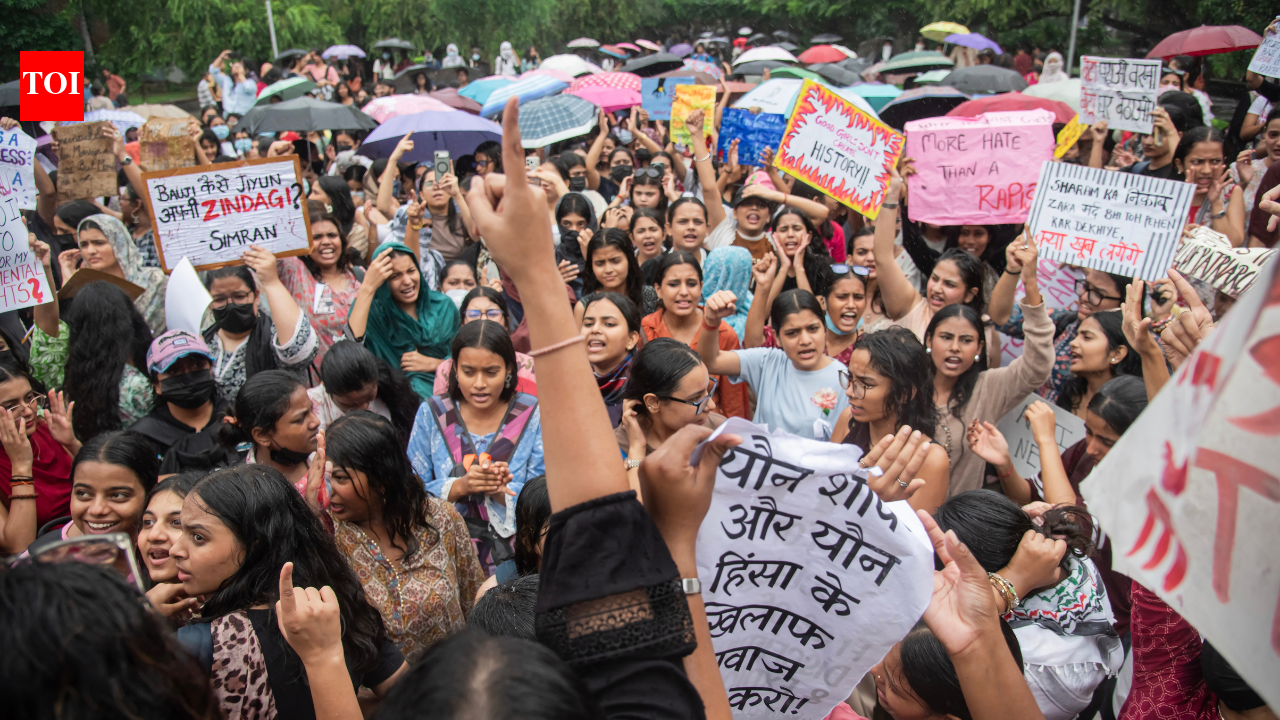
Despite a heavy downpour, Delhi University students took to the streets on Monday afternoon, marching from Miranda House to the Faculty of Arts to demand safer public spaces for women. Angered by the rising incidents of violence against women – the Aastha Kunj park alleged gang-rape being the most recent – the protestors did not mince their words with slogans and posters. “Imagine your behen beti first”, “Raaton par bhi haq hai hamara,” “Cursing is a cultural shock, but rape is not?” – these words screamed on handwritten posters, some of which were made inside metro coaches and at Vishwavidyalaya Metro station. The students also added internet culture with clock it gestures and posters that said “The baddest b***h ain’t in LA, we are here in India fighting for rights.”
Emotions and energy at the site were high as students came together in large numbers, some attending a protest for the first time
A symbol of freedom atop the statue pedestalMaking a statement of fearlessness and freedom, students climbed the pedestal of Vivekananda’s statue in the Faculty of Arts. Arshia Chakravarti, a third-year Political Science student at Rajdhani College, held a poster which read ‘Bas bohot hogaya’. “Since I’m in an off-campus college, I’ve always seen the core North Campus students climb up the Vivekananda statue pedestal (during protests). I come from West Bengal, so I have the utmost respect for him. I’ve grown up learning about his ideology. The first thing that I had to do was touch his feet, take his blessings, and then I went up there to propagate what I have learned. Being up there, I felt like I have never felt more alive and empowered,” she told us.
Making a statement of fearlessness and freedom, students climbed the pedestal of Vivekananda’s statue in the Faculty of Arts
Anisha Prabeel, a UPSC aspirant from Jharkhand, shared, “I come from a rural setup in Jharkhand, and there are so many girls dreaming of coming to Delhi to study and work toward their future, but the way things are happening, their parents are scared to send them. Even our parents worry; we haven’t told them that we are going to a protest. If we cannot ensure the safety and security of women in one of the top universities in the country in the capital, then I believe women would have no place to go. Ab yeh bilkul nahi chalega. Women ko unki azaadi aur safety milni chahiye. This generation is here to fight against patriarchy.”
As students came with hope, many questioned why there is still a need to fight for basic fundamental rights
‘It is sad that we still have to protest on this issue’ Emotions and energy at the site were high as students came together in large numbers, some attending a protest for the first time. Holding a placard which read, “It’s not a women’s safety issue, it’s a male violence issue”, Dharmishtha Sharma, a second year Journalism student at Kalindi College, told us, “It feels empowering to be at an all-women protest but it’s sad that we still have to do this. I have a friend in LSR, and all I felt was anxiety and terror when the case near the college came to light. At my college also, there have been many cases of stalking and harassment, so more than anything, I just feel anger. Protests absolutely make a difference – umeed pe duniya kayam hai aur hum bhi issi liye yahan hain. There is strength in numbers. If more of us show up, the louder our voice will be. We understand the power of voices. Cheenti akeli ho toh kuch nahi kar sakti lekin agar ek jhund mein aaye toh cheetiyan haathi ko bhi utha sakti hain.”As students came with hope, many questioned why there is still a need to fight for basic fundamental rights. Sanjana, a PhD scholar, noted, “All women have faced some form of harassment in their lives. It’s beyond frustrating, I am at a loss for words. Mujhe pata nahi ki kisi ke andar itni entitlement kahan se aati hai ki woh kisi ko aise ghoor sakta hai, haath laga sakta hai, humein abhi yeh basics sikhane padenge. And it is a drawback of our education system also which majorly lacks sex education. School mein hi ladko aur ladkiyon ko itna segregate karke rakhte hain ki vahin se problem start hoti hai.”
The protest saw displays of slogans against patriarchy and misogyny, with chants like “narivaad zindabad” and “ek kachori do samosa, inn mardon ka kya bharosa?”
Men were present as silent supporters While the march was open to women and queer people, male students joined but were away from the crowd. Adnan, a first-year master’s student at Department of History, shared, “Yeh maine pehla protest dekha hai jo sirf girls lead kar rahi hain aur bahut achcha lag raha hai unki energy ko dekh ke. Hum protest mein aaye hain as supporters. Hum door se unka hausla badha rahe hain. Jo recent incidents huye hain, woh hum mein se hi koi hain toh hum bheed mein ghus ke unki awaaz nahi chheen rahe hain. Yeh issue gender se bada hai aur hum sabko uske support mein khada hona chahiye.” Another male student, who’s pursuing master’s at the Department of History, said, “Agar mard bhi protest mein hissa lete toh woh zyada aa jate, overshadow karte iss cause ko.” He added that the protest is against crimes and in favour of safety for women, not an anti-men protest.
While the march was open to women and queer people, male students joined but were away from the crowd


