



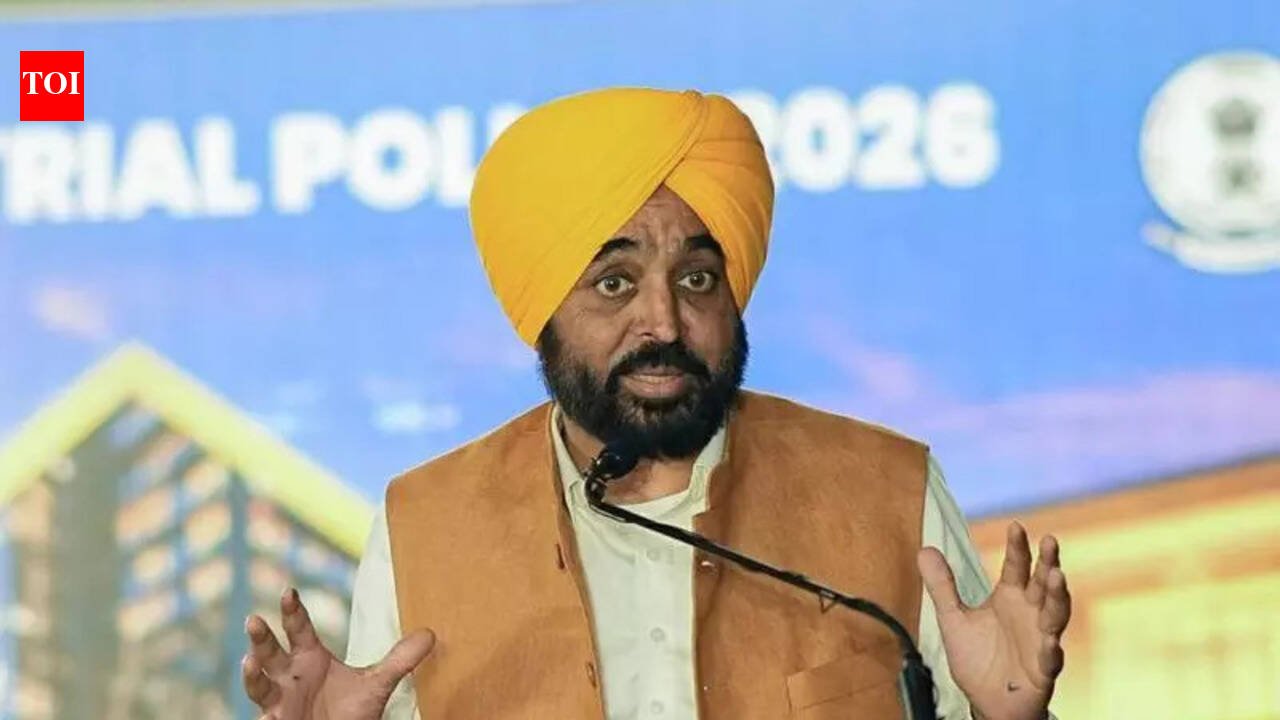
Chandigarh: Punjab govt on Saturday unveiled its Industrial and Business Development Policy 2026, claiming it has become the first state to allow investors to “self-design” incentive packages from 20 fiscal options. The framework is anchored by the introduction of a direct capital subsidy for the first time in the state.The policy also extends these benefits to existing units, making them eligible for incentives for modernisation and expansion. The move is aimed at ensuring a local manufacturer upgrading machinery or adding a production line receives the same policy support as a new investor.The new policy was approved by the state cabinet on Saturday. Punjab chief minister Bhagwant Mann unveiled the policy at a gathering of industrialists in Ludhiana. “Every other state in India hands investors a fixed menu and says take it or leave it, but Punjab has changed that. Now an investor can pick up to 20 incentives and build a package around their own business model,” he said at the event.The govt has set a target of attracting Rs 75,000 crore in industrial investment in 2026–27. Describing the trajectory as “an acceleration story”, the policy notes that Punjab has attracted Rs 1.55 lakh crore in investments since 2022, including Rs 55,000 crore last year alone. Separate frameworks have been introduced for high-growth sectors to sustain this momentum.For long-term stability, the eligibility period for incentives has been extended to a flexible 10–15 year window. According to the document, the window is “investor-controlled”, allowing businesses to decide when their “incentive clock” begins, depending on project gestation timelines. The definition of fixed capital investment (FCI) has also been widened to include land, worker housing and R&D facilities.To address environmental challenges, the state has introduced a fixed capital subsidy of Rs 7.5 crore for industries switching to paddy straw-based boilers to create industrial demand for crop residue. A subsidy of up to Rs 10 crore is also available for zero liquid discharge (ZLD) systems. Other incentives include freight subsidies, marketing assistance and exemption from canal water user charges.For job creation, the govt has lowered the eligibility threshold for the employment generation subsidy (EGS) to units with Rs 25 crore investment and 50 employees. The policy says the move will bring thousands of small manufacturers employing 30–50 people within the incentive framework. Monthly support has been fixed at Rs 3,000 for men and Rs 4,000 for women and SC/ST employees, rising to Rs 7,500 for those employed in global capability centres (GCCs).To boost women’s participation in the workforce, the policy permits women to work night shifts, subject to mandatory safety provisions.To strengthen the start-up ecosystem, the seed grant has been increased from Rs 3 lakh to Rs 5 lakh. The state will also set up an innovation and start-up hub in Mohali, positioning the city as the “Silicon Valley of North India”. A committee will approve customised packages for large-scale projects, while exporters will be eligible for freight subsidy of up to Rs 30 lakh annually.Development of border areas will be prioritised, with an additional 25% incentive boost for industrial units set up in Amritsar, Gurdaspur, Pathankot, Tarn Taran, Ferozepur and Fazilka, as well as the Kandi region.An additional 25% incentive has also been offered to nine priority sectors, including food processing, defence and aerospace, and electric vehicles. To streamline approvals, the Right to Business Act will provide in-principle clearances through self-declaration in five to 18 days, while a new FastTrack portal will target digital single-window approvals within 45 working days.Subsidy for films, web seriesThe policy offers capital subsidy of up to Rs 10 crore for film studios and film cities, and financial support of up to Rs 3 crore for film or web-series production costs. Incentives of up to Rs 50 crore have also been offered for hospitals (minimum 50 beds) and medical colleges, Rs 5 crore capital subsidy for tourism infrastructure, and up to Rs 50 crore for new higher education institutions.(Inputs from Ludhiana)


