



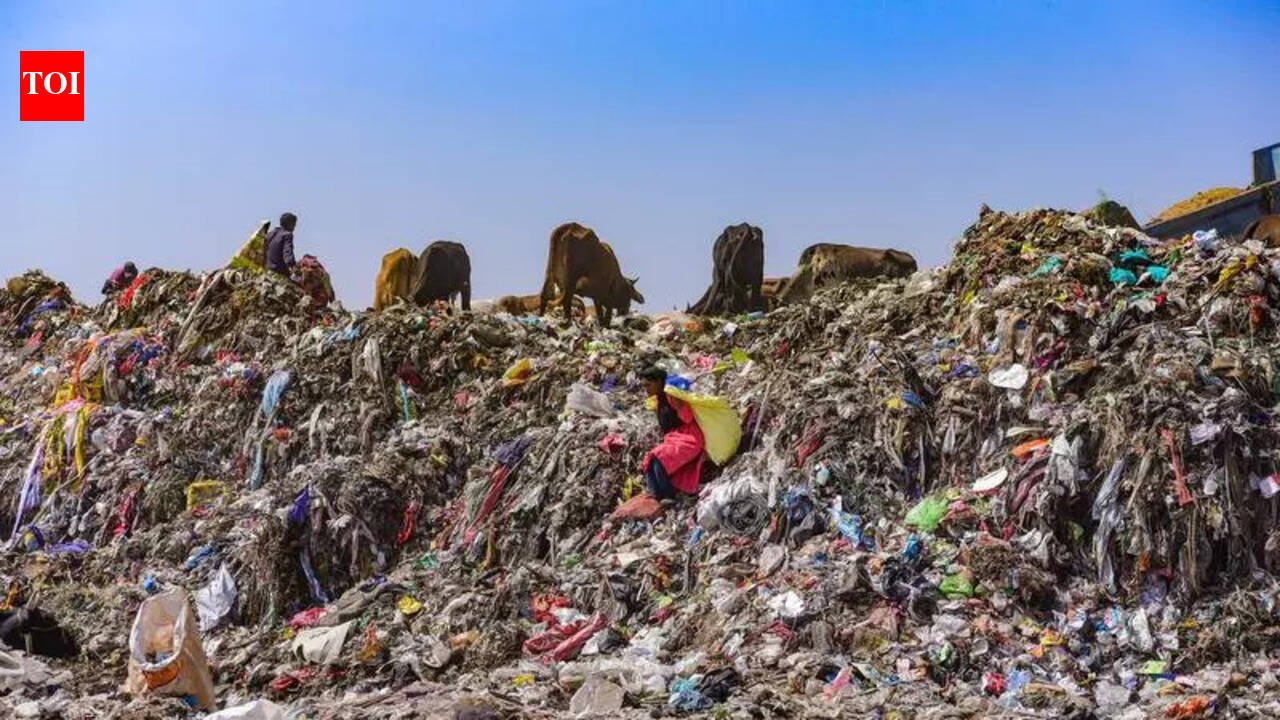
Chandigarh: Even as Punjab has been trying to improve waste management, mountains of legacy waste continue to pile up across towns in the state.About 41.11 lakh metric tonnes (MT) of legacy waste remains to be processed at urban local bodies (ULBs) in Punjab, and complete remediation is expected only by April 2027.Legacy waste refers to old municipal waste accumulated over the years at dump sites. It includes municipal solid waste, industrial waste, hazardous material and construction debris. Such waste poses serious environmental and public health risks, as it can generate toxic leachate that contaminates groundwater, trigger landfill fires, and create long-term governance challenges for urban bodies.Punjab’s 166 urban local bodies had a total of 84.09 lakh MT of legacy waste. Of this, 43.47 lakh MT has been remediated, leaving 40.61 lakh MT earlier classified as balance legacy waste. However, following directions from the National Green Tribunal (NGT), authorities reassessed accumulated unprocessed waste and added it to the legacy stock. As a result, the current legacy waste figure rose to 41.11 lakh MT, according to a compliance affidavit filed by the Punjab government before the NGT.The increase occurred because 35 urban local bodies currently face a gap between waste generation and processing, leading to the accumulation of about 49,552 MT of unprocessed waste. This waste is typically stored temporarily and processed within five to seven days.The report also provided a broader picture of Punjab’s urban waste challenge. Across the state, the 166 ULBs generate 4,008 tonnes per day (TPD) of solid waste. Of this, 3,605 TPD — about 89.95% — is being processed, leaving a gap of 403 TPD that authorities are attempting to bridge through improved infrastructure and streamlined processing.The tribunal was informed that efforts are underway to ensure the remaining waste is handled regularly so that dump sites do not expand further or create fresh legacy waste. With the Solid Waste Management Rules, 2026, coming into force from April 1, 2026, the state has planned to strengthen infrastructure and systems for waste collection, segregation and processing.Sewage, the other challenge The compliance report also highlighted challenges in sewage management across urban Punjab. The state’s 166 urban local bodies generate about 2,219.91 million litres per day (MLD) of sewage, of which 2,009.50 MLD is being treated through 162 sewage treatment plants (STPs).Of these 162 STPs, 123 meet prescribed discharge standards, six are non-compliant, 28 are under stabilisation, and five have been temporarily shut for maintenance to improve efficiency. To augment capacity, nine new STPs with a combined capacity of 24 MLD became operational between October 2025 and January 2026. Despite this, the state still faces a sewage treatment gap of 210.41 MLD.To bridge this gap, 36 new STPs with a total capacity of 195.10 MLD are under construction and are expected to be completed by December 31, 2026. In addition, 30 more STPs with a capacity of 145.7 MLD are at the planning stage and are likely to be completed by December 31, 2027. However, land availability remains an issue in four urban local bodies, delaying STP construction in those areas.


