



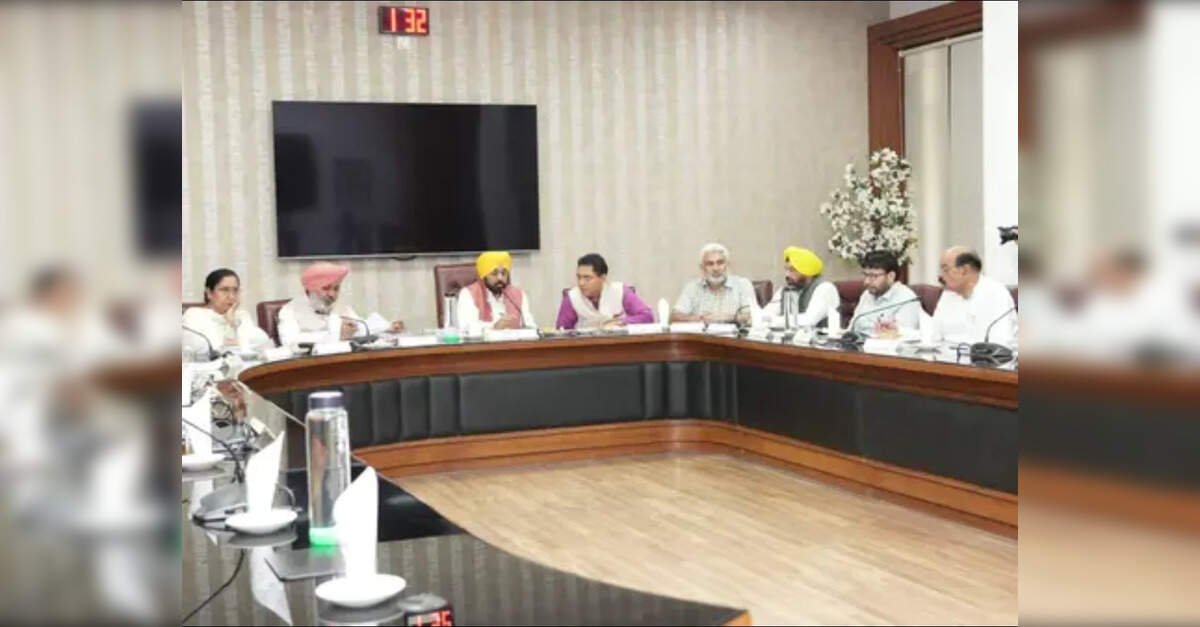
Chandigarh, The Punjab Cabinet on Wednesday gave a nod to set up three new Digital Open Universities in the state, an official statement said.
The Cabinet headed by Chief Minister Bhagwant Mann took a series of decisions aimed at strengthening education, improving governance and public service delivery, and promoting inclusive development across the state.
The Cabinet also approved a proposal to bring the Punjab Regulation of Fee of Un-aided Educational Institutions (Amendment) Bill, 2026, to regulate “unnecessary and unreasonable” increase in fee by private un-aided educational institutions.
To attract best quality educational institutions of national and international repute to Punjab, the state government has prepared the Punjab Private Digital Open Universities Policy, 2026, the government said in a statement.
The Cabinet also gave nod to Cloud University at Bohan, Hoshiarpur, MS Digital University at Fatehpur and Physicswallah Digital University at Nandpur Kesho in Patiala.
“The setting up of these universities is expected to bring quality education to the city and will help in the overall development of the area,” the statement further said.
It also approved the Punjab State Outsourced Personnel Transition to Contractual Engagement Bill, 2026, among other key policy initiatives.
“The cabinet gave nod to bring the Punjab Regulation of Fee of Un-aided Educational Institutions (Amendment) Bill, 2026 for regulation of unnecessary and unreasonable increase in fee by private un-aided educational institutions. The Bill has been necessitated as some unaided private educational institutions were arbitrarily and unreasonably increasing their annual fees, which was imposing unnecessary financial burden on students and their parents,” the statement said.
“Thus, a need has been felt to amend the Punjab Regulation of Fee of Unaided Educational Institutions Act, 2016, the Punjab Regulation of Fee of Un-aided Educational Institutions Amendment Act, 2019 and the Rules framed under the Act to check unjustified fee hikes by private unaided schools,” it added.
The Cabinet also gave a go-ahead to place the Punjab State Outsourced Personnel Transition to Contractual Engagement Bill, 2026 for the transition of eligible outsourced personnel into direct contractual engagement after a qualifying period of five years of continuous service, or three years in the case of personnel deployed in the enumerated ‘hazardous categories’.
” The remuneration of contractual appointees shall be determined by the Department of Finance and shall not be lower than the minimum rate of wages fixed under the Code on Wages, 2019, or any other law relating to minimum wages for the time being in force,” it said.
The Bill repeals the Punjab Ad Hoc, Contractual, Daily Wage, Temporary, Work Charged and Outsourced Employees’ Welfare Act, 2016 (Punjab Act No. 55 of 2016) from the date of its enactment.
The Cabinet also gave approval to amend the Punjab Goods and Services Tax (Amendment) Bill, 2026 to promote voluntary compliance, reduce litigation and streamline GST procedures, thereby benefiting trade and industry across the state.
The amendment will allow exclusion of post-sale discounts from the value of supply through issuance of a credit note without the requirement of a prior agreement. Further, it will allow issuance of credit notes for post-sale discounts for any commercial reason, thereby simplifying trade discount adjustments and reducing compliance burden, it said.
Likewise, it also aims to extend the benefit of 90 per cent provisional refund of Input Tax Credit in cases of inverted duty structure and allow refund of IGST paid on exports of goods even where the refund amount is below Rs 1,000, thereby improving liquidity and facilitating exports, it added. PTI


