






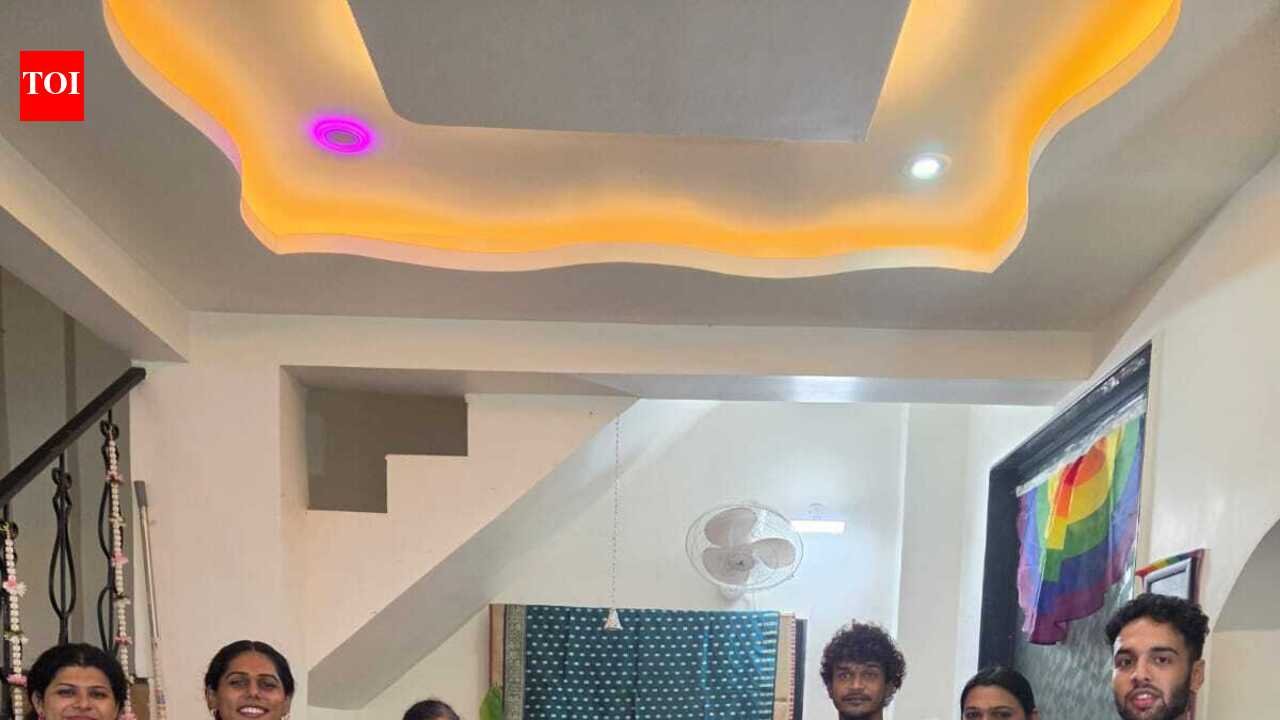
Pune: Ganapati celebrations have become spaces of shared belonging and togetherness for Pune’s LGBTQ+ community, where members can express themselves freely and work towards a common goal: accepting people for who they are.From decorating for Bappa to participating in dhol-tasha pathak, the queer community has come together in devotion this year as well.“Our main agenda is to create a safe space for the queer community, with the participation of people from all religions. That is what makes us unique,” said Shyam Konnur, director of MIST LGBTQ Foundation.MIST LGBTQ Foundation is a non-profit organisation that empowers the LGBTQ+ community through safe spaces, awareness initiatives and healthcare support.This year, the organisation celebrated Ganapati for three days in an environmentally friendly manner, immersing Bappa on its office campus. Around 20 people participated in the festivities.According to Konnur, these small gatherings provide a space for people who may not feel comfortable expressing themselves on larger platforms, such as Pride events or queer film festivals. Activities organised by the non-profit included painting shadu clay idols and decorating its office premises, neighbouring offices and local shops.“Even someone who has come to Pune to study or work can join us for Ganapati celebrations. There is a shared sense of excitement, with volunteers and community members coming together to help organise the festival,” he said.The foundation has been organising Ganapati celebrations for the past five to six years, except last year, when difficulties in raising funds prevented it from doing so. Funding continues to be a challenge, but support from well-wishers has helped sustain the initiative.“Community participation has become more forthcoming, as it was very difficult earlier to find spaces for our celebrations. We also had young gay boys participate in the festivities for the first time, and they helped us with financial support,” Konnur added.For the Shikhandi dhol-tasha pathak, Ganapati celebrations are an opportunity to unite through music amid the festive fervour. Named after a character from the Mahabharata, the group was formed in 2024, initially with the aim of bringing together trans people. It now has 50 members and is open to participation from the wider LGBTQ+ community.“Shikhandi was the first transgender king who faced gender dysphoria throughout his life. We chose this name as a symbol for our community,” said Manasvi Goilkar, president of the Shikhandi dhol-tasha pathak and an LGBTQIA+ activist.The group is India’s first LGBTQ+ dhol-tasha pathak and performs across Pune during Ganeshotsav. Its repertoire includes traditional rhythms as well as Bollywood renditions, adding to the festive atmosphere.“Dhol-tasha is a way for us to occupy public spaces and make the community’s presence felt. Public performances allow us to claim a visible and audible stake in the broader cultural landscape,” Goilkar said.Having performed across India, including in Hyderabad and Rajasthan, the group has also performed at the Shrimant Bhausaheb Rangari Ganapati and Guruji Talim. The group was also awarded the ‘Ganesh Seva Puraskar’, a recognition for its contribution to Ganapati celebrations.“Ganapati celebrations are spaces for survival, healing and freedom, allowing people to let their guard down and experience belonging without having to explain themselves. Since many LGBTQ+ people still have strained relationships with their biological families, community events become places where they find their chosen family,” Goilkar said.For other non-profits, Ganapati celebrations are an opportunity to gather a close-knit group of people and participate in rituals at home.“We celebrate the festival on a small scale, but it is an open-house celebration,” said Chaitanya Yerawadekar, director of the Marmajidnyasa Foundation.The Marmajidnyasa Foundation has been operating since 2017 and aims to drive sustainable change through advocacy, education and healthcare across the spectrum of gender, age and ability.“It was Gauri puja on Friday, and we organised a haldi-kumkum ceremony for everyone, irrespective of their gender or sexuality. Seventeen people joined us,” Yerawadekar added.He said in the organisation’s initial years, only two or three members of the queer community joined the celebrations because of societal stigma. However, following the Supreme Court’s 2018 judgement striking down Section 377, perceptions of the community began to change.“People have become more confident about expressing themselves, and society at the grassroots level has begun accepting the community. I think we should all forget boundaries of gender, caste and religion, especially during festivals, and celebrate together with open hearts,” he added.


