



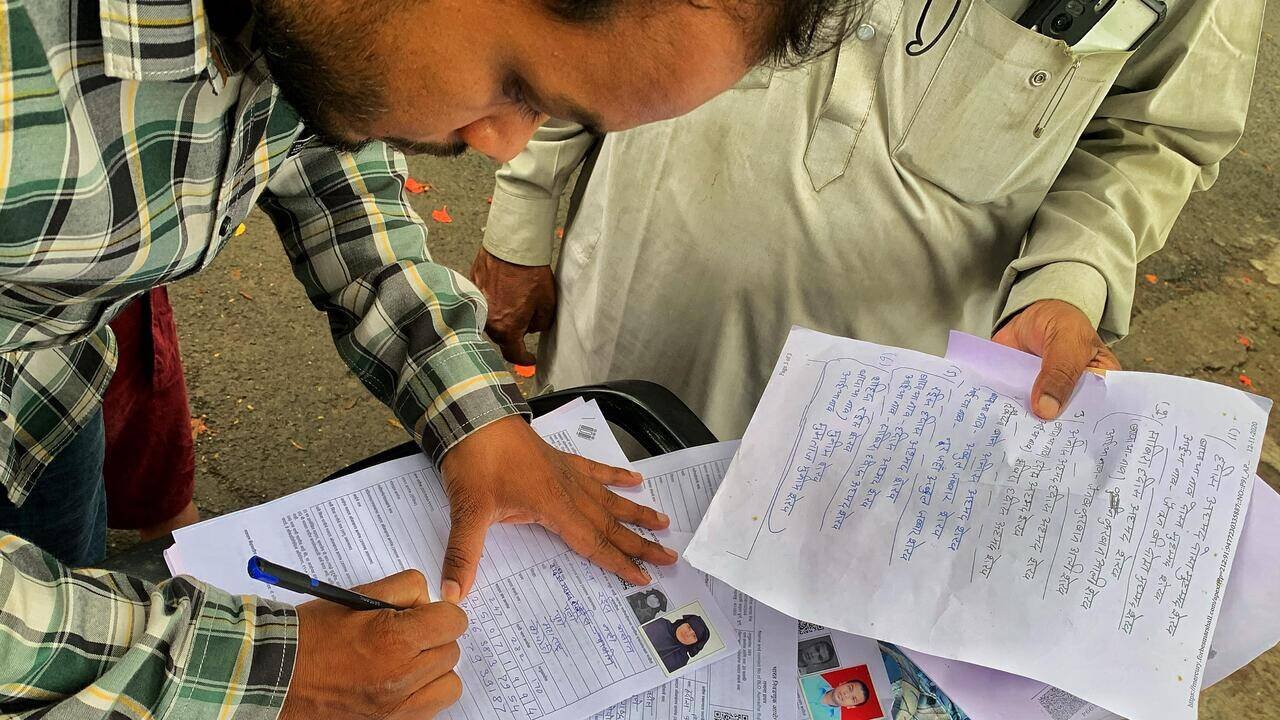
Pune: With only 5.63% of enumeration forms digitised under the Special Intensive Revision (SIR) since the exercise began on June 29, the district administration will rope in college and NCC students to assist Booth Level Officers (BLOs) with the process.The state has digitised 12.15% of these forms so far, while 57.65% of nearly 9.79 crore electors have received enumeration forms.Deputy election officer Minal Kalaskar told TOI that college and NCC students would assist BLOs in entering forms in the coming week. “Each BLO has around 1,200 forms to handle. The Pune district has nearly 90 lakh voters and significant migration, making the exercise challenging. The rainfall and wari have also slowed the process to some extent, but we expect the pace to pick up,” she said.According to the chief electoral officer’s bulletin released on Saturday, Pune has distributed forms to 35.93% (32.62 lakh) of its over 90.8 lakh electors, while digitisation stands at 5.63% (5.10 lakh). The district, however, has already completed the mapping of around 54% of voters with the 2002 electoral roll, which officials said would help while filling enumeration forms.Kalaskar said BLOs, including teachers engaged in the exercise, were expected to complete the process within the stipulated period, while booth-level agents (BLAs) had also been asked to assist.On the other hand, several voters said they were facing difficulties while filling forms, especially sections requiring details from previous electoral rolls and family information.“I received the form, but understanding some of the requirements was difficult. Many senior citizens are confused about how to fill sections linked to old voter lists,” said Kothrud resident Prasanna Bhat.A Wakad resident said many voters did not have older documents readily available. “The form asks for details from previous electoral rolls, and not everyone knows where to find this information. More assistance is needed while filling out the forms,” he said.Some residents also said they were waiting for BLO visits. “The SIR exercise has started, but the BLO has not yet reached our society. Residents are unsure whether to wait or approach officials for help,” said a Kondwa resident, Meera Chavan.Election officials said BLOs were conducting door-to-door visits and setting up camps in housing societies to improve coverage.In the recently concluded assembly session, state higher and technical education minister Chandrakant Patil has assured the house that they would reach out to the chief electoral office for an extension. Congress MLC Satej Patil had also flagged the mounting workload on BLOs, manpower shortages and monsoon-related disruptions.Congress MLC Satej Patil told the house that each BLO had been assigned nearly 1,000 voter forms, with two forms required to be filled during the revision process. Patil urged the govt to appoint additional BLOs and deploy govt employees other than teachers for the exercise so that academic work was also not affected.He also demanded that the state formally approach the CEO and the ECI seeking a six-month extension to the exercise, saying the existing July 29 deadline was unrealistic given the workload and weather-related disruptions.Among other urban districts, Thane has recorded the lowest digitisation (1.81%), followed by Mumbai Suburban (2.36%), Palghar (3.24%) and Mumbai City at 5.63%.Form distribution remains lowest in districts, namely Mumbai Suburban (16.14%), Mumbai City (24.48%), Palghar (26.96%) and Thane (27.40%).In divisions, the Konkan division remains the slowest-performing region with only 28.63% form distribution and 4.62% digitisation. The Pune division has distributed forms to 58.48% of its 2.16 crore electors, while digitisation is at 11.10%. In contrast, smaller districts have progressed faster. For instance, Hingoli has distributed forms to 99.81% of electors, followed by Dhule (95.27%), Gondia (95.24%) and Bhandara (91.93%). Chandrapur district leads in digitisation at 35.37%, followed by Ratnagiri at 27.87% and Yavatmal at 26.8%. With the enumeration phase scheduled till July 29, election officials face the challenge of accelerating both form collection and digitisation, particularly in urban districts where elector numbers are high.


