






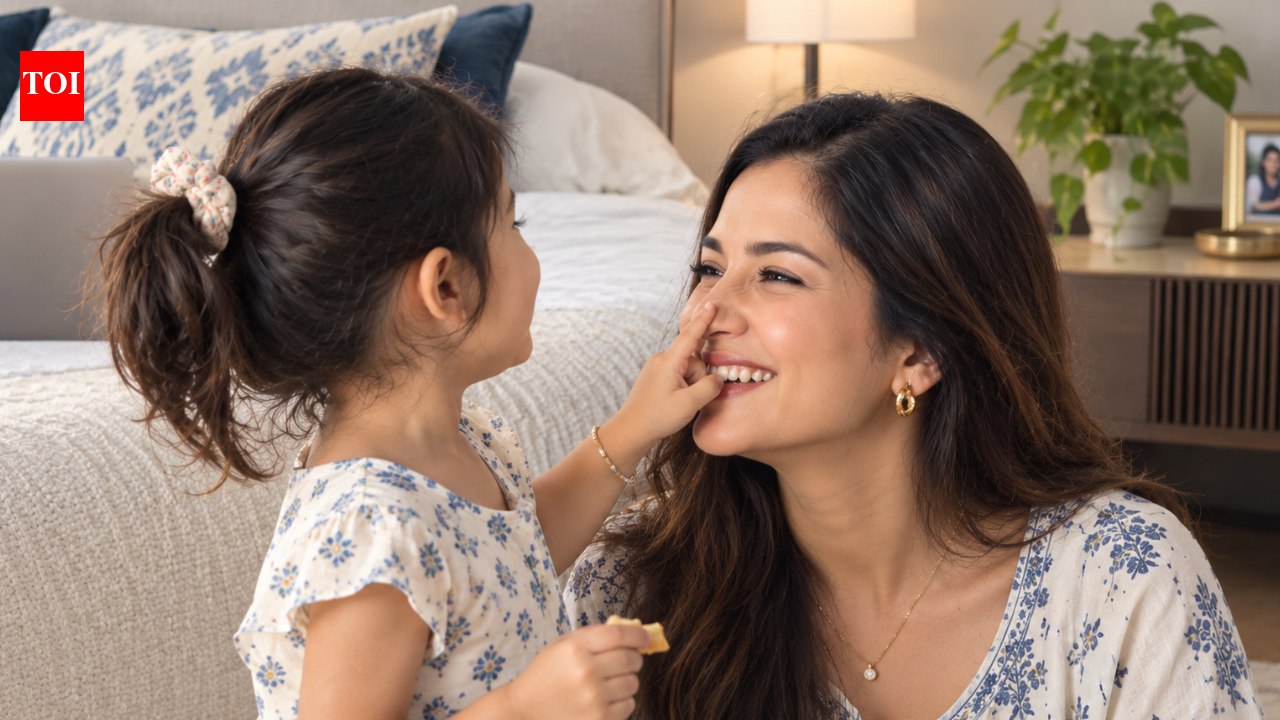
A child is telling you about something that happened at school. They are talking quickly, jumping from one detail to another, and somewhere in the middle of the conversation, their hand reaches for your face. They touch your cheek, trace your eyebrow, hold your chin or gently tap your nose before continuing with the story.You move their hand away. A few seconds later, it is back.
5 Oct 2026 | 12:06
Parents, when your child refuses to greet relatives, do you make them say hello or respect their choice?
For parents, this can be one of those small childhood habits that is easy to dismiss as fidgeting or simple mischief. But touch is not a random part of human communication, particularly during childhood. Long before children have the words to explain what they need, physical contact is one of the ways they experience closeness, reassurance and connection.That does not mean every child who touches a parent’s face is secretly communicating the same emotion. There is no scientific evidence that allows psychologists to say, “Face touching always means this.” But research on caregiver touch offers an interesting explanation for why some children may naturally bring physical contact into their conversations.
That little hand on your face may be a child’s way of staying connected.
Sometimes, talking and touching are part of the same interaction
For a young child, communication is rarely limited to words.They may lean against a parent while speaking, hold their hand, sit unusually close or play with the parent’s hair. Touch can simply become part of the way the child stays engaged in the interaction.A review of research on social touch and human development found that touch is involved in attachment, communication, social learning and emotional regulation. The authors note that these effects are particularly important during infancy and early childhood, when children’s brains and social relationships are developing rapidly.In other words, physical contact is not something that sits separately from a child’s emotional world. It can be woven into how they experience relationships.So when a child reaches for a parent’s face while talking, one possibility is surprisingly simple: they may be using touch to stay connected to the person they are communicating with.
Why the face may be especially important
There is another reason this behaviour can be interesting. A parent’s face is one of the most important sources of social information for a child.Children watch faces to understand reactions. Is Mum smiling? Is Dad annoyed? Did the parent find that story funny? Are they listening?Research has found a relationship between parental touch and children’s attention to social information.One study published in Cognitive Development observed 39 mothers and their children aged four to six during a 10-minute play session. Researchers recorded the amount of maternal touch and later tested how strongly children oriented towards social information, including faces. Greater maternal touch was associated with stronger social orienting.The researchers were not studying children touching their parents’ faces. That distinction matters. But their findings suggest that tactile experiences with a caregiver can be related to the development of children’s attention to social cues.For a child, therefore, physical contact may be one more way of remaining tuned in to a parent during an interaction.
A simple childhood habit could reflect the child’s need for closeness and connection.
It may be a quiet way of asking, “Are you still with me?”
Think about what happens when a child is telling a story while a parent is cooking dinner, looking at a phone or working on a laptop.The child may keep talking. They may repeat themselves. They may stand closer. And sometimes they may touch the parent’s face.It would be too strong to label this automatically as “attention-seeking”. But children do have ways of trying to maintain a parent’s attention without explicitly saying, “Please stop what you’re doing and listen to me.”Touch can be one of them.A broader body of developmental research shows that responsive caregiving – noticing a child’s signals and responding appropriately – is closely linked with children’s social and emotional development. The important point is not whether the child is touching the parent’s cheek, but how the parent and child are responding to each other during these moments.The child’s touch may therefore be less about the face itself and more about maintaining a moment of connection.
Touch can also make a child feel safe
There is particularly interesting experimental evidence on this.In a study of 138 parent-child pairs, researchers examined whether a brief, gentle touch from a parent affected children’s responses to social threat. The children were between eight and 10 years old or 11 and 14 years old.Parents in one group were instructed to briefly touch their child’s shoulder, while parents in the comparison group did not.The researchers found that parental touch reduced children’s implicit attention to social threat. Among children with higher social anxiety, parental touch was also associated with greater trust.Again, this study was about a parent’s touch on the shoulder – not a child’s hand on a parent’s face. So it cannot prove that face-touching means a child is looking for safety.But it does tell us something useful: physical contact from a trusted parent can carry social and emotional information for children.That may help explain why some children instinctively seek physical contact when they are excited, uncertain, tired or emotionally engaged.
Sometimes it may simply be affection
There is also a much less complicated explanation: the child may simply enjoy being close to the parent.Children do not always express affection through hugs. One child may constantly climb into a parent’s lap; another may hold their hand; another may put their head on the parent’s shoulder.For some children, touching a parent’s cheek or playing with their hair may become their own little ritual of closeness.Research reviews on affectionate caregiver touch have linked positive touch with parent-child bonding and interactional synchrony. Researchers have also examined the role of touch in the development of social and emotional systems, including mechanisms involving the body’s oxytocin system.That does not mean parents should interpret every affectionate touch as evidence of a particular hormone or brain process. Such claims would go far beyond what the research can establish.The simpler conclusion is more useful: warm, responsive touch is an important part of many healthy parent-child relationships.
And sometimes, the child may just like the sensation
Parents can also over-psychologise perfectly ordinary childhood behaviour.A young child may touch a parent’s nose because it is funny. They may like the softness of a cheek or the texture of eyebrows. They may have discovered that touching Dad’s nose makes him laugh.Children learn through their senses, and touch is one of the earliest ways they explore people and their surroundings.So a child who touches a parent’s face repeatedly does not necessarily have an unmet emotional need. Sometimes a habit is simply a habit.The context matters.If the behaviour appears mostly during affectionate conversations, it may be part of the child’s way of connecting. If it appears when the parent is distracted, it may be an attempt to regain engagement. If it happens when the child is tired or upset, physical contact may be comforting. And if the child does it everywhere and with everyone, sensory curiosity or habit may be a more useful explanation.
What should parents do?
There is no need to immediately stop a child from touching your face if the contact is gentle and comfortable.Instead, parents can observe what is happening around it.Is the child trying to tell you something important? Are you looking at your phone? Have they just come home from school? Are they upset? Are they laughing? Are they simply sitting beside you and chatting?Those details can tell you far more than the gesture itself.At the same time, children need to learn that affection does not cancel personal boundaries.If a child pokes your eyes, pulls your lips or keeps touching you after you have said no, a calm boundary is appropriate.A parent could say, “I know you want to touch my face, but please be gentle,” or, “You can hold my hand instead.”That way, the child learns two things at once: connection is welcome, and bodies still have boundaries.
The deeper reason may be the relationship, not the gesture
Perhaps the most useful way to look at this behaviour is not to ask, “What does touching my face mean?”Instead, ask, “What is happening between us when my child does it?”Developmental research increasingly shows that children learn about relationships through repeated everyday interactions – being responded to, comforted, spoken to, looked at and touched.A child reaching for a parent’s face during a conversation may therefore be doing something much more ordinary and much more meaningful than parents realise.They may be keeping the conversation physically close. They may be checking that the parent is still engaged. They may be expressing affection. They may be regulating themselves through familiar contact.Or they may simply have discovered that Mum’s nose is extremely funny.There is no single psychological answer.But if the child is reaching out gently while talking, laughing and trying to stay close, it may be worth seeing the behaviour not merely as a distracting habit, but as one of the many small ways children build and maintain a relationship with the people they feel safest with.


