



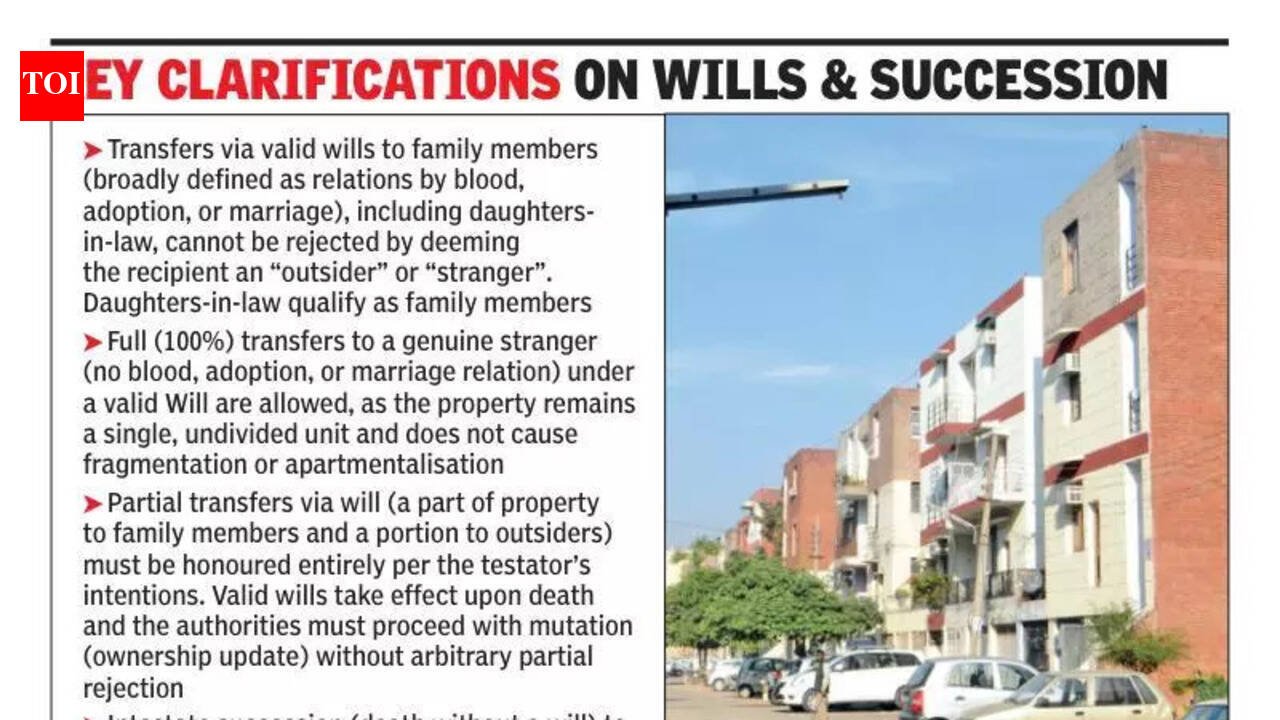
Chandigarh: The Chandigarh administration has issued fresh clarifications regarding property transfers in the city, particularly those involving wills, amid ongoing restrictions stemming from a landmark Supreme Court judgment dated Jan 10, 2023.The apex court ruling prohibits the fragmentation, division, bifurcation, or apartmentalisation of single residential dwelling units, especially in phase-I (sectors 1-30) of Chandigarh—known as “Corbusian Chandigarh”— to safeguard the heritage vision of architect Le Corbusier and prevent conversion of independent houses into multiple apartments occupied by unrelated individuals.The clarifications, issued by the UT estate department following legal consultations, address uncertainties in implementing the Supreme Court directives and a related public notice from Feb 10, 2023 (issued shortly after the judgment to guide compliance).“So far as the devolution of property in favour of the legal heirs in case of intestate death is concerned, the same has nothing to do with the fragmentation and apartmentalisation of the property. Even the testamentary successions where the entire share is being bequeathed in favour of the beneficiary of a will, who is not related to the testator, will not lead to fragmentation of the property,” the estate department communication to the estate office states.It was clarified that property transferred to a daughter-in-law via a genuine will could not be rejected by treating her as an outsider or stranger. A daughter-in-law is not a “stranger”. Family members can be related by blood, adoption, or marriage. A daughter-in-law counts as a family member.In case a will gives 100% of the property to a complete stranger (no blood, adoption, or marriage relation) and the will is genuine and valid, then there is no problem transferring the full share. It does not cause fragmentation or apartmentalisation (the property remains one unit).If the will gives a part of the property to a family member and another part to an outsider, even then the will must be followed fully (in total), not partially or piece by piece. A valid will cannot be ignored arbitrarily. The testator’s (person who made the will) intention must be respected. It takes effect immediately after death, and mutation (ownership update) should happen based on it, it was clarified.However, the authorities can refuse building plan approvals if it looks like it can lead to one house being turned into multiple apartments for unrelated people. Later sales (one beneficiary selling their share to another or to a third party) must be checked case by case to prevent fragmentation, the estate department clarified.The legal advice also stated that while passing the judgment dated Jan 10, 2023, the apex court primarily focused on phase-I of Chandigarh (Corbusian Chandigarh). It was observed that fragmentation and apartmentalisation of residential units in phase-1 of Chandigarh is destructive of the vision of Le Corbusier.


