



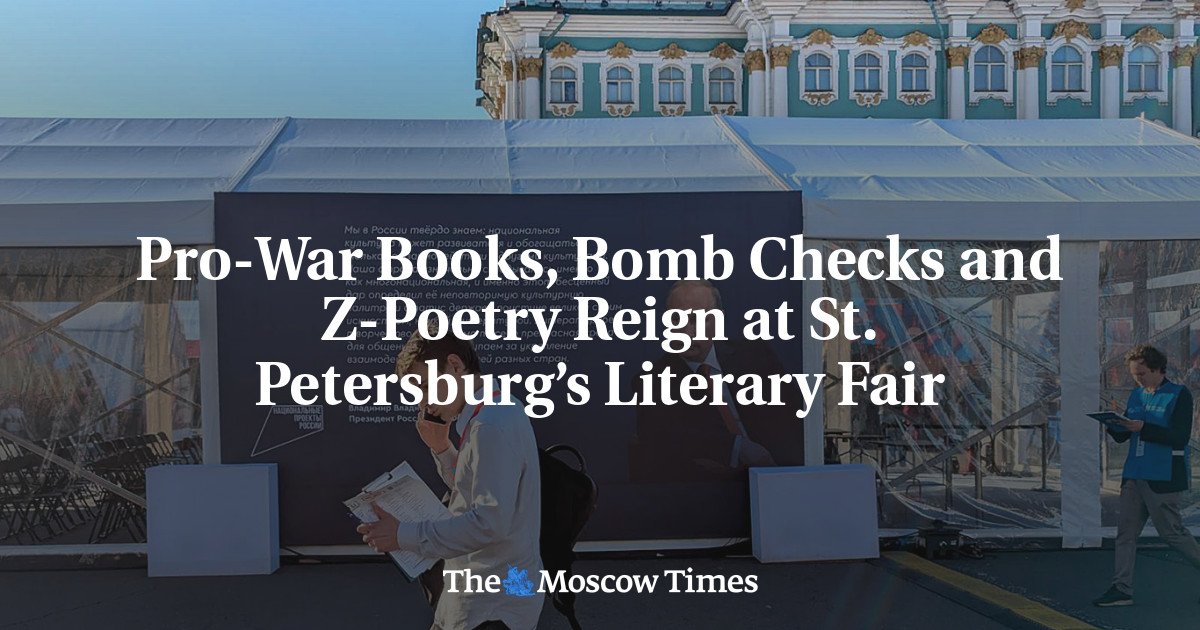
St. Petersburg, RUSSIA — Hundreds of people were gathered on Palace Square to see Zakhar Prilepin, one of Russia’s best-known nationalist writers, present his latest novel at the St. Petersburg International Book Fair.
But Prilepin, a vocal supporter of the war who fought alongside pro-Russian separatists in eastern Ukraine beginning in 2014, was running half an hour late.
As the crowd waited, police units combed the area around the pavilion while a police dog checked the building for explosives.
Prilepin survived an assassination attempt in May 2023 when a bomb exploded under his car in central Russia. His public appearances have been accompanied by heightened security measures ever since.
Finally, audience members were admitted individually and searched before entering the venue.
“That’s right. We must protect our national treasure!” one of his fans shouts.
Z-poetry
The St. Petersburg International Book Fair, one of Russia’s largest literary events, was once attended by European authors and members of the British royal family.
Today, it has become another venue for promoting narratives supporting Russia’s invasion of Ukraine.
This year’s May 21-24 event featured pro-war writers, correspondents and foreign commentators sympathetic to the Kremlin, while many prominent anti-war Russian authors remain in exile and their books have disappeared from Russian shelves under creeping censorship.
Not far from Prilepin’s talk, a performance of “Z-poetry” — wartime verse that emerged after the 2022 invasion and draws on Soviet World War II traditions while openly romanticizing contemporary warfare — was taking place on the fair’s main stage.
Moscow Times Reporter
One veteran using the pseudonym Valentin Yukhta delivered a dramatic poem about war in central Africa.
“The storm split the sky like an axe in flight,” he recited. “Thunder struck like a gong, calling battle to rise. All burned in the rain, in the screams of the night. Corpses below and jets in the skies.”
‘Are we going to make peace?’
In another pavilion, Grigory Kubatyan, a war correspondent for the pro-Kremlin tabloid Komsomolskaya Pravda, presented a collection of stories from areas near the front line.
“In war, there is much that is terrifying and funny, mad and surreal,” Kubatyan told the audience, recalling people waiting at a bus stop beside a burning vehicle. “When someone asks them: ‘Why are you standing here? Your bus has burnt down.’ They calmly reply: ‘Well, yes, that one burnt down. But there’ll be another one’.”
He repeated a common Kremlin narrative that the war had dragged on because “the whole of NATO” was fighting Russia in Ukraine.
“Russia tried until the very last moment to prevent the events leading up to the war. We can criticize our leadership for having been deceived [by the West and Ukraine]. But the fact is that while we were trying to reach an agreement, they were preparing for war” claimed Kubatyan.
Among the stories in Kubatyan’s book is one about a Russian female sniper allegedly engaged in a duel with a NATO sniper.
Although volunteers from Western countries serve in Ukraine’s armed forces, there is no independent confirmation of direct NATO military involvement in the conflict.
The discussion was interrupted when an elderly history professor from St. Petersburg University asked whether Russia would eventually make peace.
“You were having such a good time telling your stories that I thought perhaps we were being filmed for some sort of show. But I have a serious question. Are we going to make peace in the end?” he asked.
“That’s a question for the military leadership,” Kubatyan replied. “I’ll put it this way: given that an inhuman Nazi pseudo-state has now been formed in Ukraine, making peace with it is ethically wrong and pointless. If we make peace with them, it won’t last long. It’s not that simple.”
At this point, the discussion moderator announced that the event had come to an end.
“It is time for us to admit that this war has reached a stalemate. Our economy is smaller than that of the European Union. They can churn out as many drones as they like,” the professor said, comparing the invasion of Ukraine to the Crimean War of the 1850s, which ended in military defeat and economic exhaustion for Russia.
‘The French Choice of Russia’
Elsewhere at the fair, a panel titled Our War: The French Choice of Russia featured French commentators Laurent Brayard, Christelle Néant and Xavier Moreau, who discussed “Russia’s confrontation with the West and the ‘special military operation’ through French eyes.”
Brayard and Néant had traveled to eastern Ukraine to cover the conflict between Kyiv and Russia-backed rebels that started in 2014, with their coverage supporting the rebels.
Néant said she planned to write a book alleging that Ukrainian authorities remove children from Russian-speaking regions and later sell them into pedophile networks and the organ trade.
Those claims have not been independently verified and are unsupported by publicly available evidence.
Moreau, a former French military officer who moved to Russia in the early 2000s, has become a prominent pro-Kremlin commentator, hosting programs on RT France. In December 2025, he was sanctioned by the EU for spreading what it described as Russian propaganda.
The panel discussion largely boiled down to “exposing” Western globalist elites, who, the speakers claimed, were responsible for France losing its “true roots.”
“Are there many people in France who share your views? Or is the country entirely Russophobic?” one of the women in the audience asked.
“The French elites consider you Russians to be subhuman. I’m sorry to say it, but it’s true,” Moreau replied. “However, I can say that the majority of army officers actually support Russia, but are afraid to speak out about it.”
Moscow Times Reporter
The toughest time for the book industry
While this year’s St. Petersburg book fair celebrated pro-war literature, Russia’s publishing industry is facing increasing pressure.
Since the start of the full-scale invasion, Russia’s literary landscape has been effectively split between anti-war figures in exile and pro-war voices promoted by the authorities.
Writers including Dmitry Bykov, Boris Akunin, Dmitry Glukhovsky and Vladimir Sorokin, have condemned the war and left Russia, while their works have largely disappeared from sale.
Authorities are now cracking down on cultural expression that falls outside the Kremlin’s vision of “traditional values,” as well as many works by foreign authors.
In 2025, authorities launched a criminal investigation into publishers Popcorn Books and Individuum over “Summer in a Pioneer’s Tie,” a novel about a romantic relationship between a teenager and a camp counselor at a Soviet-era summer camp.
Three senior managers from Popcorn Books remain under house arrest as part of the probe into LGBTQ+ “propaganda” and “extremism.”
Publishers have reportedly advised bookstores to “dispose of” copies of books such as André Aciman’s “Call Me by Your Name” and works by Slovenian philosopher Slavoj Žižek.
The crackdown has effectively triggered a wave of self-censorship at independent publishers that still released books on sensitive topics like LGBTQ+ issues and criticism of the war.
An employee at one of St. Petersburg’s oldest independent bookstores told The Moscow Times that she now assesses the level of risk involved before ordering any book from a publisher.
“Many books that we’re now afraid to put on sale are just sitting in our warehouses, waiting for better times,” the employee said, speaking on condition of anonymity for safety reasons.
She said her store’s management decided not to participate in the fair this year.
“It’s the s***iest festival. It’s all about the state agenda. Yes, book sales would be high. But our reputation is more important to us,” she said.
A Message from The Moscow Times:
Dear readers,
We are facing unprecedented challenges. Russia’s Prosecutor General’s Office has designated The Moscow Times as an “undesirable” organization, criminalizing our work and putting our staff at risk of prosecution. This follows our earlier unjust labeling as a “foreign agent.”
These actions are direct attempts to silence independent journalism in Russia. The authorities claim our work “discredits the decisions of the Russian leadership.” We see things differently: we strive to provide accurate, unbiased reporting on Russia.
We, the journalists of The Moscow Times, refuse to be silenced. But to continue our work, we need your help.
Your support, no matter how small, makes a world of difference. If you can, please support us monthly starting from just $2. It’s quick to set up, and every contribution makes a significant impact.
By supporting The Moscow Times, you’re defending open, independent journalism in the face of repression. Thank you for standing with us.
Continue
Not ready to support today?
Remind me later.
×
Remind me next month
Thank you! Your reminder is set.


