



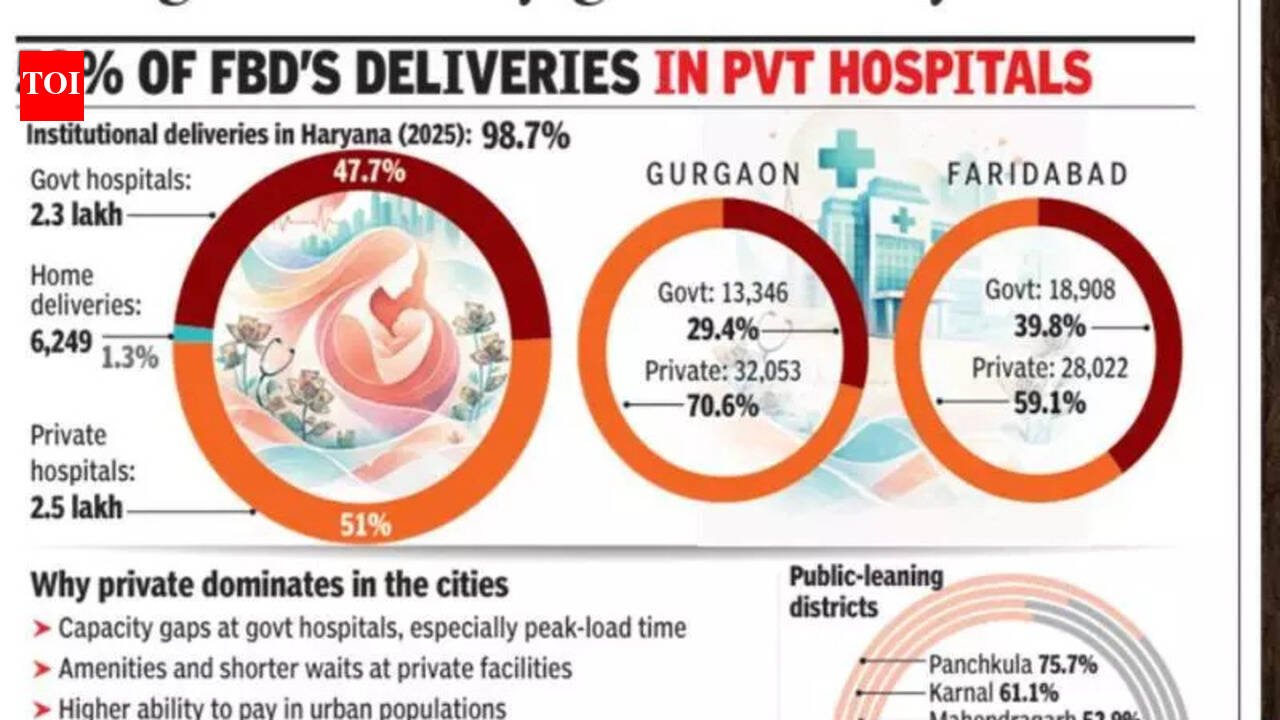
Gurgaon: Haryana‘s institutional delivery numbers appear strong at first glance. However, district-level data shows that Gurgaon and Faridabad are dragging down the public-sector share. In 2025, 98.7% of births in the state took place in health facilities. While govt hospitals handled 2.34 lakh deliveries — 47.7% — private hospitals conducted 2.5 lakh (51%). Home births, though a small share, still accounted for 6,249 cases (1.3%).According to the district-wise breakup, in Gurgaon, only 29.4% of deliveries took place in govt hospitals (13,346 births), against 70.6% in private facilities (32,053). Faridabad shows a similar tilt, with 39.8% of deliveries in govt hospitals (18,908 cases) and 59.1% in private hospitals (28,022).In short, private hospitals handled seven in 10 births in Gurgaon, bringing down Haryana’s govt facility share. This contrasts sharply with several other districts where public facilities remain the first port of call for childbirth. Panchkula (75.7%), Karnal (61.1%), Mahendragarh (52.9%) and Sirsa (54.8%) — all report a majority of births in govt hospitals, indicating a more balanced or public-leaning system outside the state’s biggest urban centres.Health officials attribute the private-sector dominance in Gurgaon and Faridabad to a dense network of private hospitals, perceived better amenities and higher out-of-pocket paying capacity among urban families. Public-health experts, however, warn that this pattern also signals under-utilisation of govt maternity services in districts that host some of the state’s busiest public hospitals — an imbalance that can widen inequities in access and affordability.In the city, the skew towards private hospitals also reflects persistent capacity constraints in the public system. Doctors and patients at the Sector 10 Civil Hospital long flagged space and staffing shortages. In mid-2023, TOI reported that a 26-year-old woman delivered on a corridor floor outside the delivery room after labour pains began en route to the ward, an episode that triggered a departmental inquiry and a reshuffle of ward guards and staff. Doctors at the Sector 10 hospital in Gurgaon said, “The hospital often runs well beyond its sanctioned bed strength, especially during peak delivery periods, squeezing referrals, postnatal care and privacy, factors that nudge families towards private facilities even for routine births.” The data also underlines that home deliveries are not eliminated. Faridabad alone reported 522 home births in 2025, while Palwal logged 1,296, among the highest in the state. Statewide, over 6,000 women still delivered at home despite long-running institutional delivery and maternal health programmes. Specialists point out that even small percentages translate into large absolute numbers, often tied to migrant belts, informal settlements, interrupted antenatal follow-up or late arrivals at facilities.A senior health official said, “When most districts show strong reliance on govt hospitals, Gurgaon and Faridabad’s numbers are worrying. It’s not just about infrastructure—it’s about confidence in public care.” As Haryana holds the line on institutional deliveries overall, its most urbanised districts are becoming increasingly dependent on private healthcare. The trend raises difficult questions on equity, out-of-pocket costs, and the long-term capacity of the public system to anchor maternal care as populations grow and urbanise.


