



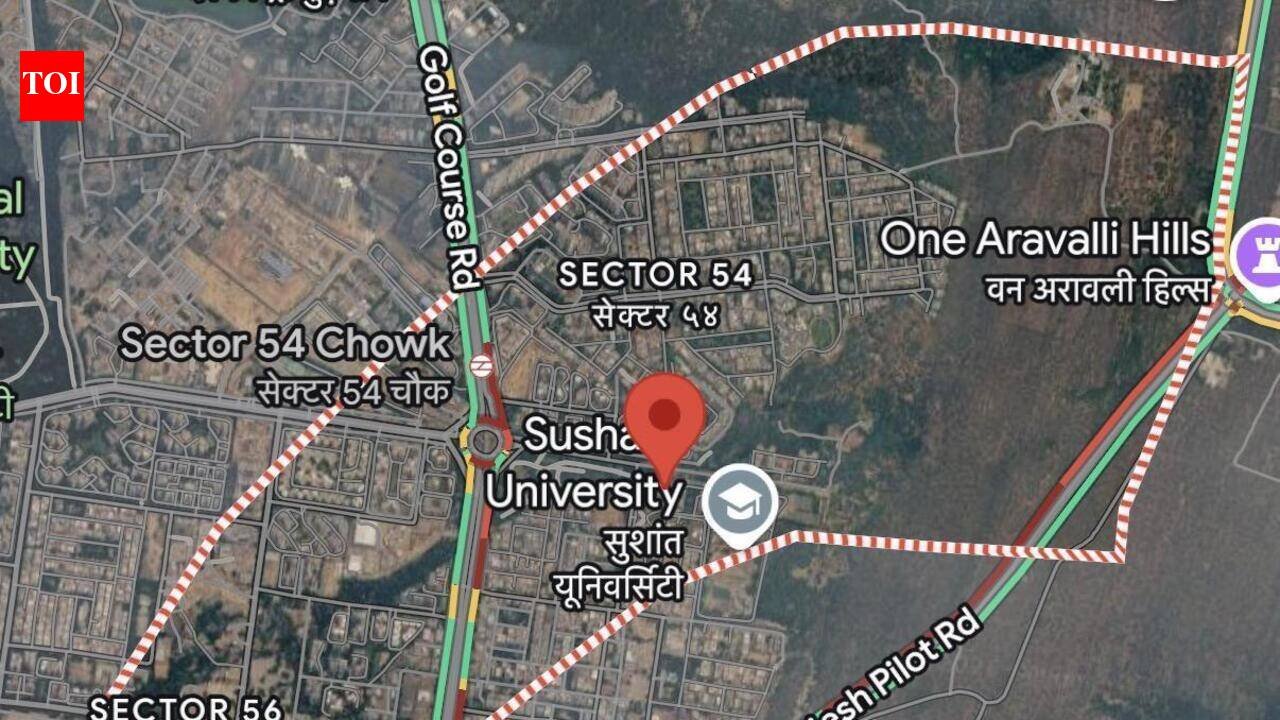
Gurgaon: Supreme Court has restored ownership of a prime land parcel worth over Rs 30,000 crore to MCG.The property abutting Golf Course Road — in one of India’s most expensive real estate corridors — vests in MCG, an SC bench ruled on Monday, setting aside a 2007 Punjab and Haryana high court judgment.The dispute concerns the uninhabited land parcel — 436 bighas and 18 biswas — in Wazirabad. Rejecting decades-old private ownership claims, the bench of Justices Sanjay Kumar and K Vinod Chandran ruled that this land situated in the city’s Haiderpur village forms part of village common land (shamilat deh).The court disagreed with HC, which had accepted the claims of private proprietors and subsequent purchasers, including developers, after holding that the panchayat had failed to prove the land was actually used for common village purposes.Delivering the 85-page judgement on Monday, the bench observed at the outset that the litigation involved land in one of the country’s fastest-appreciating property markets.“Land is considered the ‘new gold’. More so, when such land is proximate to expanding urban agglomerations. Land in Gurgaon in the state of Haryana, lying right next to the NCT of Delhi, qualifies in this regard with flying colours,” the bench said.The case is about who legally owned around 436 bighas of valuable land in Haiderpur — the private landowners (and companies that later bought the land) or the gram panchayat.The main dispute was whether this land was “shamilat deh” (village common land), which by law belongs to and is managed by the panchayat for the benefit of the village, or whether it was privately owned land that never became panchayat property.The case has gone through revenue authorities, HC and finally SC, which had to examine old revenue records, village customs and historical land laws to decide the true legal status and ownership of the land.After examining colonial-era settlement records, Punjab Village Common Lands (Regulation) Act, 1953, the Haryana legislation and decades of precedent, the bench concluded that the land continued to retain its legal character as shamilat deh.The court also rejected the contention that MCG lacked the authority to continue litigation after the abolition of the gram panchayat. Referring to Section 161 of the Haryana Municipal Corporation Act, 1994, the court held that village common lands vesting in the panchayat automatically passed to the municipal corporation after inclusion of the area within municipal limits.“The argument that MCG had no locus to step into the shoes of the Gram Panchayat… be without merit,” observed the court. After noting that Haiderpur undisputedly fell within the municipal boundaries notified in 2008, the court concluded: “In consequence, the locus of MCG stands settled.”The bench on Monday allowed a batch of connected civil appeals arising out of HC’s 2007 judgement, set aside HC’s Aug 24, 2007 judgement and upheld the 1955 mutation in favour of the erstwhile Gram Panchayat, Wazirabad, whose rights now vest in MCG.Allowing the appeals, the court observed, “The impugned common judgement dated 24.08.2007 passed by the HC is, therefore, unsustainable on facts and in law. The appeals are, accordingly, allowed setting aside the same and confirming the mutation effected on 13.09.1955 in favour of the Gram Panchayat, Wazirabad, which shall enure to the benefit of its successor-in-interest, the Municipal Corporation, Gurgaon (now, Gurgaon).”MCG commissioner Pradeep Dahiya told TOI, “We are now first going to take possession of this 274 acres of land. We will plan the land for public use.”Explaining the process of what lies ahead for the utilisation of this high-value land, an MCG official privy to the matter said, “Based on the demarcation report, we will first take possession of the land. After that, we will determine its status — whether it falls in the Natural Conservation Zone (NCZ), is forest land, or is part of the Aravalis. Once that assessment is complete, we will decide how the land should be used. It is likely to be developed as an eco-tourism project or for a similar environmentally compatible purpose.”


