









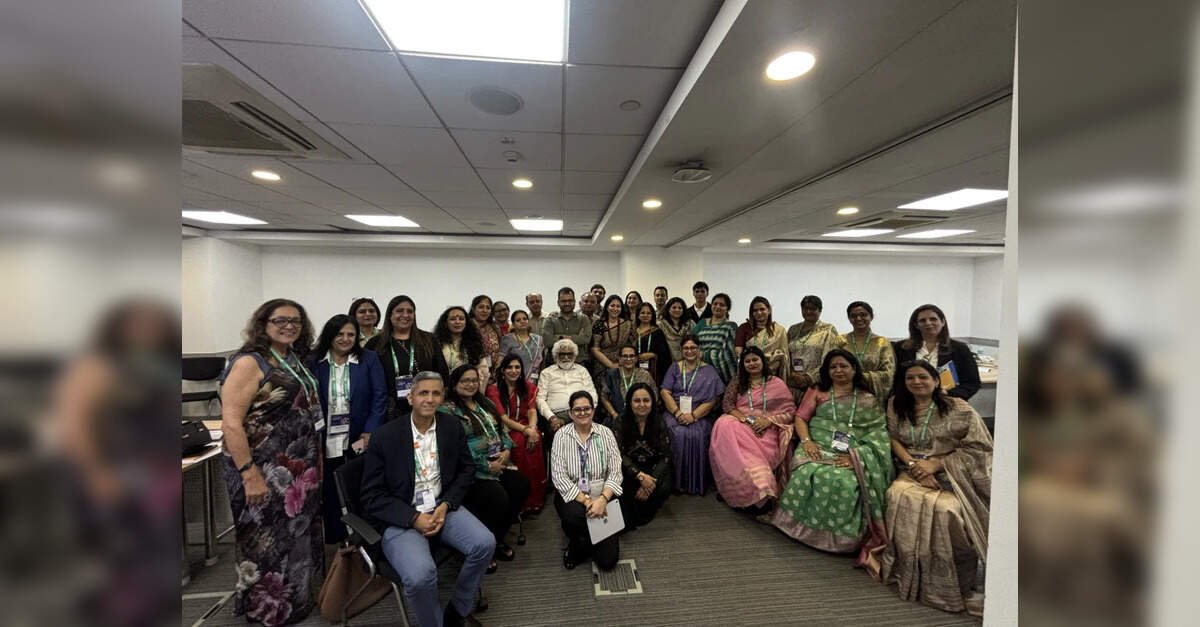
Gurugram, September 2026: School principals, directors and education leaders from across the National Capital Region came together at an exclusive closed-door leadership roundtable organised by ETEducation, to deliberate on what it truly means for a school to be “AI-ready” and how institutions can move beyond AI literacy towards practical, student-led innovation.
The session, held at the ETEducation office in Gurgaon, brought together over 30 school leaders for a candid, table-based discussion moderated by Yasmin Taj, Editor – ETEducation & ETHRWorld, examining how artificial intelligence is reshaping governance, teaching, assessment and student development in Indian schools. The roundtable saw participation from Dr Peeya Sharma (Ryan International School), Rajesh Malhotra (Sainath Public School), Mary Mahendri (Gems International School), Akhilesh Chandra Chaturvedi (Delhi Public School – Maruti Kunj), Dr Shanker Dutt Bhatt (Billabong High School), Manisha Khanna (St Andrews World School), Madhu Uppal (The Blue Bells School), Suresh Chander (Grand Columbus School), Dipin Rao (Sharda International School), Dr. Manisha Dahiya (Sri Chaitanya Schools), Madhavi Goswami (Cambridge School), Ruchi Gambhir and Geeta Sachdeva (Excelsior American School), Raina Bajaj and Vandana Mahajan (Mount Olympus School), Neelu Sharma (Imperial Heritage School), Madhu Chauhan (Tagore Public School), Geeta Kanwar (St Xavier’s High School), Nishu Pandey (Sri Venkateshwar International School), Moksha Yadav (The Moksh International School), Shivani Mishra (SCR Global School), Anuradha Gupta (The Shriram Millennium School, Gurugram), Philomena Gonsalves (Saraswati Global School), Dipika Sharma (Maxfort School, Dwarka), Dr Jyoti Pruthi (International Affairs & Collaborations), Sanyogita Sharma and Dr Manpreet Kaur (Manav Rachna International Schools), Monika Mehta (Shreeji School), Himani Asija (Ambience Public School), and Heemal Handoo (Hansraj Model School).
Beyond the AI-enabled label
Opening the discussion, participants agreed that AI readiness cannot be reduced to a checklist or the mere presence of tools such as ChatGPT in classrooms. A genuinely AI-ready school, leaders noted, must align its leadership vision, culture, curriculum, pedagogy, assessment practices, teacher capacity, student behaviour, administration and ethical safeguards not adopt technology for its own sake.
The larger question, several leaders observed, was whether schools were building an AI-literate society or an AI-native one. While concerns around student dependency, declining creativity, copied assignments and unreliable AI-generated question papers surfaced repeatedly, the roundtable placed greater emphasis on constructive, forward-looking applications of the technology.
Teachers as mentors, not just users
A recurring theme was the evolving role of the teacher from “sage on the stage” to “guide on the side.” Leaders argued that an effective AI mentor must be familiar with relevant tools, capable of evaluating AI-generated information critically, aware of institutional policies, and equipped to question AI-supported student answers through open-ended, reasoning-based prompts.
Participants called for teacher training to move beyond basic tool operation which most educators pick up independently towards using AI meaningfully to strengthen pedagogy, differentiate instruction and reduce administrative workload, particularly around lesson planning and paper correction.
Rethinking assessment
With written submissions increasingly vulnerable to AI-generated copy-paste work, leaders called for updated assessment rubrics that evaluate reasoning, collaboration, creativity, research, real-world application and the ability of students to explain their own work to peers. One example discussed was reframing a conventional water-purifier model project into an investigation of school-level water wastage pushing students to demonstrate understanding rather than submit a polished final product.
A governance framework for schools
Discussions also centred on the need for formal, documented AI governance at the school level, aligned with government and CBSE guidance. Suggested measures included a dedicated AI governance committee, a written school AI policy, risk classification frameworks (red, yellow, green), clear rules on data inputs, AI declaration forms for student and staff work, and defined protocols for reporting AI-related incidents.
Leaders stressed that such governance should not rest solely with senior management principals, teachers, support staff, parents and students all have a role to play, with support staff flagged as a group requiring particular awareness and safeguards.
From classroom projects to real-world impact
The concluding discussion returned to a central idea: that AI-readiness should be measured not by dependency but by interdependence students using AI as one tool among many to investigate authentic problems, collaborate, present ideas and iterate. Examples shared during the session included a student-led bus-tracking application and a nationally recognised innovation that began as a
Class 4 idea and was eventually patented.
The session also included a special introduction to the India School AI Challenge (ISAC) 2026, offering schools and students a platform for challenge-based AI learning and real-world problem-solving.
As the roundtable drew to a close, one thing was clear: the schools represented in the room were not waiting for AI readiness to arrive – they were already building it, one classroom, one policy and one student idea at a time. With platforms like ISAC 2026 on the horizon and a shared commitment to keeping human judgment at the heart of innovation, the road ahead for India’s schools looks less like a challenge to be managed and more like an opportunity to be shaped.


