



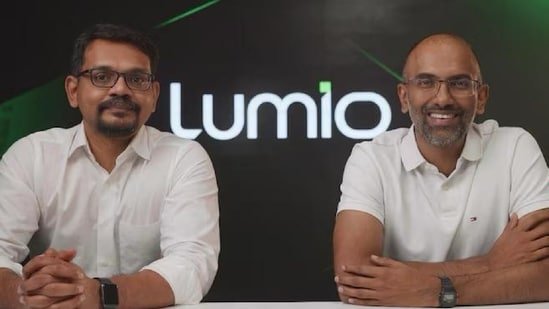
The home entertainment market in India has changed drastically in the past couple of years. From racing to pack brighter panels, thinner bezels and louder speakers in a single device to focusing on content discovery and on-device AI, the smart TV space has evolved rapidly in a short span of time. This shift has not only intensified competition in an already crowded Indian market but it has also begun to change what buyers expect from their smart TVs. Interestingly enough, at a time when most brands are selling hardware specifications, Lumio, a homegrown home entertainment brand founded by Raghu Reddy and Kailash Sankarnarayanan, is taking a different approach – it is building features, rather experiences, that aim to solve everyday issues of Indian users.
For instance, Lumio’s discovery app, TLDR, which comes pre-loaded on its TVs, began solving the content discovery issue for music and sports fans. Then earlier this year, the company launched a version 2 of this app, which solves this problem for almost all content categories. In addition to this, the company recently launched Project Neo, which puts an “agentic AI” to work between your phone and your TV.
For the unversed, Project Neo lets a user scan a QR code in the TLDR app, pair their WhatsApp number, and text the TV a query as casual as wanting a movie where a particular celebrity is dancing on a train. Project Neo then finds the title and shows the user whether it is available on the set. It works over chat and voice, and the founders say they have tested and validated more than nine Indian languages that perform well with it. Another feature that Lumio has launched in beta mode lets users forward an Instagram reel to Lumio’s handle, after which the system detects the film or show, and then it shows titles relevant to the reel to the users on their TVs.
Lumio’s future plans
These features are aimed at bridging the gap between the content that users experience on their smartphones, on social media, and the one that they access on their smart TVs. To understand Lumio’s future plans, we sat down for a conversation with Raghu Reddy and Kailash Sankarnarayanan, co-founders of Lumio. During our conversation they said that instead of chasing panels, processors and other hardware-led specs alone, Lumio’s approach is to identify real problems in the viewing experience and build both hardware and software to solve them.
“Our fundamental belief is to identify problems people face in their experience and build both hardware and software solutions that keep making it better,” Sankarnarayanan told HT Tech, adding that TVs slowing down and the daily struggle of deciding what to watch were the two pain points no one was addressing and it’s what led to the duo to decide on making smart TVs first.
During our conversation, the Lumio co-founders also touched upon the company’s future plans in India, in terms of features and experiences. While the founders named Project Neo as an early effort, they did mention what was coming next.
“…soon we’ll launch collections, where you can text on WhatsApp any time whatever comes to mind, and it shows up as a collection when you next switch on. We’re also building a feature to send a photo to the WhatsApp number and have it appear on your TV, since sharing family photos to a TV is usually tedious. So we’re simplifying the friction that keeps you from enjoying the TV,” Sankarnarayanan said during our conversation.
Interestingly, while Lumio is leaning into software and discovery, Reddy said monetisation is not a near-term concern. “We’re not really thinking about monetisation at this point. The idea is to double down on TLDR and other experiences: how can we solve for pain points or things people would love to do on a TV but can’t? We’re trying to build solutions for that so people have a better experience on our TV,” he told us, adding that revenue models, if any, will follow whichever features catch on.
Lumio to increase prices of its TVs?
Beyond future plans and new experiences, we also talked about the existing geopolitical conditions and the global chip shortage that has forced brands across categories to raise prices of their device in India and elsewhere around the globe. When we asked the founders a question that has been on everyone’s mind: will TVs get costlier in India? The answer was a polite yes.
“We’ve already seen price increases in smartphones and laptops. TVs are a smaller percentage of the overall bill of materials, but they’re getting impacted too, and you’ll see more price increases in the TV space over the next six months or so,” Reddy told us.
“I think it’s inevitable. Every brand operating is impacted, so everyone will increase prices, including us,” he added.


