



The six police officers arrived at the Snilesworth estate in two pickup trucks last week, according to one account. They asked to go up on the moors, a source said, and “so off they went”.
A vast expanse of spectacularly undulating lands on the western edge of the North York Moors, Snilesworth is globally renowned for its grouse, partridge and pheasant shooting. It is known locally for attracting “rich people from London in helicopters and blacked-out SUVs”.
This time, though, it was another rarified flying visitor that had drawn the police’s interest: the North York Moors are at the centre of a mystery surrounding a missing bird of prey.
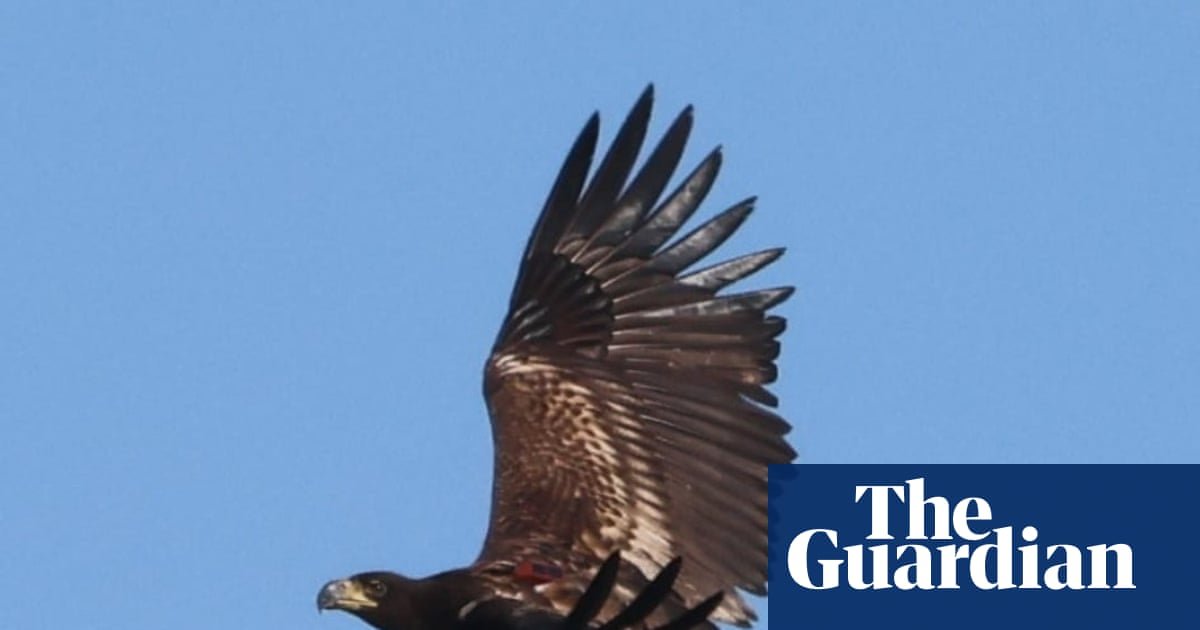
The officers, representing the national wildlife crime unit and North Yorkshire police, were seeking clues to the whereabouts of a white-tailed eagle, also known as a sea eagle, and more colloquially called the ‘flying barn door’, due to a 2.5-metre wingspan that makes them the UK’s largest raptor.
Little appears to have been found in the copse that is said to have been the focus of the officers’ attentions. But enough apparently worried them about the circumstances surrounding the bird’s disappearance for North Yorkshire police to issue a call for information from the public on Monday.
“The eagle’s disappearance is being treated as suspicious,” their press release said, “and an investigation is underway”.
This was a more significant matter than your average avian disappearance. Since 2019, the Roy Dennis Wildlife Foundation (RDWF) and Forestry England have been seeking to reintroduce white-tailed eagles to the south coast.
Once widespread across the UK, human persecution caused their extinction in England, with the last pair breeding there in 1780.
To date, 45 young white-tailed eagles have been released from the project’s base on the Isle of Wight. In 2025, two of the birds bred in Dorset – something not seen in that county for 240 years.
It is the resulting chick – satellite-tagged since birth and now fully grown – that has now disappeared. The cause of the disappearance is unknown. But one possibility aligns with what the RSPB says is a largely unchallenged scandal: the routine shooting, trapping or poisoning of birds of prey in the UK.
The proximity of the eagle’s last known location to a number of large grouse shooting estates has not gone unnoticed. Between 2015 and 2024, 921 confirmed incidents of raptor persecution were recorded, of which at least 55% occurred on or near land managed for game bird shooting, according to the RSPB.
With many similar incidents going unseen and unreported, the figures are said to represent only the tip of the iceberg.
It pays, then, to be careful. When the missing eagle was born last August, a satellite-tag was strapped to its back. “Like a rucksack,” said Tim Mackrill from the RDWF. In the first three years of life, white-tailed eagles are highly nomadic, and this one was no different.
“They have a wanderlust,” said Mackrill. “Last winter it was mainly on the south coast but this spring, it did a huge flight up to the east of England, into Scotland and right into the Loch of Strathbeg in Aberdeenshire.
“It came all the way back to the south coast in Dorset, then in late April it went north again to the North York Moors.”
It may have been a fateful trip. North Yorkshire has a reputation among bird lovers as a raptor graveyard.
A fifth (21.84%) of the confirmed incidents of persecution between 2015 and 2024 occurred in North Yorkshire, with buzzards topping the list of 138 birds killed, followed by red kites and hen harriers.
Of those, 50% were were shot, 21% were poisoned and 13% were trapped. The remaining 16% suffered other forms of persecution including nest destruction.
Mackrill said the signs were ominous. The tag on the missing eagle’s back recorded its location and body temperature every five minutes, transmitting packets of data every six hours.
The bird entered the North York Moors at some point on 30 April. Mackrill said it was by a roost site and still alive at 1.20am the following morning, when the last signal was received.
“Then it went offline and we have had nothing since,” he added. “[Officers] went to see the last known location and nothing was found. It is suspicious because the tags are really reliable. There is no reason for it to stop transmitting.” After the signal went dead, estate staff assisted the RSPB with a search of the area, and nothing was found.
Mark Thomas, head of investigations at the RSPB, runs a 15-person team that helps the police investigate alleged wildlife crimes. He helped secure the conviction this January of gamekeeper Racster Dingwall and two other individuals who were recorded in camouflage on Grassington Moor in the Yorkshire Dales, using radios to coordinate a plot to shoot hen harriers.
“This eagle has vanished in … the worst county in the UK for bird crime,” Thomas said. “North Yorkshire is consistently the worst and has been for like decades.”
He added that it was not the first time that birds from the white-tailed eagle reintroduction project had gone missing – with three disappearing last year in Wales, Scotland and Sussex respectively.
Birds of prey are not generally killed for sport, but in an attempt to prevent any perceived threat to gamebirds or livestock. “All of those cases have been concluded because they just can’t prove what happened,” he said. With regard to the latest disappearance, he reasoned: “I think something has happened in the middle of the night whilst this eagle was at roost. Now, these things don’t fly around in the dark. They will wait till first light.
“If you’re asking me to look at the probability … it’s most likely the bird has been shot. And if the bird is shot whilst it’s roosting, then it’s being shot at night, potentially with thermal imaging gear.”
The best hope for justice, Thomas added, was that the perpetrator would not be able to keep from boasting. “What tends to happen in this community is people chat,” he said. “They will literally go down the pub and say something.”
Dr Ruth Tingay, a conservationist and director of the campaigning group Wild Justice, said: “Wilful blindness is no longer an option,” adding that the police needed more resources and stronger powers.
Organisations representing gamekeepers urged caution, however. Marnie Lovejoy, deputy director of conservation at the British Association for Shooting and Conservation, said: “At this stage no one knows what has happened to this eagle, and we hope it is found alive and well.
“As an organisation we condemn the illegal killing of birds of prey without reservation – but what has happened in this case is exactly what the investigation needs to establish.”
Camilla Swift from the National Gamekeepers Organisation said: “White-tailed eagles specifically have very little impact on game birds or their breeding, and there is no evidence that a gamekeeper was involved in any way.”
Snilesworth estate management declined to comment. Andrew Gilruth, the chief executive of the Moorland Association, said in a statement: “Once again, conclusions are being drawn before the facts are known. The loss of a satellite signal does not prove what has happened to a bird.
“Tags can fail, leaving activists embarrassed when birds they claim have been killed by gamekeepers have later turned out to be alive. Birds can also die naturally or fall ill, and satellite tags may not transmit properly if affected by terrain or cover … Allegations are not facts, and speculation is not evidence.”
Back at the estate, head gamekeeper, Charlie Woof, was busy preparing for a charity clay pigeon shoot. He declined to make any comment about the missing eagle, and there is nothing to suggest that Woof or his team may have been involved in its disappearance. The range of possible suspects is huge, including local farmers and others connected to nearby grouse lands, of which there are many.
Woof may also have been understandably publicity shy after suffering some national media attention as a younger man. In 2008, as a 23-year-old junior gamekeeper on the same estate, he pleaded guilty, alongside the then chief gamekeeper and a fellow junior keeper of illegally trapping birds of prey by using live pigeons as bait, for which he was fined £100.
“It’s private property, I am going to have to ask you to leave,” Woof said when asked about the missing eagle on Thursday. “I don’t know anything about it.”


