



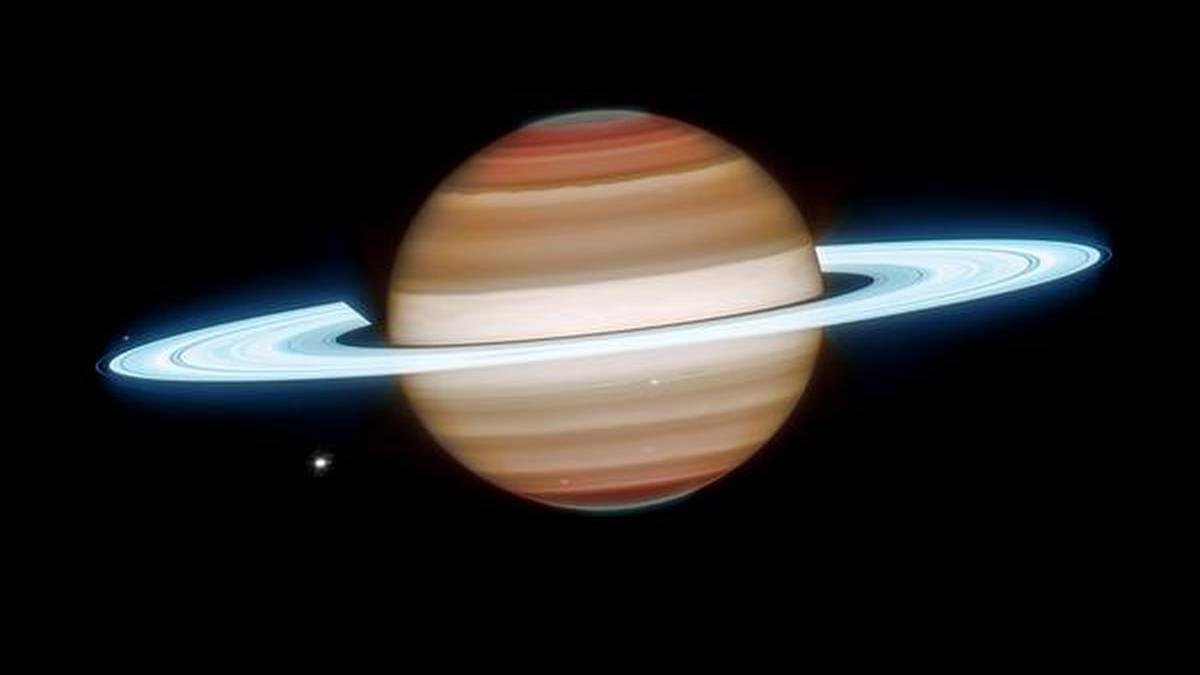
In March 2026, the Webb and Hubble space telescopes teamed up to observe Saturn and acquire a richer understanding of its atmosphere. This image shows Webb’s view. The rings are bright because they are made of water ice, which is very reflective.
| Photo Credit: Space Telescope Science Institute/NASA
PRAXIS is an acronym of ‘Planetary Rings Autonomous EXploration with In-situ Sampling’. NASA has just selected a mission concept called ‘PRAXIS’ for its Innovative Advanced Concepts (NIAC) 2026 phase I funding.
The mission will consist of a bio-inspired robotic explorer driven by an artificial intelligence (AI) model. It will be capable of directly sampling particles from planetary ring systems — something no mission has ever attempted before. The mission’s selection for NIAC was guided by open questions in the science of planets’ rings that NASA’s Planetary Science Decadal Survey has flagged as important.
These questions include how planetary rings form, how they evolve, and what ring particles are made of.
Rather than fly through a ring — which would pose collision hazards — PRAXIS currently plans to just graze the ring plane. Specifically, once it has picked a target particle, the spacecraft will perform a touch-and-go sample of the particle’s surface using a long deployable boom, staying at a safe distance from the moving ring particles. Once it has a sample, the craft will move on to another region or gap in the rings to sample from another area.
When it has a sample, small instruments will snag free-floating particles and the AI model will help measure particle size, porosity, and composition.
Being selected for NIAC phase-I finding means the PRAXIS team can start running simulations and studying system design. If the idea advances to phase II, the team can start building a physical prototype. According to its developers, the PRAXIS sampling system can be used in missions to study many ringed planets.
Published – July 26, 2026 04:18 pm IST


