






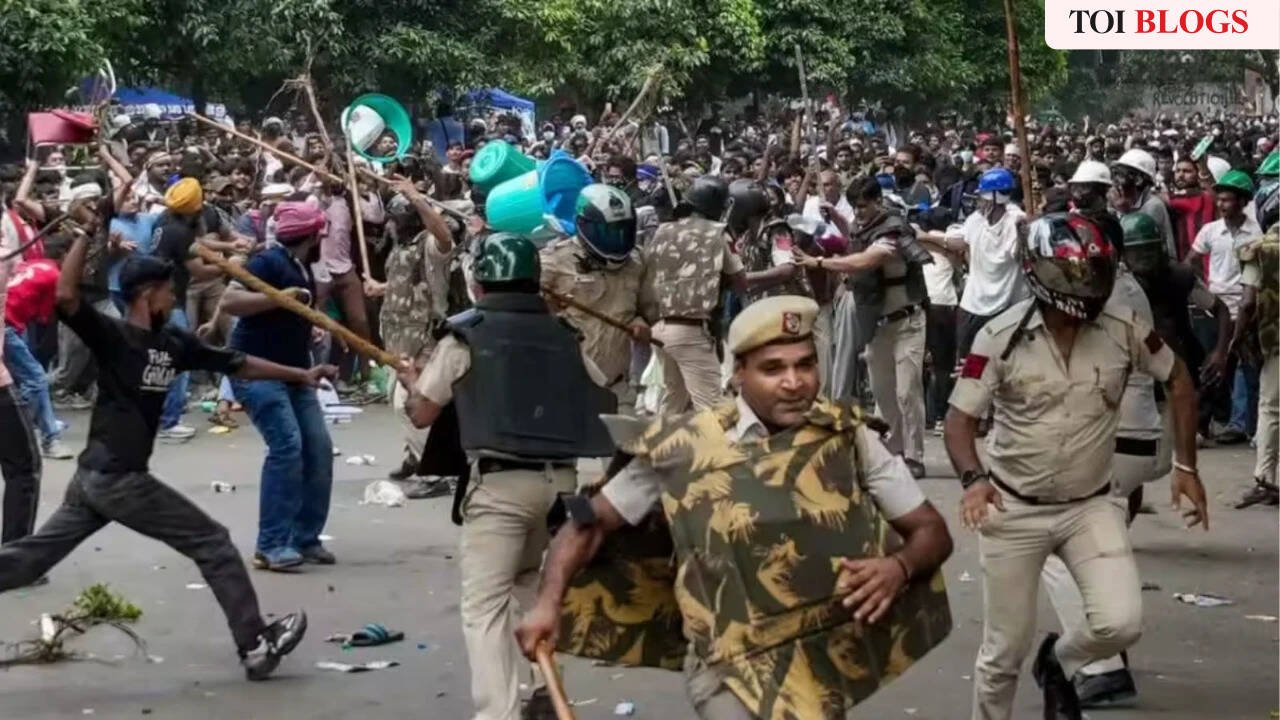
For as long as I have been in this trade, a press card at a Delhi barricade has worked roughly like a hall pass: it never made you popular with the police, but it usually got you through, or, at worst, into an argument. On October 10 and 11, it got you into a bus. The Editors Guild counted 38 journalists detained over those two days, 36 of them in Delhi, and what makes the figure remarkable is not its size so much as its indifference to credentials.Reporters were picked up with badges around their necks and microphones in their hands, which is to say with every requirement the Delhi Police had itself laid down, having advised journalists covering the protest to wear their identity cards at all times so that there would be no confusion. The confusion, it turned out, was entirely on one side.
Image credit: Reuters
Newslaundry’s reporters, having identified themselves, were told there was no media here, koi media nahin hai, a sentence that would be funny if it were not being said by men in uniform to people holding cameras. Paranjoy Guha Thakurta, who was reporting on Indian power before most of those constables were born, was detained near Jantar Mantar for the apparent offence of talking to another journalist.
–
It took the Supreme Court, sitting on a Sunday, to say what used to go without saying: that journalists and lawyers must be allowed to do their work. Reporters say some of the detentions came after the order. When the highest court in the land has to remind the police that the press may report, the press has already lost something, whatever the final verdict; journalists, in short, have become fair game, and the more interesting question is not whether but why now.
From 1.0 to 2.0
This government has not been short of protests, nor, to be fair, of patience with some of them. Farmers camped on Delhi’s borders for the better part of a year; wrestlers sat at Jantar Mantar for months; and this summer the first Jantar Mantar movement, over the NEET paper leaks, ran for weeks, survived Sonam Wangchuk’s fast and ended with an Education Minister’s resignation. Reporters were not always spared in those days, but those were individual cases, picked out and prosecuted. What we saw in the second cycle was something else: not a case but a sweep.The sweep came wrapped in an escalation that would be impressive if it were aimed at anything more dangerous than students with flags. Mobile internet was switched off for 24 hours within four kilometres of Raisina Hill. Metro gates were shut, Chhatrasal Stadium was turned into a holding pen, and the security deployment was somewhere between 22,000 and 33,000 personnel, depending on whom you ask, which is itself a measure of how large a number has to be before nobody bothers to count it precisely. Two days later, Jantar Mantar, the capital’s designated address for dissent since the early 1990s, was de-notified, its replacements placed at a convenient distance from anyone who might be listening.
–
The Union Home Secretary and the Delhi Police Commissioner have since tendered unconditional apologies to the Supreme Court in a contempt case over the Metro shutdown, which tells you that even the people who ordered all this are no longer entirely sure it was proportionate. A government that has won three general elections does not, in the ordinary course, need a small army to manage a Saturday afternoon in Lutyens’ Delhi. When it deploys one anyway, the overreaction tells us less about the protesters than about the state’s own reading of the moment, and one can only assume that reading is that it feels threatened.
Who gets picked up
Look at the list of the detained and a pattern emerges that no amount of crowd management explains. The names belong overwhelmingly to younger, digital-native newsrooms, Newslaundry, Scroll, The Quint and their kind, and to independent reporters filming on phones: precisely the journalists who are seen as independent of, and critical towards, the government of the day. Phones were seized, and reporters say they were pressed to delete what they had shot, which is an odd thing to demand of a crowd you are merely dispersing and a perfectly logical thing to demand of a witness.The Solicitor General supplied the theory behind the practice in the Supreme Court, where he argued that in the digital age anyone with a mobile phone is a journalist, and that much of what passes for reporting at these protests is reel-making. He has a point about the noise, as anyone who has run a newsroom in the age of the vertical video will concede. But the answer to that problem cannot be to let a station house officer decide, at a barricade, who is a reporter and who is a nuisance; the Press Club of India’s president put the question exactly, asking how the state or the police can decide who is a journalist. Worse were the allegations from women journalists of sexual harassment, including one who says a senior officer molested her and who then found herself on the receiving end of an SC/ST Act petition from him. The court has ordered no coercive action against her and has said it wants to lay down guidelines for how police deal with the press.I am prepared to accept that some of this was the heat of the moment. The Delhi Police has never been the gentlest force in the country, the police say some protesters posed as journalists, and men who have been on their feet behind barricades for twelve hours do not always make fine distinctions. But heat does not usually arrive with a pattern, and it does not usually follow an advisory to wear the very press cards that were then ignored.
The fear behind the barricade
The level of escalation suggests something deeper than irritation, and the clue lies in what this protest is about. A government can absorb a fight over exam papers; this one absorbed one in the summer, at the cost of a minister. A fight over the voters’ list is of a different order, because it questions not a policy but the process from which the mandate itself flows.Every year, the Election Commission runs a summary revision, which updates the existing rolls and leaves the burden of proof largely with the state. The Special Intensive Revision turns that around, asking anyone enrolled after 2003 to prove their date and place of birth with documents, which is a simple enough request if you are salaried, settled and own a filing cabinet, and a rather harder one if you are a migrant worker, an elderly widow or simply poor. More than 130 million names have dropped off the draft rolls, and when a leading English daily reported that two of the three election commissioners had objected at least 14 times in ten months, the argument stopped being about paperwork. The Commission’s reply, that differing views are normal and every decision was unanimous, will reassure anyone who has never sat through a committee meeting. And since a Chief Election Commissioner can only be removed by impeachment, the protesters’ demand lands, as such demands do, at the government’s door.Then there is the neighbourhood, which every ministry in Delhi watches more closely than it admits. In 2024, students brought down Sheikh Hasina in Dhaka, and the Jamaat-e-Islami, which her government had banned, walked back into the open; in 2025, young Nepalis set fire to their parliament and saw their government fall. Analysts are right that India is not Bangladesh or Nepal, and that this government’s popular support is real. But states do not plan for the likely outcome, they plan for the worst one, and the worst one in this region has a recent and well-documented script in which a leaderless youth movement opens a vacuum that older, better-organised forces rush to fill. That anxiety explains, though it does not excuse, the reflex now visible in BJP leaders’ talk of foreign funding and George Soros, offered so far without evidence.The trouble with that script is that this movement keeps refusing to read from it. Its demand is narrow, the removal of one officer, and its founder says plainly that he is not asking for a change of regime. Its symbol is the Tricolour, and a day before I write this, Connaught Place’s Central Park was shut “due to administrative reasons” so that people cannot gather there to wave it.History is not encouraging for the side with the barricades, either. In August 2011, the UPA detained Anna Hazare on the morning of his fast and sent him to Tihar; by evening it was ordering his release, which he declined until he had been given the Ramlila Maidan. In May this year, the Cockroach Janta Party’s X handle was withheld in India and was back under a new name within minutes, and when Wangchuk was carried off from his fast in July, the demand went up from the minister’s resignation to the Prime Minister’s. Repression, so far, has been this movement’s most reliable recruiter.
Who shut the shops?
Which brings me to the question I would most like answered, and which nobody in authority seems in a hurry to answer: who shut the shops? Somebody decided that Metro gates in the heart of the capital would close, that trains would be disrupted, that mobile data would vanish across four kilometres of the administrative core, that Central Park would be locked for two days, and that Connaught Place, in the run-up to Diwali, would wear the look of a curfew. Each of those decisions had an author. The Home Secretary has told the Supreme Court that the internet suspension was examined under law and found proportionate, and has asked the court to let the government suspend services again in situations of necessity; the Police Commissioner says everything was done in good faith on intelligence inputs. The traders of Connaught Place, one of whom went to the Delhi High Court this week worried about disruption to business, are entitled to ask who, exactly, has been doing the disrupting.An apology to a court is not the same thing as accountability to the public, and the Solicitor General has already clarified that the government’s apology does not stop it from defending what it did. Every protest cycle in Delhi is also a learning cycle, and the question is what each side learns from it.After the first Jantar Mantar, the police appear to have learned to stop crowds earlier, further out and more completely. The lesson they should have learned is that the camera at the barricade is not the enemy but the only independent record of what happened there, a record that a police force accused of brutality needs at least as much as its accusers do.The Supreme Court now proposes to frame guidelines on how the police treat journalists at protests, and that is welcome. The awkward truth, though, is that the Delhi Police already had a guideline: it asked us to wear our press cards, and we did. A government confident of its mandate does not need to lock a park to stop people waving its flag, or detain the people who came to watch them do it.
Disclaimer: Views expressed above are the author’s own.


