



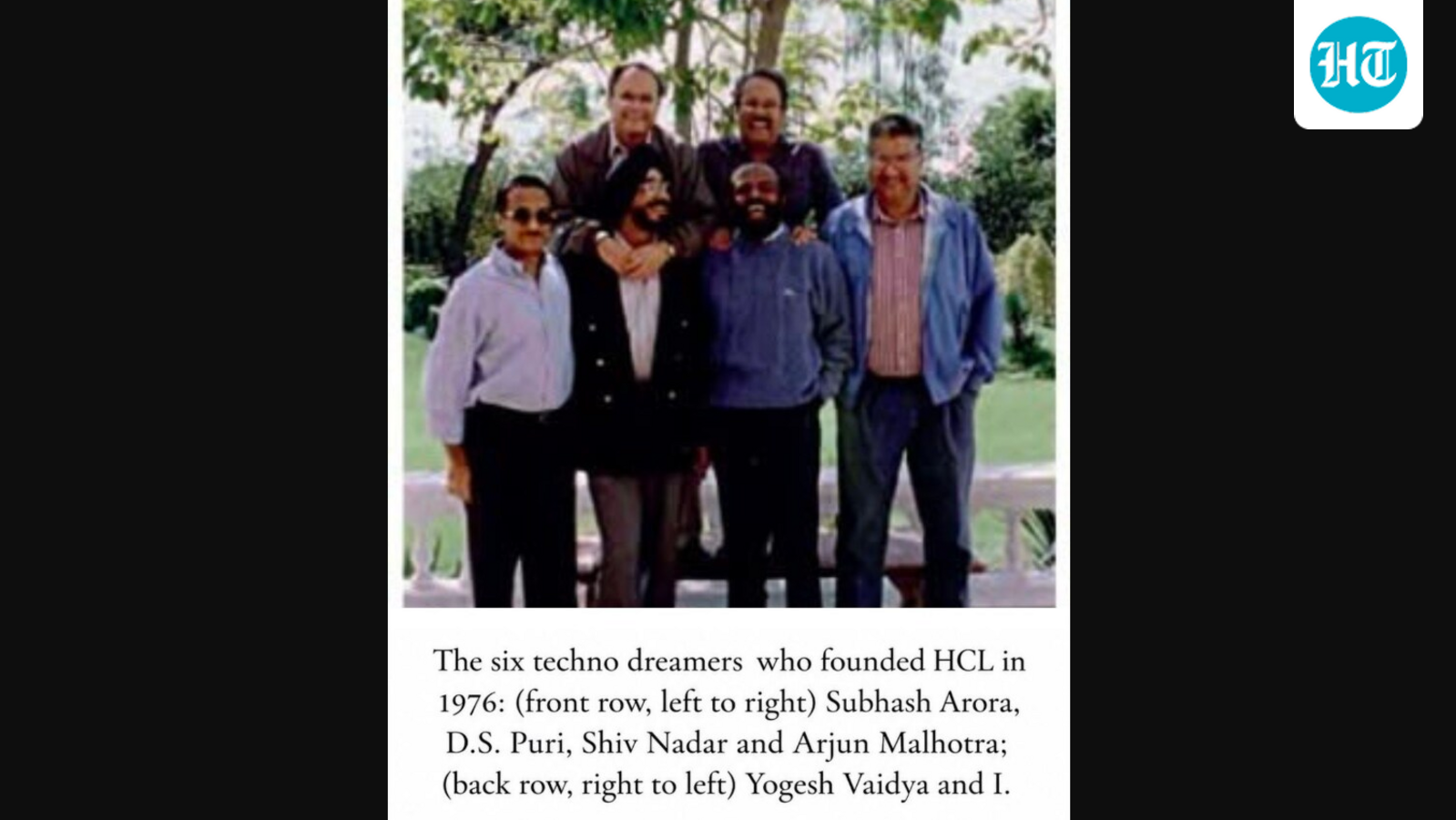
Before HCL became a global technology powerhouse, it was just a bold idea shared by six ambitious men who walked away from their careers to build India’s tech future. Scrapping together ₹1.87 lakh by pooling savings, borrowing money, and selling a car, they launched a company from a tiny Delhi barsati, starting an iconic 50-year journey of innovation.

“We quit our jobs. There were six of us — Shiv Nadar, Arjun Malhotra, Yogesh Vaidya, Subhash Arora, D.S. Puri and me,” Ajai Chowdhry, one of HCL’s founding members, wrote on X.
He recalled how in 1976, the year the company started, startups were “not really a thing in India”. He continued, “Venture capital did not exist. Banks were not exactly lining up to lend money to six young men with an idea and no collateral. And computers? Most people had barely heard of them. But we believed the microprocessor was going to change the world. So we took the plunge.”
How did they start the business?
Chowdhry recounted, “Between the six of us, we managed to put together ₹1.87 lakh. We borrowed, pooled our savings and, in one case, even sold a car. Our first office was a small barsati in Golf Links, Delhi. We called ourselves Microcomp.”
The team wanted to build an Indian computer, but they soon ran into a problem: they didn’t have a manufacturing license. The solution resulted in the birth of HCL.
Chowdhry explained, “That eventually led us to UP Electronics Corporation. They had the licence. We had the technology. And that partnership gave birth to Hindustan Computers Limited — HCL.”
What happened next?
“But perhaps the most audacious part of the story was what happened next. We started selling a computer that was still being designed. We had a brochure and a mock-up of the machine. That was it. Our sales teams went across India, knocking on doors and convincing businesses to buy into a technology they had never used before,” the tech founder shared.
The first orders:
He revealed that HCL’s first orders came from IIT Kharagpur and IIT Madras. “Then came the harder part — convincing businesses. In Coimbatore, we were up against DCM DP, a much bigger and more established name. I still remember sitting in the reception area of Premier Mills while the DCM team made its pitch. We went in second. And we won. That one order gave us five more. Then ten. That was HCL in those early years: not having the biggest balance sheet, the biggest brand or the easiest path — but finding a way.”
Also Read: Employees scream ‘We want hike’ as HCL CEO takes the stage during Chennai event
Chowdhry recalled how the team of six were restless. They looked for gaps to expand their business and hired people with a “cowboy” spirit. “We believed that technology had to be made useful and accessible, not intimidating. And we kept moving.”
The HCL story:
Chowdhry recalled how they took a company established in India to Singapore within just four years. Expressing what the journey means for him, he continued, “From a small room in Delhi to a global technology company. When I look back at 50 years, I think about six people sitting together in 1976, wondering if this crazy idea could actually work. I think about a barsati. A brochure for a computer that did not yet exist. And the courage to knock on the next door.”
He added, “That, to me, is the real HCL story. 50 years later, the technology has changed beyond anything we could have imagined. But the spirit remains the same: Dream big. Take the risk. And above all, Just Aspire.”
What did social media say?
An individual posted, “It’s amazing what’s been achieved! True grit!” Another commented, “Kudos to you all. The pride of India.”
A third expressed, “Amazing story! In 1976, computers were part of science fiction for most people.” A fourth wrote, “My father bought an all-in-one HCL desktop back in 2002-2003 when I was 4-5 years old. This tweet unlocked a core. memory of my life. My father used to proudly teach me the HCL abbreviation because it is made in India.”
Ajai Chowdhry completed his Bachelor of Engineering from Jabalpur Engineering College in 1971. He pursued higher studies at the University of Michigan.
He played a crucial role in taking India’s original IT garage startup to a global stage. He was conferred with the prestigious Padma Bhushan in 2011.


