



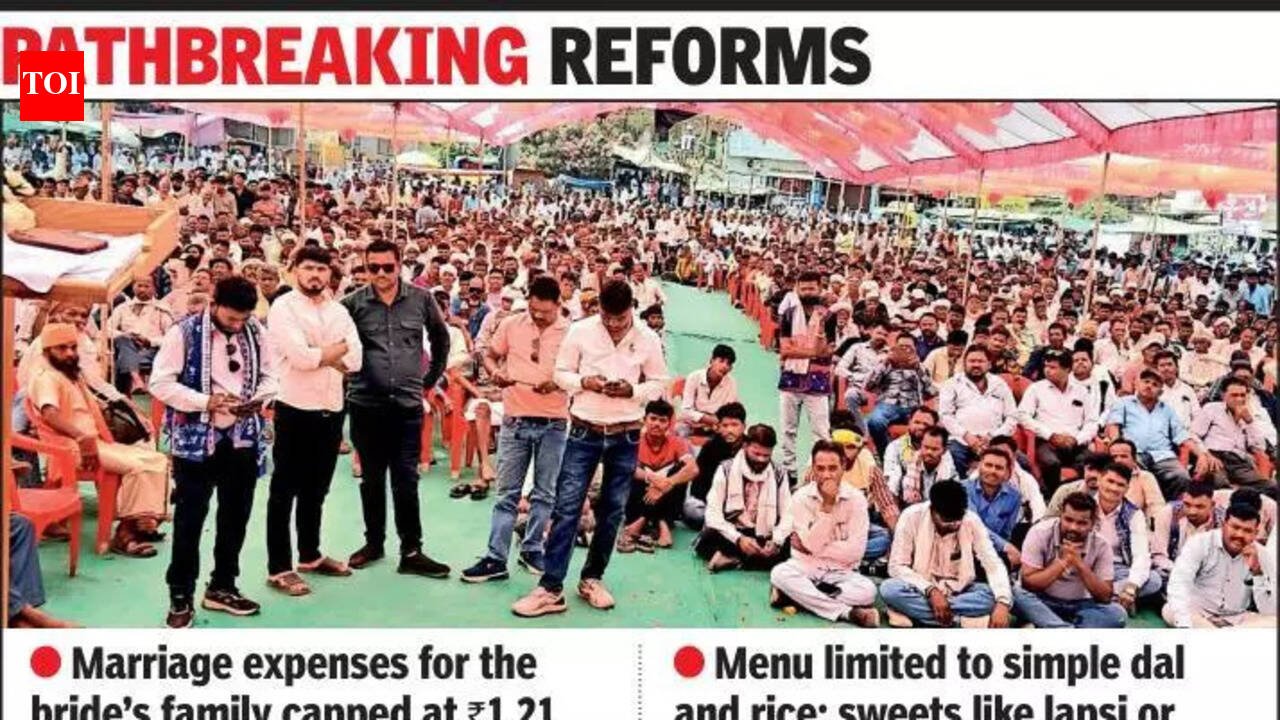
Vadodara: While polygamy has traditionally been prevalent among tribal communities in eastern Gujarat, particularly among the Bhil tribes, a shift is now underway.The Bhil Samaj Panch (BSP) in Dahod has introduced regulations to discourage the practice, including a hefty penalty of Rs 11 lakh on men who marry twice.As part of a push to modernize social customs, the body also announced measures to cap wedding expenses. The community now aims to restrict second marriages to exceptional circumstances.“A second marriage will be permitted only in cases with strong justification, such as the inability to have children or the death of the first wife. Prior approval from panchas will be mandatory, and if the first wife is alive, her consent will also be required,” said BSP president S L Makhodiya.Any violation of the new rule will attract a fine of Rs 11 lakh. Of this, the expenses borne by the first wife’s family during the wedding will be reimbursed, while the rest will be directed toward community welfare.BSP members include elected representatives at various levels and even those who contested assembly or Lok Sabha elections. Community leaders, former govt officials and village headmen are also included.Meetings were held in Garbada and Zalod recently to prepare a model marriage constitution. Members of the Bhil tribe are being encouraged to follow this. “We can proudly say that over 150 marriages were held with the model constitution after Holi itself. We took up the new constitution as people were spending very large amounts on wedding. They take loans for marriages, and even relatives are forced to give large amounts of cash as gifts in ceremonies,” said Makhodiya.Makhodiya and others pointed out that, as per tradition, the groom’s family paid ‘dahej (dowry)’ to the bride’s family. “This was meant to take care of the wedding expenses borne by the family, but today, money is sought based on the education and other qualities of a bride. The amount can be as high as Rs 5 lakh. Expenses on food, DJs, jewellery and other things have also gone through the roof,” he added. He said that, according to rough estimates, the average wedding costs Rs 8 lakh to Rs 10 lakh.Former MLA Chandrika Bariya, who is supporting the movement, said, “A major reason why women join their husbands in working at construction sites is the dowry paid by the husband’s family,” she said. Bariya added that ostentatious spending on DJs, which were unheard of in the past, and convoys of cars, had become a trend.“DJs would charge Rs 20,000 to Rs 25,000 per day and were roped in for around three days. Often, cars in the convoy were empty, with few occupants in each car, but this was done just to show numbers,” Bariya said.‘Implementing code tough’Vadodara: Tribal researcher and author Kanji Patel said that tribals people emulate what they see around themselves. “When they saw other sections of society splurging on weddings, they started doing so even if they could not afford it. They were exposed to such weddings through movies, television and even what they saw,” he said.Patel said the code may not be followed in the true sense. “Such spending often becomes compulsive or like an addiction. Those who can afford will anyway flout from such restrictions,” he said.Patel added that the decision to stop such spending may also have come from other communities that took such decisions in other parts of the state.


