






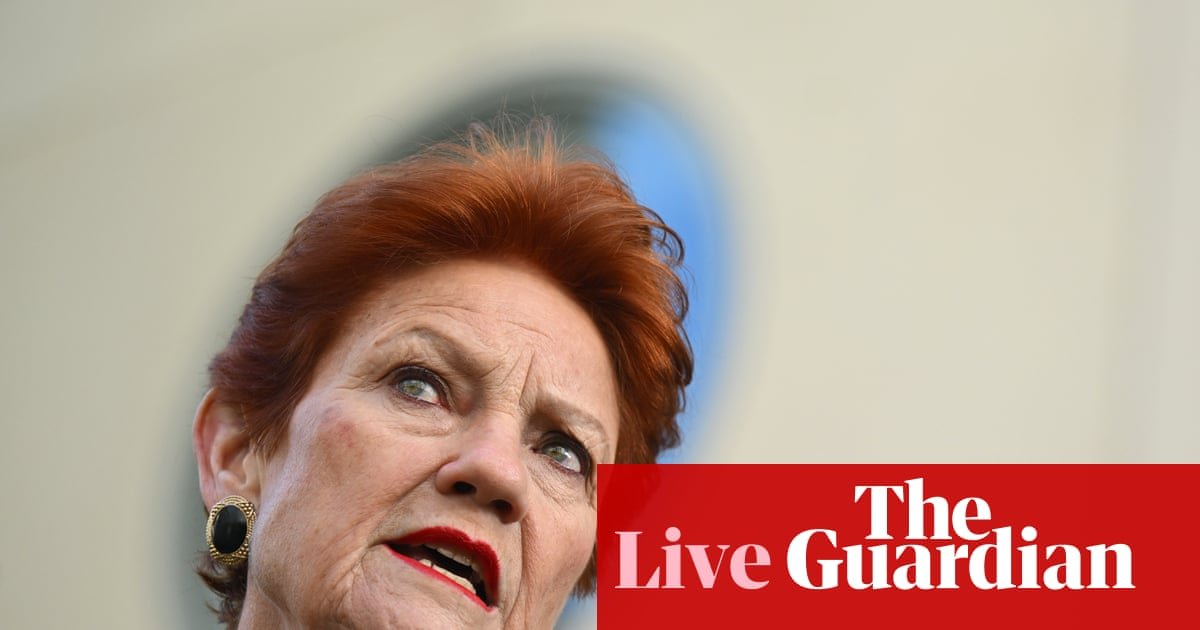
One Nation reveals ‘net-negative’ migration policy
One Nation is targeting international students and the families of skilled migrants in its proposal to cut 750,000 temporary visa holders in Australia over three years.
The move would return temporary visa numbers back to 2017 levels.
Hanson says net migration under the plan would be “net-negative” for the first three years, and then sit at 130,000 – however who knows what that actually means because when One Nation recently announced this, none of its MPs seemed to be able to define what net migration was.
For those playing at home, net migration measures people coming into or leaving the country for a period of at least 12 months over 16 months and thus excludes tourists. Much of the confusion was around whether backpackers and people on the Pacific Australia Labour Mobility (PALM) scheme would count under the Nom.
About 10% of the temporary visas to be cut would include people living in Australia who don’t have a visa and have exhausted all options to stay.
Key events
Joyce stands by Hanson’s comments disparaging Albanese’s mother
Barnaby Joyce has defended Pauline Hanson’s comments that a person shouldn’t be allowed to live in public housing for multiple decades because there isn’t enough housing.
Hanson, in a podcast in February, criticised the length of time Anthony Albanese’s mother had lived in housing commission, and then said it was “pathetic” that the PM kept bringing up the story.
Joyce told Sunrise this morning that Albanese’s log cabin story doesn’t wash anymore:
[Hanson] didn’t say that she [Albanese’s mother] was a bad woman, or that she had done some form of theft or anything like that. The question was put to her about public housing, and I stand by what she said … The premise of that question was, should people live in public housing forever? Which the answer is no, because we just don’t have enough public.
I don’t know the Prime Minister’s mother. I’m sure she’s a very, very good woman … But the whole, you know, log cabin story of living in a housing commission home that the Prime Minister rolls out over and over again for a person who owns multiple houses, and good luck to him, and God bless him, and he’s about to go live in a $4.5m house on the Central Coast. It just doesn’t wash.
Hanson’s ‘nasty, grubby’ politics shows she’s not fit to lead says Hastie
Andrew Hastie says attacks against him have been really hard on him personally, and says he’s standing up against the “nasty, grubby politics” that Pauline Hanson represents.
Hanson has refused to apologise for a One Nation video that labels Hastie a “traitor” after he gave evidence against Ben Roberts-Smith in his failed defamation trial.
Hastie told the Today show the whole saga shows Hanson is not fit to be a leader:
I’ve experienced this for for 5 or 6 months now. It’s been really hard. It’s been hard on me personally. It’s been hard on my staff, but it’s been really hard on my wife as well, who I left behind to go overseas knowing I might not return. So yeah, it is a slur. That’s why I’ve defended myself. But I’m also standing up for other veterans because it’s not just about me.
And I think this sort of nasty, grubby politics underscores Pauline Hanson’s true character. And with Australia facing a once in a generation cost of living crisis, with artificial intelligence coming at us very hard and fast, I think she’s revealed that she doesn’t have what it takes to be Prime Minister of this country.
Hanson’s comments on Albanese’s mother ‘gratuitous and unnecessary’: Hume
Jane Hume has joined the pile on, blasting Pauline Hanson for her comments about Anthony Albanese’s mother.
Hanson had criticised her for living in public housing over several decades in a podcast released in February, which Albanese yesterday called nastiness and spitefulness.
Hume says the comments were distasteful, and also pointed to the ongoing fight between Hanson and Andrew Hastie, after a One Nation cartoon called the former SAS captain a “traitor”.
I think that these comments were gratuitous and unnecessary. And the idea that you would disparage people that have grown up in social housing, I think, is a little distasteful. I mean, it doubles down on the fact that Senator Hanson has also disrespected our veteran community with her atrocious comments about Andrew Hastie in that cartoon. Calling a veteran a traitor, I think, is possibly the worst thing you can do.
But this does seem to be a common theme in One Nation now, that sort of unnecessarily provocative rhetoric.
Labor has ‘refused to adopt’ Coalition migration asks, Hume says
Perhaps one reason for Labor’s delay in making its migration announcement has been because it wants to see if it can get the Coalition somewhat on board.
Last week the prime minister and opposition leader met – while Angus Taylor sent a letter with several demands.
The deputy Liberal leader, Jane Hume, is asked on RN Breakfast this morning if its fair to say the talks have been “productive” as health minister Mark Butler has this morning suggested.
She says:
Well, it seemed that there were a number of things that we had proposed to the government that they simply have refused to adopt. We’ve been pretty clear. We want to make sure that we link our migration numbers to the number of houses that are built, that the housing minister should come to parliament each year and announce the number of new houses that have been built, and that will then put a cap on the number of people that can come to the country.
But the mix of your migration policy is just as important, and getting that right to make sure that you don’t push the country into recession is really important.
Asked then what the Coalition’s migration policy is, she says she won’t “pre-empt” any announcements.
One Nation visa numbers will send Australia into recession, says Hume
While they might not agree on exactly what migration policy Australia should have, the government and opposition are on a brief unity ticket this morning in arguing that One Nation’s temporary visa plan would destroy the economy.
Deputy Liberal leader, Jane Hume (while still taking the opportunity to have a go at Labor) says Pauline Hanson has plucked the number out of nowhere and has no modelling to back it up.
She tells News24:
Simply saying we’re going to have negative migration for a number of years, negative nom, well, that would be a real shock to the economy, and it would make all Australians poorer.
My concern here is that these numbers have simply been plucked out of thin air that there isn’t any modelling behind them.
Hume is asked why One Nation is driving the agenda again instead of the Coalition, but she says she disagrees:
We’ve been talking about migration, from the moment that Angus Taylor became the leader … Work has been going on to the background, but it’s so important to get this right, because sending the country into recession means that all Australians pay the price. It simply can’t be a slogan, you have to do the work behind it.
Health minister says One Nation plan would devastate critical industries
The health minister, Mark Butler, says Pauline Hanson’s plan to cut temporary visas by 750,000 over three years would kill critical industries.
Speaking to reporters in the press gallery corridor this morning, Butler says it would cause serious economic damage – particularly to construction and aged care sectors.
Pauline Hanson said a few weeks ago, she didn’t care what the impact of her migration policy would be on business, but this is just another level entirely. This is going to smash industries like construction. It would devastate the health sector and aged care and disability.
The government has stalled on its own migration plan that was initially supposed to be announced by home affairs minister, Tony Burke more than a month ago. Butler remains tight lipped over when Burke will make the announcement.
One Nation reveals ‘net-negative’ migration policy
One Nation is targeting international students and the families of skilled migrants in its proposal to cut 750,000 temporary visa holders in Australia over three years.
The move would return temporary visa numbers back to 2017 levels.
Hanson says net migration under the plan would be “net-negative” for the first three years, and then sit at 130,000 – however who knows what that actually means because when One Nation recently announced this, none of its MPs seemed to be able to define what net migration was.
For those playing at home, net migration measures people coming into or leaving the country for a period of at least 12 months over 16 months and thus excludes tourists. Much of the confusion was around whether backpackers and people on the Pacific Australia Labour Mobility (PALM) scheme would count under the Nom.
About 10% of the temporary visas to be cut would include people living in Australia who don’t have a visa and have exhausted all options to stay.
Krishani Dhanji
Good morning, Krishani Dhanji here with you for another busy sitting week.
There’s a few moving parts in Parliament this week – One Nation has this morning announced a migration plan that will drastically cut temporary visas, and lead to more headache for the Coalition who are asked why Pauline Hanson is driving the agenda and not them.
Speaking of Hanson, her fight with Andrew Hastie shows no sign of ending – we’ll likely hear more back and forth from the pair today.
And, the government could look to water down its digital duty of care laws after hints from the communications minister Anika Wells yesterday that she was willing to negotiate on the ministerial powers in the bill.
Let’s get stuck in!
Save $5,000 by electrifying, organisations say
Australian households could save $5,000 a year by electrifying their homes and cars, AAP reports, and more than 30 organisations will call for incentives and stronger policies in Canberra as part of a national campaign.
The campaign is linked to the international Electrify Now campaign, and follows a COP31 push to raise the global electrification rate from about 20% to 35% by 2035.
Groups including Energy Consumers Australia, the Electric Vehicle Council, Farmers for Climate Action, and Rewiring Australia will launch the campaign at Parliament House, calling for changes to help more Australians replace equipment powered by gas, petrol or diesel.
Energy Efficiency Council policy head, Jeremy Sung, said:
There’s a role for the Australian government to send a clear signal that electrification is happening and that it’s what the future of our energy system will depend on.
At the moment, federal policy is sending mixed messages.
Labor announces $300m grants for crisis accommodation
Krishani Dhanji
The government is giving $300m in grants to build crisis and transitional accomodation, that will deliver 500 new homes and support around 19,000 vulnerable Australians.
The housing minister, Clare O’Neil and social services minister, Tanya Plibersek, say the total crisis housing package will support more than 50,000 women and children escaping family violence, and help young people at risk of or already experiencing homelessness.
But the money itself isn’t new: it was previously announced as concessional loans for the sector to help build the accommodation, and will now instead provide direct grants following consultations.
The grants will go to providers including state governments, community housing providers and First Nations organisations.
Plibersek said in a statement:
Too often we ask, “why didn’t she leave?,” when we should have asked, where would she go? We know that safe housing is absolutely critical to help women and children leave violence. That’s why we are building more than ever before.
Bumper weekend for auctions
Cait Kelly
Data from Cotality has shown auction rates were up over the weekend, with almost 60% of homes selling – the highest peak in 19 weeks.
The national preliminary clearance rate hit 58.5%, a small jump from the 52.7% recorded last week.
Experts have warned that Australia’s penchant for auctions – we are among the few countries that regularly use them – has helped push prices up.
While the weekend rate was up, there is still an overall decline in the number of houses being sold through auctions.
Speaking to the Australian Financial Review on Sunday, Cotality’s Tim Lawless said the rise in clearance rates should be viewed against a longer-term plunge in volumes.
The number of auctions held was up 11.4% on a week ago – but held more than 30 per cent lower than a year ago.
Welcome to Guardian Australia’s live coverage for Monday.
Krishani Dhanji will be joining us shortly.
Let’s begin.


