


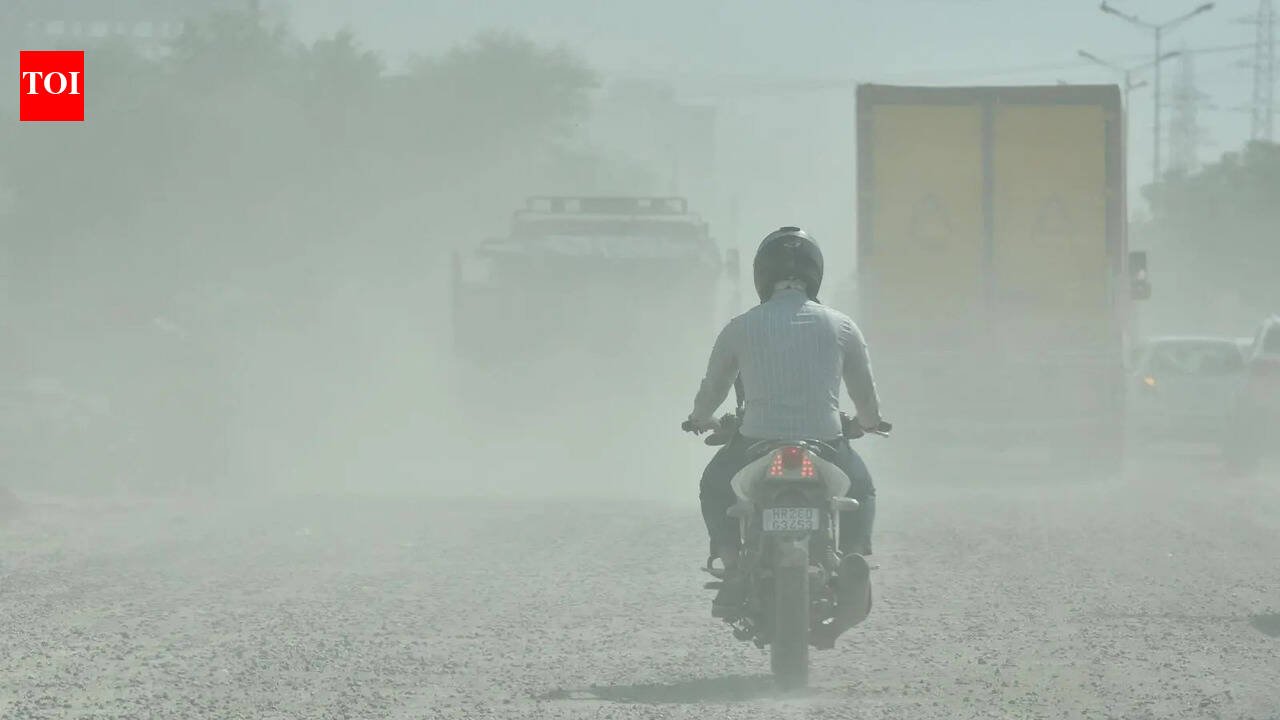
Gurgaon: The city has seen a sharp fall in fine particle pollution (PM 2.5) over the past decade, dropping by more than half from 198.44 micrograms µg/m³ in 2015-16 to 91.7 in 2026-27, a decline of nearly 54% over the decade, according to a dashboard built by environmental research and data analytics firm Envirocatalysts using Central Pollution Control Board (CPCB) data.The city’s annual PM2.5 levels declined to 105.17 µg/m³ in 2018-19 and further to 90.19 µg/m³ in 2019-20, and have since remained relatively stable between 88 and 92 µg/m³, indicating a plateau despite pollution-control measures across NCR. Despite this reduction, concentrations still far exceed both national and WHO air quality standards.PM10—driven largely by road dust, construction, and resuspended particles—has remained persistently high over the years. Levels stood at 236.42 µg/m³ in 2017-18 and 231.07 in 2018-19, then declined to 179.17 in 2019-20. They fell further during the pandemic to 163.68 in 2020-21, rose again to 197.36 in 2022-23, and dropped to 167.7 in 2026-27.The trend points to continuing dust pollution challenges in Gurgaon amid rapid urbanisation, infrastructure expansion and large-scale construction activity.Ground-level ozone—a secondary pollutant formed from nitrogen oxides, volatile organic compounds, and sunlight—showed fluctuating trends over the years. Levels rose from 32.37 µg/m³ in 2015-16 to 53.04 in 2016-17, then to 79.77 in 2017-18. The city recorded its highest ozone concentration of 94.07 µg/m³ in 2019-20. Though levels declined to 60.93 in 2021-22 and 48.48 in 2023-24, they rose again to 61.28 in 2025-26 before falling to 41.1 in 2026-27.Experts have increasingly flagged ozone as an emerging urban pollutant because it is formed through atmospheric reactions rather than being directly emitted, particularly during summer months.Nitrogen dioxide (NO2), associated largely with vehicular emissions and combustion sources, showed a fluctuating but overall declining trend. NO2 levels increased from 17.79 micrograms µg/m³ in 2015-16 to 35.99 in 2018-19 before gradually declining. The city recorded NO2 levels of 21.68 in 2020-21, 22.2 in 2021-22 and 15.36 in 2024-25 before levels rose again to 22.83 in 2026-27.Similarly, Sulphur dioxide (SO2) levels remained comparatively low through the decade. SO2 concentrations fell from 10.25 micrograms µg/m³ in 2015-16 to 6.64 in 2016-17 and further to 5.57 in 2021-22. Though the city saw temporary increases in some years, including 13.06 in 2019-20 and 12.05 in 2023-24, levels again declined to 5.37 in 2026-27.Carbon monoxide levels fluctuated over the years but broadly remained stable. Gurgaon recorded its highest CO level of 2.92 milligrams µg/m³ in 2016-17. CO concentrations largely remained between 1.1 and 1.7 milligrams µg/m³ in subsequent years, with the city recording 1.13 in 2026-27.“A detailed analysis of the data suggests that while NO2 levels have dropped slightly compared to pre-BS VI implementation, PM2.5 and PM10 levels haven’t shown similar improvements and remain hazardous for Gurgaon. This indicates that overall activities across polluting sectors remain beyond the city’s cumulative capacity, alongside significant contributions from sources beyond the city boundary, as Gurgaon follows the larger pollution patterns seen across other cities in the airshed,” said Sunil Dahiya, founder and lead analyst at Envirocatalysts.Dahiya said cleaner fuel adoption, tighter emission norms, BS-VI transition and industrial controls may have contributed to the decline in NO2 and some improvement in PM2.5 levels. However, he cautioned that pollution levels in Gurgaon continue to remain significantly above safe standards.
