









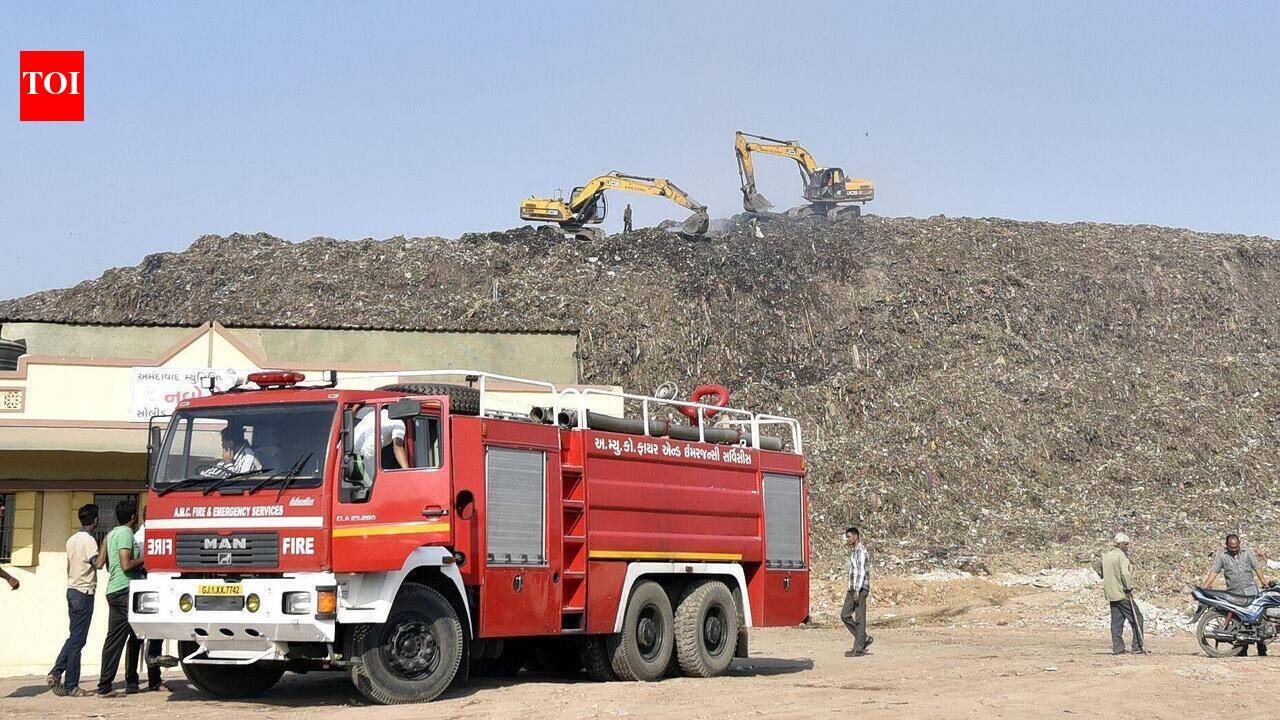
Ahmedabad: Every day, around 4,000 metric tonnes of Ahmedabad’s garbage reaches Pirana, the 22-metre-high mountain of waste that has been growing on the city’s south-western edge since the 1980s. While the garbage remains visible, what escapes from it is not — but satellites operated by European and Japanese space agencies have now measured Pirana’s methane emissions with unprecedented precision.Pirana releases an average of 38,000 metric tonnes of methane every year, with emissions rising to 42,000 tonnes in 2024, according to a new study. Methane is around 80 times more potent than carbon dioxide over a 20-year period. The study found that Pirana had the lowest year-on-year variability among all Indian landfills measured, indicating a persistent and stable discharge rather than a temporary spike. NASA’s EMIT instrument independently cross-verified the findings.The findings are significant for Ahmedabad because the study states, “The absence of an effective landfill gas collection system results in a large fraction of the generated methane being released directly into the atmosphere.” Pirana has no gas collection wells, engineered liner beneath the waste or impermeable cap over it.
Pirana dump site
The study, led by researchers at the Centre for Atmospheric Sciences, IIT Delhi — Shalini Yadav, Sajeev Philip, Ravi Kumar Kunchala and Subhadeep Ghosh — was published in Environmental Research Communications. It provides multi-year, satellite-derived measurements of annual methane emissions from Indian landfills.Methane is generated when organic waste decomposes without oxygen beneath compressed layers of garbage. Pirana’s emissions in 2024 were equivalent to the peak emission rate recorded at Lee County Landfill in the US, the highest-emitting US site in comparable research.The researchers point to a fundamental difference in landfill engineering. “The landfills in China and the US have proper liner systems, gas collection systems, and are capped with a vegetation layer, whereas India has open dumps that directly release all the methane emissions into the atmosphere.”Waste composition further adds to the problem. “The Indian dumpsites receive a larger amount of organic waste compared to landfills in the US or China, which also contributes to greater methane emissions,” the study states. Ahmedabad’s food-heavy municipal waste stream therefore provides abundant material for methane-producing bacteria.Pirana’s emissions also offer a striking comparison with Delhi. The capital’s three major dumpsites together released around 2 lakh metric tonnes of methane in 2024. Ghazipur, operating since 1984 and now more than 60 metres high, emitted about 1.2 lakh tonnes, compared with 61,000 tonnes in 2019. Although Pirana receives more waste daily than Ghazipur — 4,000 tonnes against 2,000-2,200 tonnes — its lower height and different waste composition result in lower methane emissions, rather than better management.The satellite-based Cross-Sectional Flux method measures methane columns downwind of a landfill and works backwards to calculate emissions. It found conventional bottom-up estimates were 70-90% lower than actual emissions at Ghazipur and 30-70% lower at Bhalswa.The national atmospheric impact is also measurable: “There is an increase in atmospheric methane over India from 2019 to 2024, reaching nearly 1,980 ppb, corresponding to an overall increase of about 60 ppb.”


