



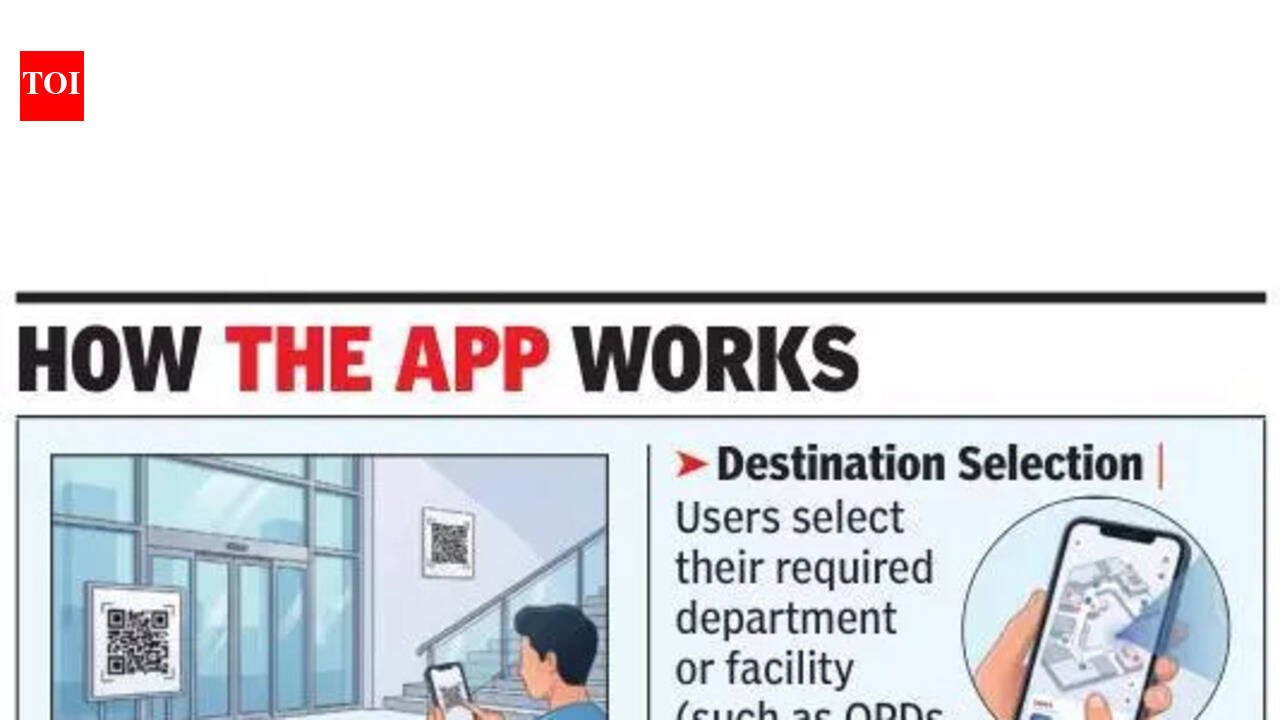
Chandigarh: Navigating the busy corridors of the PGI is akin to walking through a maze. With a massive daily footfall of over 10,000 patients and their attendants, the hospital is now turning to patient-friendly technology to solve a decades-old problem: getting lost.A new high-precision navigation app, PGI Margdarshan, is in its final troubleshooting phase and is being readied for a full-scale launch. Developed by Dr Anurag Ramavat and a team from the ENT department, the app is designed to provide “last-metre” navigation in areas where traditional GPS often fails.The project was born out of the chaos of the COVID pandemic. “The idea came when patients were struggling to find their way and there was no one around to ask. Even as a faculty, I found this place to be a maze when I first joined,” she said.Unlike standard map services, the app utilises Augmented Reality and 3D imagery to provide precision down to just two feet. Patients simply scan QR codes placed at building entrances and near lifts to “check in” their location. Once a destination is selected from a dropdown menu, the app displays 3D pictures of the actual surroundings with superimposed arrows directing the user exactly where to turn. To ensure no one is left behind, the app supports voice commands in Hindi, English, and Punjabi.With 10,000 people entering the campus daily, the strain on security guards and hospital staff to provide directions is immense. PGI Margdarshan aims to reduce this directional fatigue and decrease the anxiety patients feel when rushing to time-sensitive appointments.To address concerns regarding digital literacy among the diverse patient population, PGI plans to deploy Sarthi volunteers during the initial rollout to assist those unfamiliar with QR codes. The app has also been optimised, ensuring it runs smoothly on basic Android smartphones without requiring high-end hardware.The mapping is strictly tailored to patient-centric zones, covering OPDs, the bank, the market, and research blocks. For security reasons, faculty offices and private research labs remain unmapped and restricted. To ensure the system’s longevity, the physical QR codes—currently laminated—will soon be replaced with durable, tamper-proof PVC versions.All the lift and staircase areas have QR codes pasted throughout the campus, as all visitors and patients use such places.The innovation is backed by a Rs 42 lakh grant from the Indian Council of Medical Research. Dr Ramavat confirmed that the team has already secured the trademark and copyright for the app, marking a significant milestone in indigenous medical-tech innovation at the institute.The full launch is expected within the next month, potentially setting a new standard for hospital infrastructure across India.BoxScan to start: Patients begin by scanning QR codes strategically placed at building entrances, staircases, and near lifts across the campusPrecise localisation: Once scanned, the app recognises the user’s exact location with a high precision of up to two feet, overcoming the limitations of standard indoor GPSDestination Selection: Users select their required department or facility (such as OPDs, the bank, or research blocks) from a simple dropdown menu


