


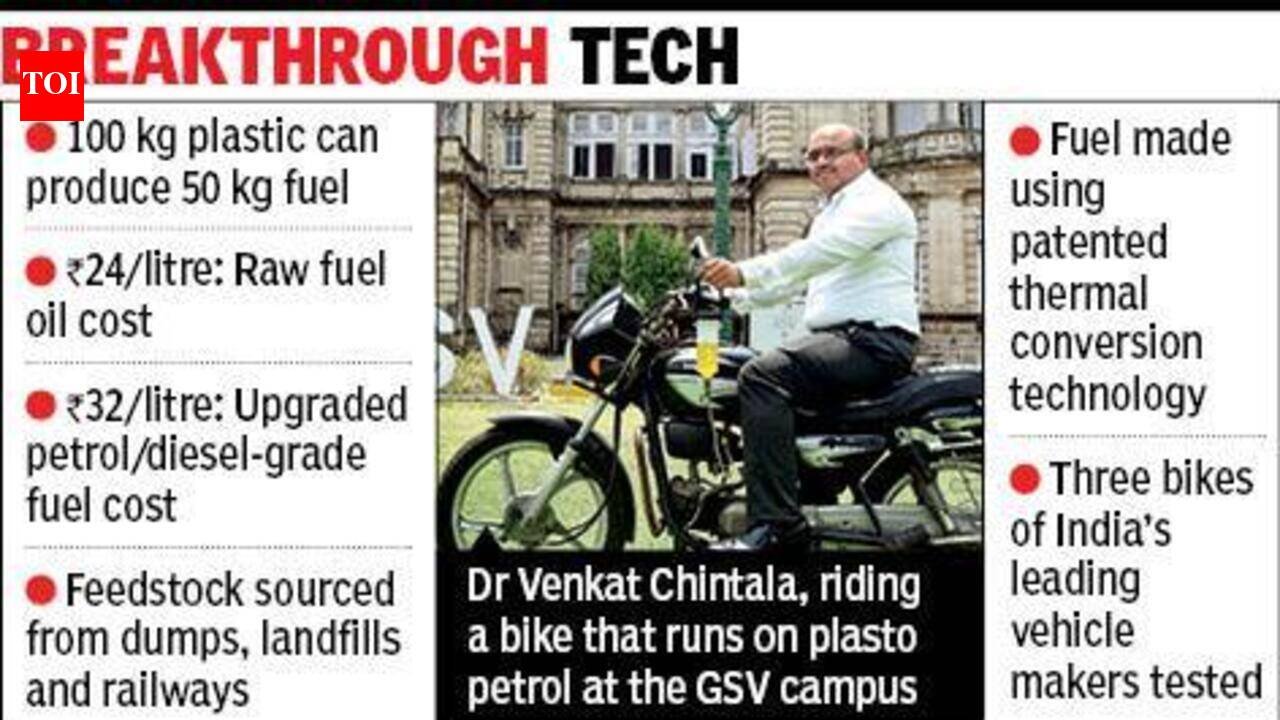
Vadodara: For millions of motorists weary of fuel price shocks, a major respite lies in the most unexpected place: the plastic waste piling up in landfills.Scientists at Gati Shakti Vishwavidyalaya (GSV) have developed a pathbreaking technology that has successfully converted mixed plastic waste into petrol and diesel-like fuels.The innovation has already moved beyond the laboratory. In successful trials, three motorcycles from India’s leading two-wheeler manufacturers ran on the plastic-derived fuel, with one widely sold 100cc bike delivering a mileage of 60 km per litre, close to 62/ per litre achieved on regular petrol. The bikes also cleared third-party Pollution Under Control (PUC) tests, with emissions remaining within permissible limits.What’s more, the plasto-petrol, as the scientists call it, comes at a price one-third of prevailing prices!.!The project, led by Dr Venkat Chintala, traces its roots to a Department of Science and Technology-funded initiative that began nearly a decade ago. After joining GSV in 2020, Chintala established the Plasto Fuels Research Centre and scaled laboratory experiments into a pilot facility at the railway waste-management site near Vadodara station.“Most technologies work with segregated plastic streams, but real-world waste is mixed and contaminated. We have focused on developing a process that can handle those conditions while maintaining fuel quality,” Dr Chintala told TOI.At a pilot facility near the Vadodara railway station yard, around 1.8 tonnes of plastic waste is processed every day. Plastic collected from municipal dump yards, landfill sites and railway establishments is converted into fuel oil through a patented thermal conversion process and subsequently upgraded into petrol- and diesel-grade fuels.According to researchers, every 100 kg of plastic waste processed yields nearly 50 kg of usable fuel. While the raw fuel oil can be produced at about Rs 24 per litre, the upgraded fuel costs around Rs 32 per litre. Researchers estimate that the technology has achieved nearly 90% parity with conventional fuels.The promise that plasto-petrol holds can be gauged from the fact that even aviation giant Airbus is working with GSV to develop sustainable aviation fuel from municipal waste.Researchers are now exploring deployment of the technology in regions where waste management and fuel supply are both major challenges. Leh-Ladakh, Kedarnath and Badrinath are among the locations under consideration, while discussions are at an advanced stage for setting up similar facilities at a railway locomotive shed in Jhansi and at a military establishment in Kolkata.GSV vice-chancellor professor Manoj Choudhary is in advanced talks with various ministries, including Railways and Defence, to scale up the project across the nation.
