



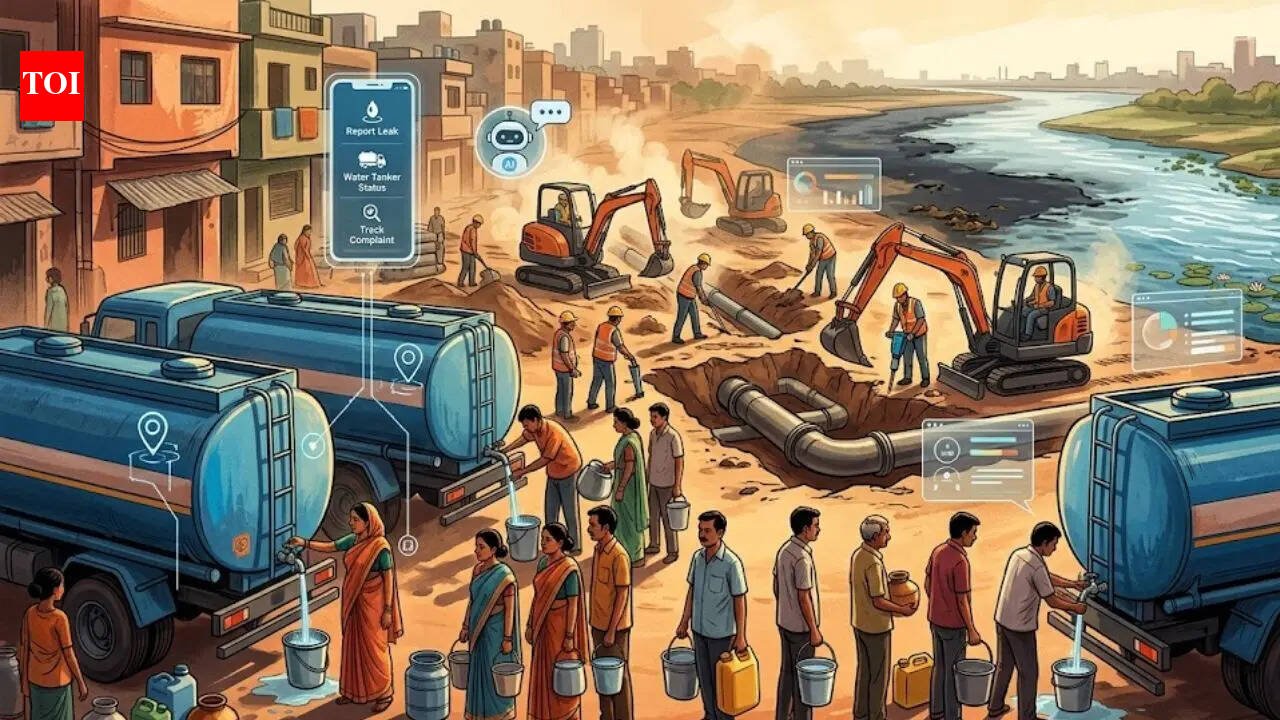
NEW DELHI: With another intense summer approaching, Delhi govt on Monday unveiled its Summer Action Plan 2026-27 to shore up water supply, tighten sewer management and accelerate the clean-up of the Yamuna, while rolling out digital tools to improve grievance redressal and transparency.Launching the plan at the DJB headquarters in Jhandewalan, water minister Parvesh Verma said the focus will be on maintaining peak production, plugging distribution gaps and ensuring accountability in tanker operations. “Supplying clean water and protecting the Yamuna are not just administrative tasks but a shared responsibility,” he added.Officials said Delhi aims to sustain a peak water production of 1,002 MGD through the summer months. All major treatment plants – Chandrawal, Wazirabad, Haiderpur, Nangloi, Okhla, Dwarka, Bawana and Sonia Vihar – are being readied, with continuous monitoring of raw water quality, particularly ammonia levels, to prevent disruptions that have previously plagued the capital.
Action plan during scorching heat
To augment supply in water-stressed areas, DJB plans to expand its tube-well network from 5,854 to nearly 6,290 units before peak demand sets in. Authorities have also undertaken annual reservoir cleaning, maintenance of underground storage and booster pumping stations, along with intensified leak detection drives to curb losses in the distribution network.Tanker supply, meanwhile, is set for a technology overhaul. About 1,200 tankers will be deployed monthly, backed by GPS tracking, geo-tagging and real-time dashboard monitoring. Digitised route mapping and fixed supply points will help curb misuse, the plan states. “The tanker system is not a permanent solution. Our effort is to make it transparent while strengthening pipelines,” Verma said.Water quality surveillance is being stepped up, with eight laboratories testing 1,600-1,700 samples daily to ensure compliance with BIS norms. DJB said the proportion of unsatisfactory samples will be kept within a 3-5% range, alongside expansion of field sampling.Pipelines have been laid in 1,646 of Delhi’s 1,799 unauthorised colonies, with the remaining areas to be covered in phases. Officials said bridging last-mile gaps will be a priority this summer.On the sewer front, the plan emphasises replacement of ageing lines, desilting of drains and deployment of mechanised equipment to tackle blockages. A key focus remains preventing untreated sewage from flowing into the Yamuna.Govt also launched an advanced customer relationship management platform, a DJB 1916 mobile app, an AI-powered chatbot and a WhatsApp-based interface to streamline complaints. A 24×7 call centre will support the system, with automatic escalation from junior engineers to senior officials if issues remain unresolved. Talks with Haryana for additional raw water are also in progress.


