






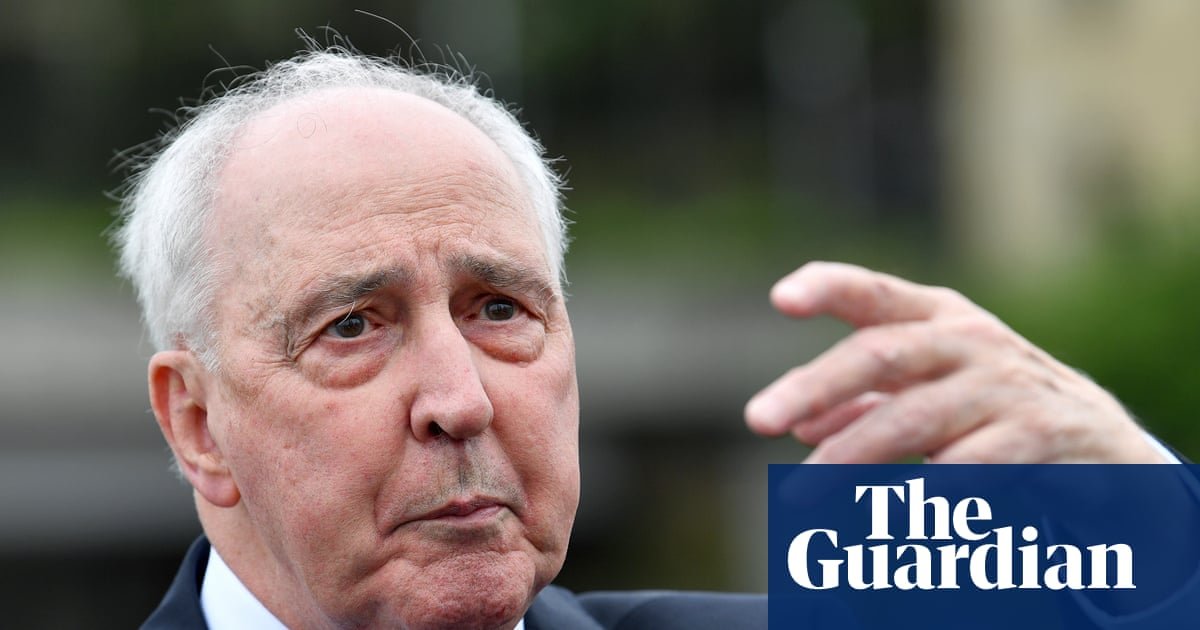
Aukus critic Paul Keating has said the submarine deal is locking Australia in to any future US conflict with China – “a war America would certainly lose” – and making Australia a target for retribution.
The former prime minister seized on comments reported out of Washington this week from Republican congressman Michael McCaul – a China hawk and co-chair of the Congressional Friends of Australia caucus – who said “Australia is a target” for enemies of the US already. However, McCaul argued that greater integration with the US military would better protect Australia rather than leaving it more vulnerable.
McCaul also said it was “logical to assume” US nuclear-powered submarines rotating through Australian bases could also be nuclear armed after 2032, and that Australia’s participation in a US war against China over Taiwan was assumed by the US military establishment.
“I don’t think it was even questioned. It’s just obvious,” McCaul said.
“Australia, being a Five Eyes [intelligence-sharing network member] and an ally of the United States, would be at odds with China invading Taiwan and threatening the Indo-Pacific.”
He said it was “absolutely critical” for Australian to back any US intervention to protect Taiwan.
McCaul met with the prime minister, Anthony Albanese, the defence minister, Richard Marles, and the foreign affairs minister, Penny Wong, during a visit to Australia this month.
Keating said the US would “certainly lose” in a war with China over Taiwan.
“But having lost, [the US would] scuttle itself back to San Diego, leaving Australia vulnerable to China for having participated in a military escapade against it and its military assets.”
Keating said Australia’s increasing enmeshment within the US military, especially through Aukus, was seeing Australia’s “sovereignty effectively being shredded”.
“Australia is now getting locked in and locked up to the military prerogatives of the United States.”
The Guardian revealed last week that the US military, and its corporate interests, control, or have access to, more than 100 military bases across the Australian continent. More than half of the military installations in Australia have some level of US control or access.
Intelligence sites such as Pine Gap play a critical role in US warfighting, downlinking masses of surveillance data from satellites, and providing targeting information for US strikes.
In parliament this week, Greens senator David Shoebridge seized on McCaul’s further comments that he considered Australia a “beachhead” for the US in its efforts to deter China and maintain peace in the region.
“The US spruikers of Aukus have said they want to make Australia the beachhead for US military war against China,” Shoebridge told a press conference at Parliament House.
“I want to be clear what happens at a beachhead: people get killed at a beachhead, destruction happens at a beachhead in someone else’s war.
“How on Earth does Aukus make us safe, when a foreign military is bringing their nuclear-armed submarines into this country and consciously saying they want our country to be the beachhead in a war with China? It’s time we ended Aukus before we become the US’s beachhead.”
Q&A
What is Aukus pillar one?
Show
Pillar one of the Australia-UK-US (Aukus) agreement involves Australia being given the technology to command its own fleet of conventionally armed, nuclear-powered submarines. There are two stages:
• First, Australia will buy between three and five Virginia-class nuclear-powered submarines from the US, the first of these in 2032. But before any boat can be sold to Australia, the US commander-in-chief – the president of the day – must certify that the US relinquishing a submarine will not diminish its navy’s undersea capability. The US submarine fleet now has only three-quarters of the submarines it needs (49 boats of a force-level goal of 66). And there are significant concerns the US cannot build enough submarines for its own needs, let alone any for Australia.
• Second, by the “late 2030s”, according to the “optimal pathway” outlined in Australia’s submarine industry strategy, the UK will launch the first specifically designed and built Aukus submarine for Britain’s Royal Navy.
The first Australian-built Aukus submarine, for the Royal Australian Navy, will be in the water “in the early 2040s”. Australia will build up to eight Aukus boats, with the final vessels launched in the 2060s.
Each of Australia’s nuclear submarines is forecast to have a working life of about three decades. Australia will be responsible for securing and storing the nuclear waste from its submarines – including high-level nuclear waste and spent fuel (a weapons proliferation risk) – for thousands of years.
Aukus is forecast to cost Australia up to A$368bn to the mid-2050s.
Under Pillar One of the proposed Aukus agreement – a multi-decade deal slated to cost Australia $368bn to the mid-2050s – Australia will buy three “in-service” Virginia-class nuclear-powered, conventionally armed submarines from the US, beginning in 2032.
From the early 2040s, Australia expects to deploy a new, larger Aukus-class submarine. The new class will be designed in the UK and the first boat built for the Royal Navy. Australia will then build five Aukus submarines – except for their nuclear reactors – in South Australia. America’s Virginia class submarines do not currently carry nuclear weapons but, from 2032, the US navy is planning to equip some of its Virginia boats with nuclear-armed sea-launched cruise missiles.
The regular rotation of US nuclear submarines through HMAS Stirling is also part of Aukus cooperation.
The US has a policy of “strategic ambiguity” around the deployment of its nuclear arsenal, refusing to confirm or deny the presence of nuclear weapons on platforms around the world. The Treaty of Rarotonga prohibits Australia from “stationing” nuclear weapons on its territory.


