


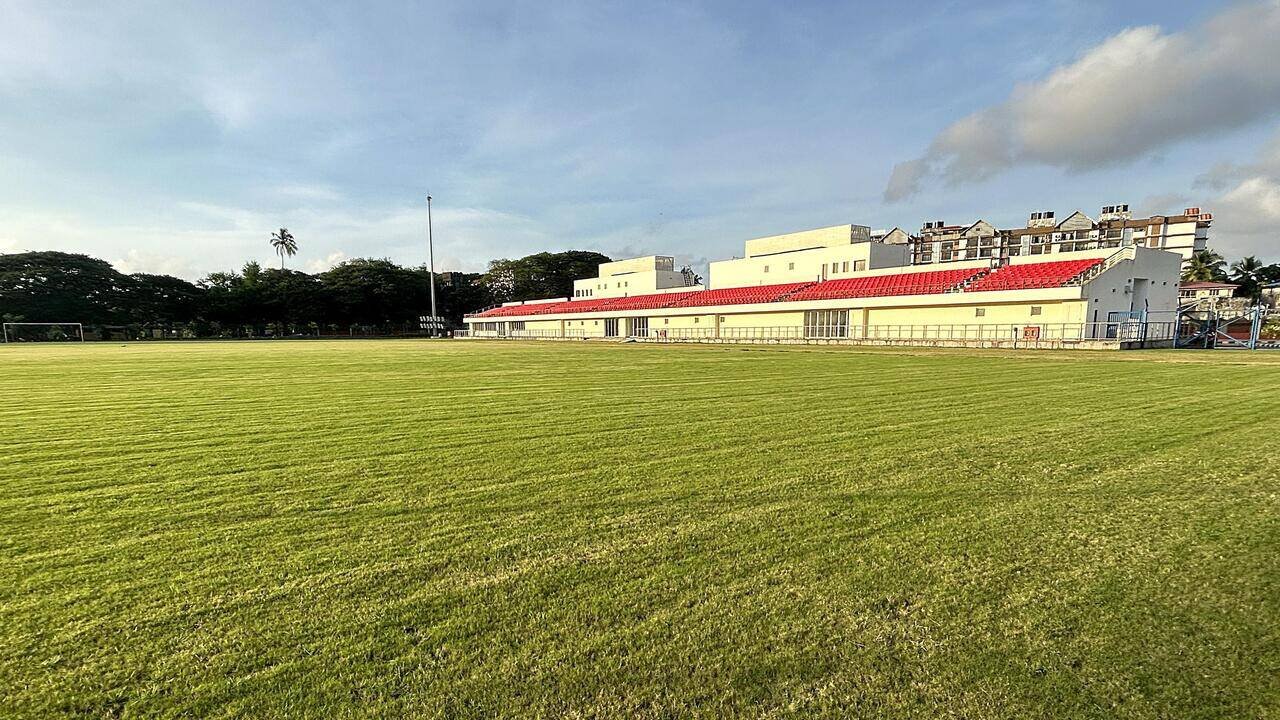
Panaji: In 2014, as he left Goa to take over the reins of the defence ministry in Delhi, the last file Manohar Parrikar signed as the then chief minister was the construction of a new football stadium at the parade ground. He was fulfilling a solemn vow that he made to the players and people of Goa a decade earlier, when he ordered the demolition of the Dayanand Bandodkar Stadium at Campal to make space for parking during the International Film Festival of India (Iffi).For, in 2004, Parrikar walked into the field on the ruins of the old venue where a tiebreaker was being played. He explained that the ground’s orientation was in the east/west direction, rather than the standard north/south axis, which meant players, specifically goalkeepers, had to deal with sunrays. It was a major flaw and there was no scope for expansion in the north/south direction.And there on that ground, the man who gave football the state sport status— the only one in the country—promised an alternative: Another stadium next door at the parade ground.So, after two decades, when the stadium became a reality and govt, driven by commercial profit, took the decision to hand over the football ground to a private player on a 10-year commercial licence, it not only threatened the legacy but was also completely against Parrikar’s explicit promises and wishes for the youth of Panaji.“Privatisation is a terrible idea,” Padma Shri awardee Brahmanand Shankhwalkar recently told TOI. “Instead, govt should honour Parrikar’s promise to the people of Goa that Campal will be turned into a hub for football where access would never become a problem.”It took people’s protests for govt to rescind the decision and hand it over to the Corporation of the City of Panaji (CCP). But unlike Parrikar’s promise, there are doubts whether local footballers and city-based clubs will have enough access.“The plan was always to use this venue in the city to have inter-school and college finals, state camps and even local GFA (Goa Football Association) matches that could draw a maximum of 2,000 spectators,” said Shankhwalkar.The former India captain reckons that the stadium should be managed by either GFA or the Sports Authority of Goa (SAG).Shankhwalkar, Goa’s first Arjuna Award winner, has a strong connect with Campal, having trained and played club matches here for decades. His performances during inter-college tournaments were widely appreciated.“Campal and football are inseparable. Parrikar used to discuss a lot of plans with us. He also wanted a women’s team to be training and camping here since security wouldn’t be an issue. There should also be a dedicated slot for locals to practice. Before Don Bosco came up with artificial turf, I saw people playing on uneven grounds, sometimes on the beach,” said Shankhwalkar.Parrikar passed away in 2019, but not before leaving his mark on Campal.“When the city’s iconic ground was permanently sacrificed to make way for Iffi infrastructure, local footballers were left without a home pitch. Recognising this void, I fiercely demanded and made Parrikar and Francis D’Souza, the then urban development minister, have it at the present site. We got then CM Laxmikant Parsekar to lay the foundation to ensure the capital city’s youth would always have an accessible, state-of-the-art playground,” said Elvis Gomes, then member-secretary, Goa state urban development agency (GSUDA) that prepared the blueprint for the stadium. It helped that Gomes was also the president of GFA, when he prepared the document.Today, the privatisation has been averted, but the future of Parrikar’s promise remains deeply uncertain.
